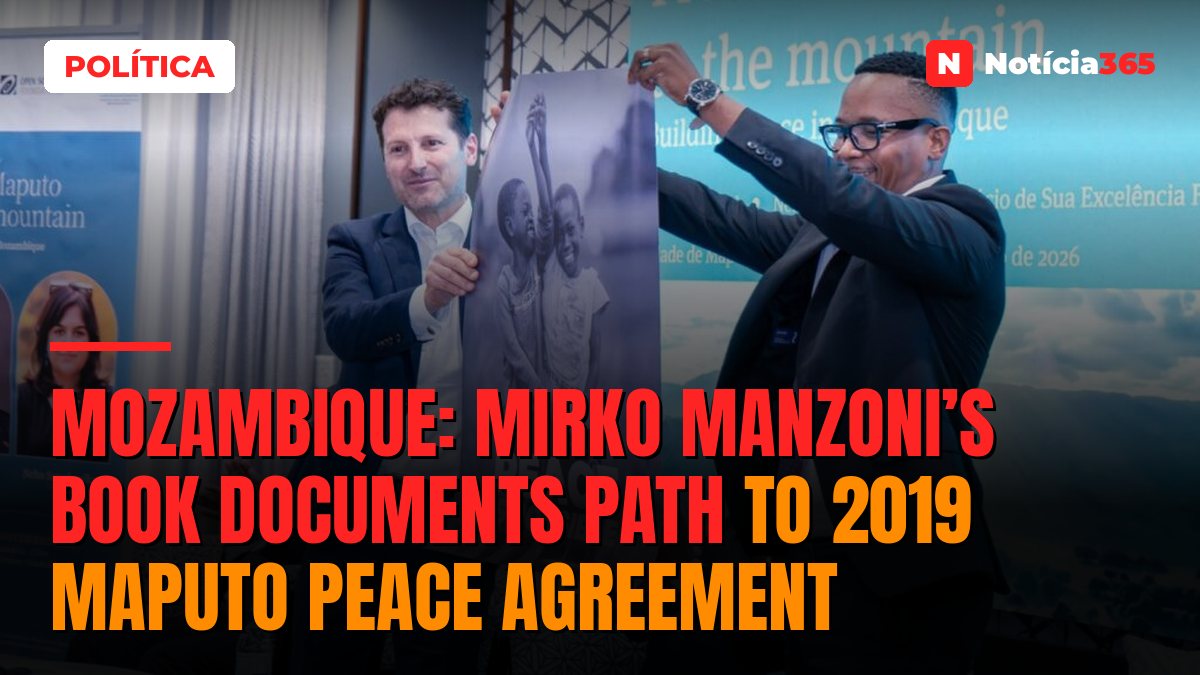
The course of the negotiations that culminated in the signing of the Maputo Agreement for Peace and National Reconciliation in August 2019 has now been documented in a book. The work, entitled From Maputo to the Mountain: Building Peace in Mozambique, was launched in Maputo on Monday by former UN envoy and Swiss diplomat Mirko Manzoni, one of the international figures who played a leading role in the mediation process between the Government and Renamo.
With a foreword by former President Filipe Nyusi, the book, written by Mirko Manzoni and Neha Sanghrajkare, revisits the key moments of the talks and the agreements that paved the way for the Disarmament, Demobilisation and Reintegration (DDR) process.
Mirko Manzoni was directly involved in the peace process, accompanying the Mozambican delegations during one of the most delicate periods in the country’s recent political history. He decided to turn that experience into a written account, recalling the progress, deadlocks and moments of uncertainty that marked the negotiations.
Among the most difficult memories is the death of Afonso Dhlakama, then leader of Renamo, on 3 May 2018 in the Gorongosa Mountains. Manzoni believes that this event put at risk the continuation of a process that was already under way with President Filipe Nyusi.

Photo: IMD – Instituto para Democracia Multipartidária
“None of this was straightforward. There were very difficult moments. The most difficult for me was 3 May 2018, when Afonso Dhlakama died in Gorongosa. It was a sudden shock. I had spoken to him on the telephone just a few days earlier. Dhlakama had started this path with President Filipe Nyusi, and there was a risk that the process could end with his death. But that is not what happened,” the former diplomat recalled.
According to Manzoni, the determination to continue the process prevailed, even in the face of a change in Renamo’s leadership. The process continued with Ossufo Momade, who took over the party leadership following Dhlakama’s death, allowing the negotiations to reach a conclusion.
“Both sides found motivation in the work they had already done and in what they had built up to that point. President Nyusi decided to take the process forward, together with the new leader of Renamo, Ossufo Momade. On 6 August 2019, the Maputo Agreement was signed. It was a moment of relief, profound joy and recognition that, although nothing is perfect, an understanding could be reached,” he said.

Photo: IMD – Instituto para Democracia Multipartidária
More than simply recalling the events that led to the signing of the agreement, the author explains that the book seeks to offer a reflection on the importance of peace and the need to preserve the understandings reached. Manzoni believes that Mozambique’s experience can provide lessons for other countries facing conflict.
“We wrote this book for Mozambique and its people, whom I have learned to admire and respect, particularly for their resilience, determination and desire to move forward. We also wrote it so that the world can learn from Mozambique’s experience,” Manzoni explained.
The former United Nations Special Envoy to Mozambique believes that peace should not be understood as a process completed with the signing of an agreement, but rather as a commitment that requires constant renewal.
“As the country moves forward, one truth remains undeniable: peace is never complete. It is a permanent undertaking, a continuous struggle that we must never stop pursuing. Stone by stone, we build a new day. I believe that this is precisely how the Maputo Peace Agreement fulfilled its purpose. Peace based on national ownership does not eliminate differences, but gives the country the capacity to live with them and to find ways of disagreeing without returning to war,” he stressed.
Looking at the challenges facing the country, Manzoni argues that dialogue, the ability to listen and national leadership remain essential to preventing setbacks. In this context, he points to the Inclusive National Dialogue promoted by the current President of the Republic, Daniel Francisco Chapo, as another demonstration of the commitment to seeking consensus through mutual understanding.

Photo: IMD – Instituto para Democracia Multipartidária
“The challenges ahead are real, both for Mozambique and for the world, and will require the same patience, the same ability to listen and the same sense of national leadership. The Inclusive National Dialogue, recently promoted in Mozambique by His Excellency the President of the Republic, Daniel Francisco Chapo, is another example of this determination to place dialogue at the centre of building solutions. It is an experience that can serve as an example to the entire world,” he said.
The book includes a foreword by former President Filipe Nyusi, who considers a written record of events important because it allows present and future generations to understand the paths taken, identify mistakes and recognise the progress achieved.

Photo: IMD – Instituto para Democracia Multipartidária
“It is often said that what is written remains. This means that everything that has happened, for better or worse, will be recorded. What went wrong can be identified and corrected, allowing us to do better in the future. On the other hand, what was achieved successfully can be recognised and serve as a reference for other initiatives,” Filipe Nyusi said.
The former Head of State also congratulated the initiative, acknowledging that, although the book recounts an experience led by foreign participants, it represents a significant contribution to the historical record of Mozambique’s peace process.
The Institute for Multiparty Democracy (IMD), which closely followed the process, also considers the book a contribution to understanding the path towards national reconciliation. On the occasion, a representative of the institution highlighted the importance of the involvement of international mediators and the continuation of their commitment to peace, even after their respective missions had ended.

Photo: IMD – Instituto para Democracia Multipartidária
“Even today, I wonder what kind of Mozambican tea President Nyusi served the authors. Whatever it was, it seems to have been quite effective, because this launch is another sign that his commitment to peace in Mozambique did not end with the conclusion of his mission. The authors, Mirko Manzoni and Neha Sanghrajka, offer us an account that reveals the often-invisible behind-the-scenes work of the process that led to the building of peace in Mozambique. This book is therefore not merely a record of facts, but also a testimony to perseverance, trust and commitment, values that must continue to nourish and sustain our peace,” the IMD representative said.

Photo: IMD – Instituto para Democracia Multipartidária

Photo: IMD – Instituto para Democracia Multipartidária
The book launch was attended by several national and foreign dignitaries, notably the President of the Assembly of the Republic, at a ceremony that once again brought into focus the importance of preserving historical memory and consolidating peace in Mozambique.

Photo: IMD – Instituto para Democracia Multipartidária
Source: O País