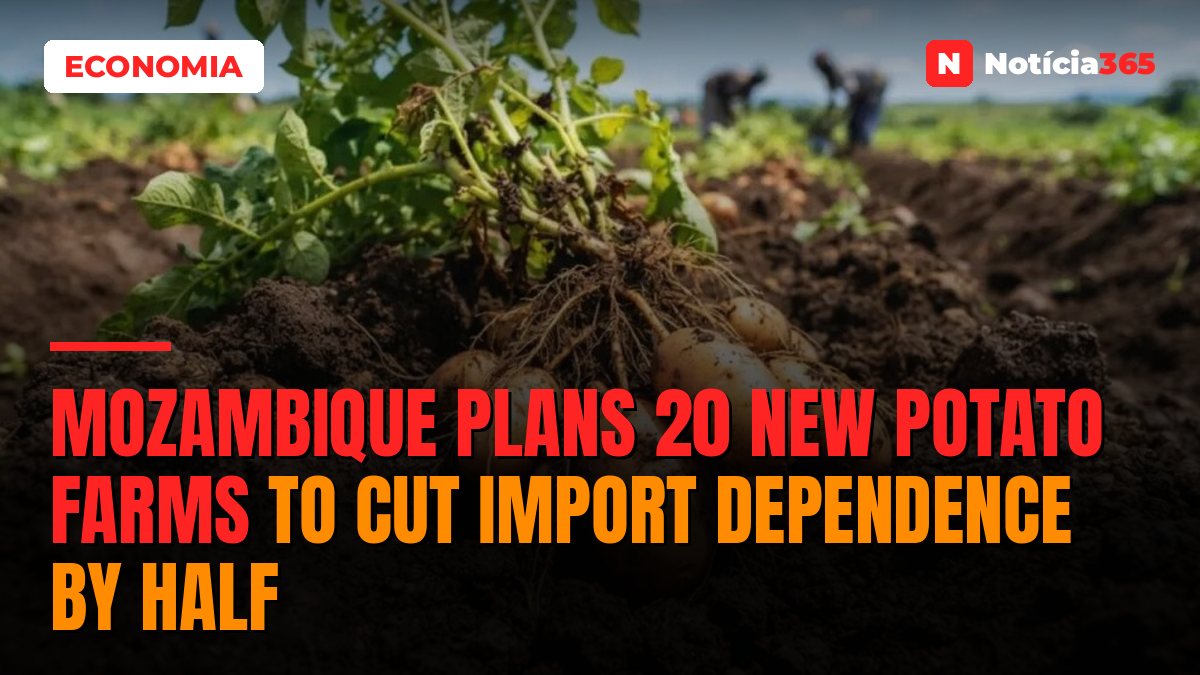

The Mozambican government intends to scale up domestic potato production, with officials indicating that the establishment of 20 agricultural operations — modelled on existing productive units — could reduce imports by between 40% and 50%. The initiative aims to reduce the country's dependence on South Africa, which accounts for more than 70% of domestic supply, and to curb foreign exchange expenditure.
The proposal was put forward on Tuesday, 3 November, by the Secretary of State for Commerce, António Grispos, in a statement released by the Ministry of Economy, according to the Lusa news agency. Grispos argued that increasing domestic output and diversifying supply sources were essential steps toward reducing external dependency.
"We also need to think about diversifying our sources of supply. We cannot continue to depend on South Africa for more than 70% of our potato consumption," he said.
Grispos pointed to agricultural initiatives developed in the Moamba district of Maputo Province and in parts of Inhambane as models that could be replicated across other regions of the country to expand national supply.
"We need to move forward with real numbers. We have this production, for example, that we mentioned in Moamba, and a little in Inhambane. If we have 20 farms that multiply this growth, we will achieve a reduction of around 40 to 50% in our imports," he explained.
To deliver on the expansion, the government considers it necessary to strengthen support for farmers, particularly through improved access to quality seeds, agricultural inputs, and greater coordination among government entities linked to the agricultural sector. An increase in domestic supply would help reduce external purchases and, consequently, the outflow of foreign currency.
Despite the stated ambition to develop domestic production, Grispos ruled out imposing immediate restrictions on potato imports, warning of the risks of shortages and price increases if such measures were introduced before the country had built sufficient productive capacity.
"We are not going to restrict imports if we do not have domestic production. Imagine we restricted today — tomorrow there would be a shortage of potatoes. Two things would happen: we would have nothing to eat and prices would skyrocket," he cautioned.
The Secretary of State argued that any limitation on external purchases must be preceded by a genuine increase in domestic output, in order to avoid supply disruptions and harm to consumers. "Taking such a measure would be an illusory step, completely disconnected from the policy we should be following," he stressed.
The drive to reduce potato imports forms part of the government's broader strategy to promote domestic production. In October, the executive approved import restrictions on certain products, including sliced bread and ceramic goods, on the grounds that domestic supply is capable of meeting market demand.
In the agricultural sector more broadly, the government has also advocated for increased mechanisation, better access to production inputs, and the development of supply chains capable of meeting domestic demand.
In the case of potatoes, however, the priority remains building productive capacity before any eventual introduction of import restrictions. Although Grispos outlined the possibility of developing 20 farming operations, the government has not presented a concrete investment plan, nor specified the locations of the units or a timetable for their implementation.
Source: Diário Económico
Original article: https://www.diarioeconomico.co.mz/2026/11/03/negocios/agronegocios/executivo-prepara-expansao-da-producao-de-batata-para-cortar-importacoes/