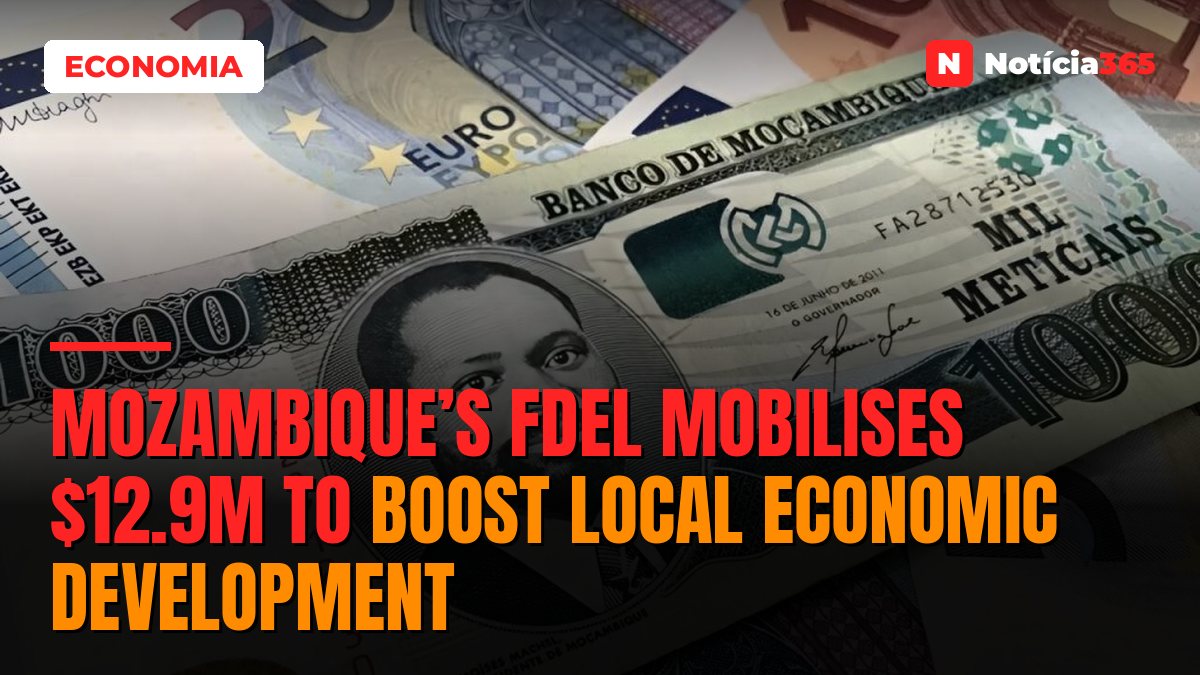

The Mozambican government has mobilised approximately $12.9 million for the first financing cycle of the Local Economic Development Fund (FDEL), an instrument designed to support small businesses and productive initiatives across the country’s districts and municipalities. According to government data released through September 2026, the programme has approved 18,755 projects and is associated with the creation of more than 42,000 jobs.
The resources were made available under the 2025 fiscal year, with the stated objective of stimulating entrepreneurship, promoting income generation, and expanding employment opportunities in communities — particularly among young people, women, and small business owners.
According to the Ministry of Planning and Development (MPD), the financing covers economic activities linked to agriculture, livestock, trade, industry, services, tourism, and technology — sectors considered strategic for energising local economies. The government’s nine-month balance for 2026, cited by the national press, points to the approval of 18,755 economic initiatives and the creation of 42,191 associated jobs under the programme.

Earlier official data published by the Ministry indicated that, as of 12 March 2026, a total of 1,366 projects had been effectively financed, corresponding to disbursements of approximately $1.1 million during the fund’s initial operational phase.
The government considers the mechanism an opportunity to improve access to productive financing, particularly in regions where small entrepreneurs face difficulties obtaining credit from traditional financial institutions. The FDEL was designed as a decentralised financing instrument, enabling resources to be channelled towards economic projects selected at district and municipal level.
According to the Ministry of Planning and Development, the distribution of resources takes into account criteria related to population size, territorial extent, and poverty levels, with the aim of ensuring a balanced allocation of financing across the country’s different regions.
Minister of Planning and Development Salim Valá has argued that the programme seeks to transform small economic initiatives into sustainable businesses capable of generating income and employment in communities. Financing is granted on concessional terms, with beneficiaries required to repay the amounts received in accordance with their respective amortisation schedules. This mechanism allows recovered resources to be redeployed in financing new projects.
“The FDEL seeks to transform small economic initiatives into sustainable businesses capable of generating income and employment in communities,” said Salim Valá, Minister of Planning and Development.
Demand for the Fund has been substantial. Official data indicate that, since applications opened in October 2025, more than 350,000 investment proposals have been submitted, illustrating the scale of financing needs among small businesses across the country.
In response to this high demand, the government plans to strengthen the FDEL’s financial capacity, with an allocation of approximately $23.5 million for the 2026 fiscal year. The figure represents a significant increase from the roughly $12.9 million made available in the first cycle and would, in principle, allow for a broader range of economic initiatives to qualify for financing.
According to the Ministry of Planning and Development, the implementation of the programme will continue to be supported by monitoring activities, technical assistance, and beneficiary capacity-building, with the aim of ensuring the sustainability of investments and improving the economic outcomes of financed activities.
The Fund was officially launched in July 2025, in the district of Vilankulo, Inhambane Province, by President Daniel Chapo, as part of government measures aimed at stimulating production, entrepreneurship, and economic inclusion.
Source: Diário Económico
Original article: https://www.diarioeconomico.co.mz/2026/11/03/economia/fdel-mobiliza-mais-de-129-milhoes-de-dolares-para-impulsionar-economia-local/