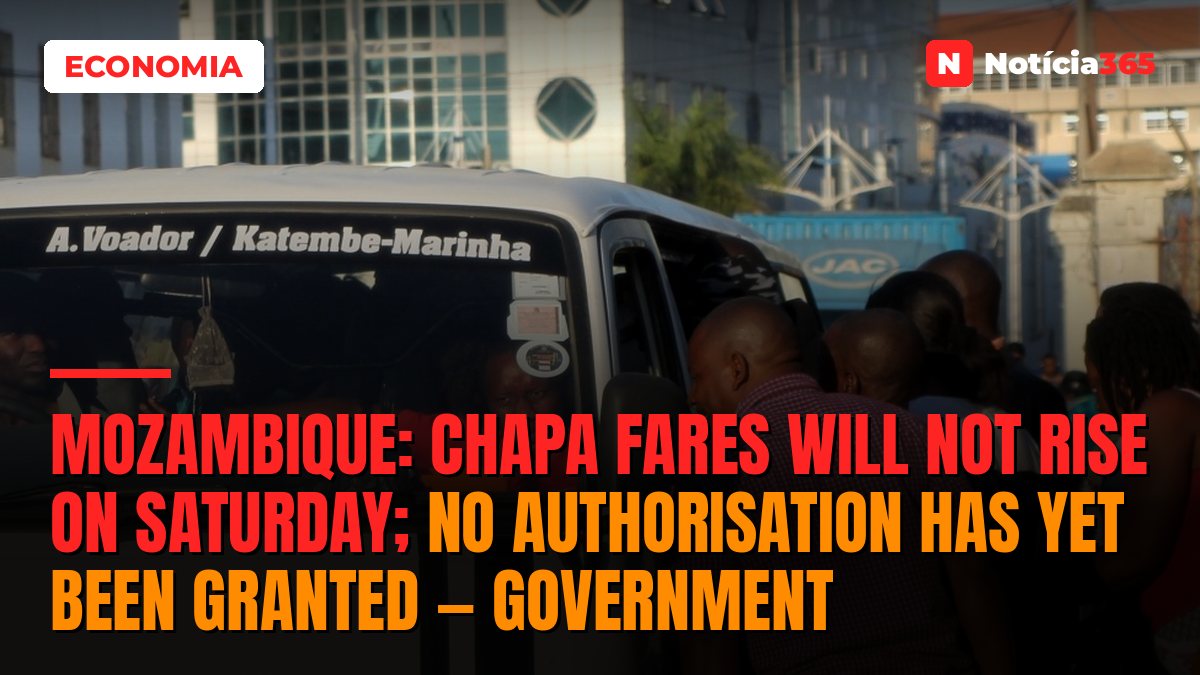
Four days after the Mozambican Federation of Road Transport (FEMATRO) announced a five-metical increase in chapa fares in the Maputo Metropolitan Region, the Government has finally commented on the matter. The Executive denies having authorised the fare increase and, therefore, the new fare will not come into effect on 7 November, the date set for its introduction.
Government spokesperson Inocêncio Impissa said on Tuesday that the Executive had not yet been formally informed that negotiations on adjusting fares for semi-collective passenger transport in Maputo had concluded. “The Government has not yet been formally informed that the negotiations have ended. Once they have concluded, the outcome will certainly be communicated. The relevant sector will provide the information, and the Government will then be able to report on it,” Impissa said.
Responding to questions from journalists during the briefing on the 32nd Ordinary Session of the Council of Ministers, the Government spokesperson recalled, however, that, as it has been announcing in recent weeks, chapa fares could eventually increase, although he did not specify a date. He attributed this position to the fact that the Government is no longer in a position to continue subsidising transport operators.
“Since the previous session and the one before that, we have been announcing that the possibility may eventually arise for transport operators to introduce these adjustments,” Impissa said. He also reiterated that public transport fares would not be adjusted “to ensure that part of the population continues to have access to transport at an affordable price”.
It should be noted that FEMATRO’s announcement had already raised questions because fare increases are normally announced in the presence of a Government representative. In this case, that would be the Maputo Metropolitan Transport Agency (AMT), with which transport operators have been negotiating. However, last Friday, the AMT was not present at the press conference announcing the chapa fare increase.
FEMATRO’s announcement raises further questions because none of the five municipalities in the Maputo Metropolitan Region – Maputo, Matola, Boane, Matola-Rio and Marracuene – has authorised the fare adjustment at a meeting of its Municipal Assembly, as has been customary. This follows the Government’s decision, having reached the point where it can no longer afford to subsidise the sector, to refer the matter to local governments, specifically the municipalities.
It should be recalled that, for the previous fare adjustment, which took place in February 2023, it was the Maputo Municipal Council that authorised a three-metical increase in transport fares across the entire Maputo Metropolitan Region, comprising the cities of Maputo and Matola and the towns of Boane and Marracuene.
If fares are increased, the cost of living will rise
Should fares be increased, the cost of living will rise further, since semi-collective passenger transport fares are one of the components of the Consumer Price Index (CPI), which is monitored monthly by the National Statistics Institute (INE). If the fare increase goes ahead, inflation (the general rise in prices) could increase considerably in November, driven by the passenger transport sector.
As a consequence of inflation, the already high cost of living will also rise. For example, someone who currently spends 1,584 meticais on four chapa journeys (there and back) to get to work over 22 working days would have to spend 2,024 meticais following the five-metical increase, an additional 440 meticais.
It should be noted that, in September, the country recorded a monthly price increase of 0.16%, while annual inflation rose by 6.31% compared with the same month in 2025. This increase was driven by higher prices for second-hand cars, beer and cement.
By Evaristo Chilingue
Source: Carta de Moçambique