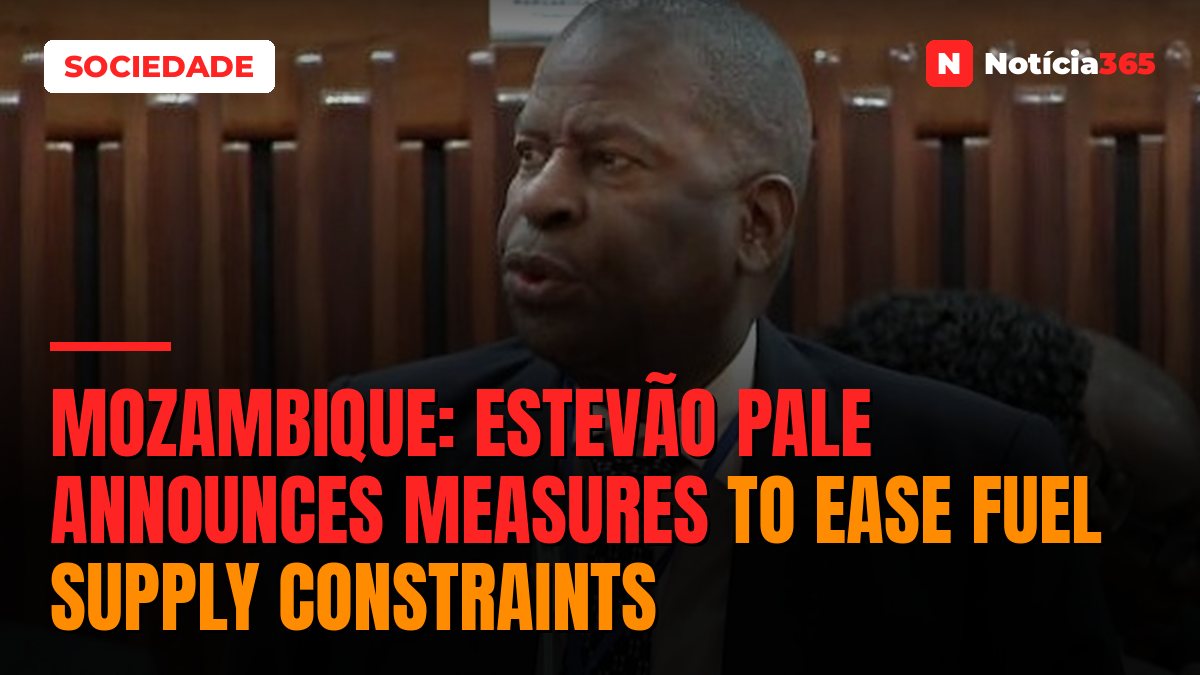
The Minister of Mineral Resources and Energy, Estevão Pale, has announced that the Government is implementing a series of measures to normalise fuel supplies on the domestic market, ease import constraints and minimise the impact of energy costs on households and productive sectors.
Pale provided the information during a session of Parliament, in response to questions from parliamentary groups about the causes of the fuel shortage and the Government’s actions to address the situation.
He explained that the current crisis stems from a combination of internal and external factors, particularly Mozambique’s dependence on imported petroleum products and disruptions in the international market.
Around 80% of the petroleum products imported by Mozambique came from the Middle East, a region affected by an escalation in the conflict and disruptions to supply chains in March 2026, the minister said.
The closure of the Strait of Hormuz also contributed to higher purchasing and transport costs, forcing the country to seek suppliers in more distant regions and creating logistical difficulties in delivering the products.
Pale also pointed to difficulties in securing financing for imports, which reduced the operational capacity of distribution companies to ensure regular supplies to the domestic market.
He added that some of the fuel unloaded at ports remains subject to financial retention arrangements, with ownership continuing to rest with suppliers until the payment instruments have been regularised.
Another factor contributing to the situation is pressure from cross-border demand. Mozambique has lower fuel prices than several neighbouring countries, encouraging smuggling and the illegal movement of petroleum products out of the country.
Government makes US$50 million available for fuel imports
In response to these constraints, the Government has strengthened coordination between the National Petroleum Products Company (Petromoc), the Bank of Mozambique and commercial banks to speed up the issuance of bank guarantees and regularise payments to international suppliers.
One of the measures adopted is the creation of a payment facilitation mechanism through Petromoc, with a financial capacity of US$50 million, intended to ensure the continuity of imports during crisis situations.
Pale said this mechanism had enabled Petromoc to increase the daily volumes it handles by 115%, raising its market share to more than 50% and strengthening its ability to respond to domestic demand.
The Government has also decided to temporarily ban the re-export of fuel intended for domestic consumption, without affecting the normal transit of products to landlocked countries in the region.
The minister further highlighted the strengthening of Petromoc’s operational capacity, allowing the company to make additional volumes of fuel available and supply retail operators, regardless of whether they have existing contracts with other distributors.
The Government has also stepped up loading operations at the terminals in Maputo, Beira, Nacala and Pemba. This includes the possibility of extending operating hours and carrying out operations on Saturdays.
Exceptional measures have also been adopted to simplify customs procedures, with the aim of reducing delays in the storage and customs clearance of petroleum products.
Monitoring of stock levels, replenishment plans and distribution to filling stations continues to be carried out in coordination with sector operators. Pale said fuel availability was showing signs of returning to normal, although some constraints persisted.
Source: O País