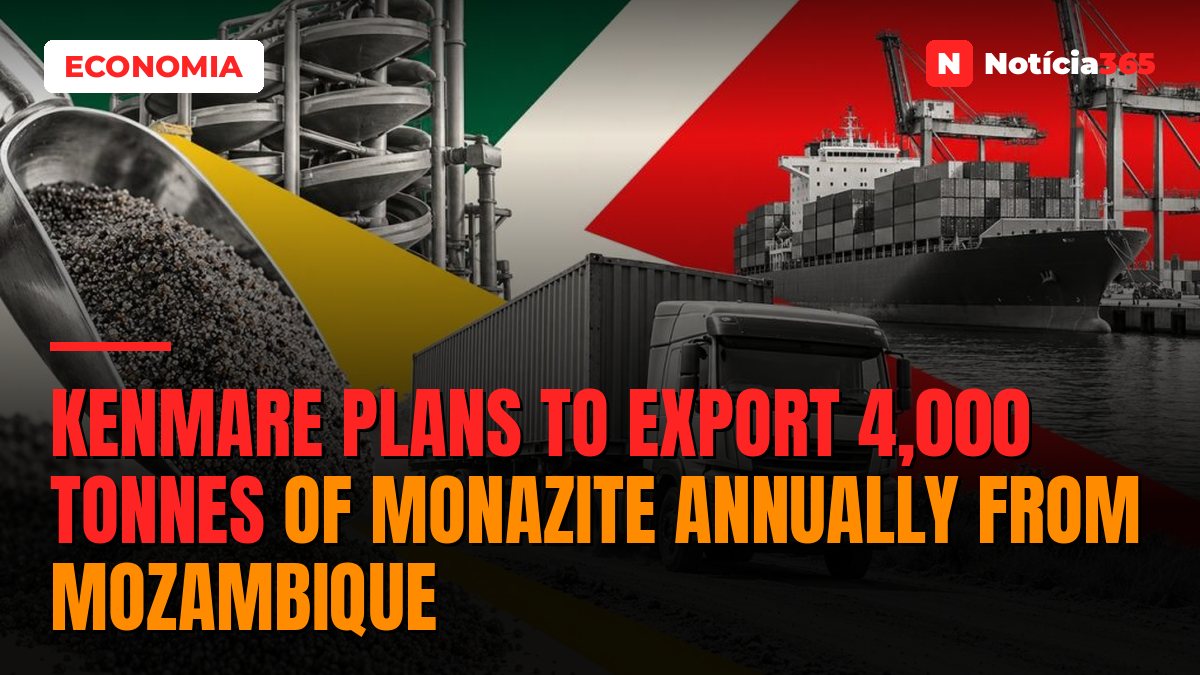

Kenmare Resources plans to produce and export at least 4,000 tonnes of monazite per year from Mozambique — a mineral containing rare earth elements used in the manufacture of permanent magnets and advanced technologies. The company intends to initiate the licensing process with the government ahead of developing the resource.
The information was provided by Gareth Clifton, Kenmare’s manager in Mozambique, during the Conference on Value Addition Based on Available Mineral and Energy Resources, which opened on Monday, 19 October, in Nacala, Nampula province, in the north of the country, according to Lusa. Clifton said the company plans to proceed with development after completing a preliminary assessment of the project’s viability.
According to Clifton, the pre-feasibility study was completed two weeks ago and initial results point to favourable conditions for extraction. “The initial results indicate that the project is viable, so we have launched a definitive feasibility study,” he said, while acknowledging that economic and methodological questions remain unresolved.

Despite the promising preliminary results, the company considers logistics to be the main obstacle to the project’s realisation. Clifton pointed to transport difficulties in moving ore from Nampula province to the Port of Nacala, citing the poor condition of the roads and extended rainy seasons that can disrupt the movement of goods.
Clifton also explained that monazite is classified as a radioactive material, making it subject to specific restrictions and controls. The company does not yet have the appropriate equipment to ensure its safe transport. The plan envisages road transport to the Port of Nacala, from where the ore would be shipped in container vessels.
Logistics and Licensing Conditions Weigh on Project Progress
“However, economic viability — especially given the difficulties of road access during the rainy season — represents the greatest obstacle to implementing the project, as we would, in a sense, be held hostage to weather conditions,” Clifton said. For the Kenmare manager, it is essential to secure transport conditions that allow ore to flow continuously throughout the year.
“We need to guarantee a constant flow of transport to Nacala — we cannot afford to go three or four months a year without being able to move containers. Since rain prevents road traffic, that ends up being the biggest obstacle of all,” he added. On the licensing front, Clifton said the company is aware of the regulatory requirements applicable to the extraction and transport of this type of resource and expects to begin the process with the government, counting on flexibility in its handling.
Kenmare has operated the Moma mine in Nampula province since 2007 and accounts for approximately 6% of global titanium feedstock supply. Its production serves the international paints, plastics, and ceramic coatings industries. This month, the company announced that ilmenite production rose 12% in the third quarter to 233,600 tonnes, representing growth of 59% compared with the previous quarter.
Despite the production increase in the third quarter, Kenmare revised its full-year ilmenite production guidance downward, setting it at between 710,000 and 750,000 tonnes. The revision was attributed to delays in bringing the WCP A processing unit online. In the same operational update, the company confirmed it is in ongoing discussions with International Resources Holding (IRH) of the United Arab Emirates regarding a potential acquisition of the miner, and reiterated that the renewal of its Implementation Agreement with the Mozambican state remains a “fundamental priority”.
Source: Diário Económico
Original article: https://www.diarioeconomico.co.mz/?p=554949