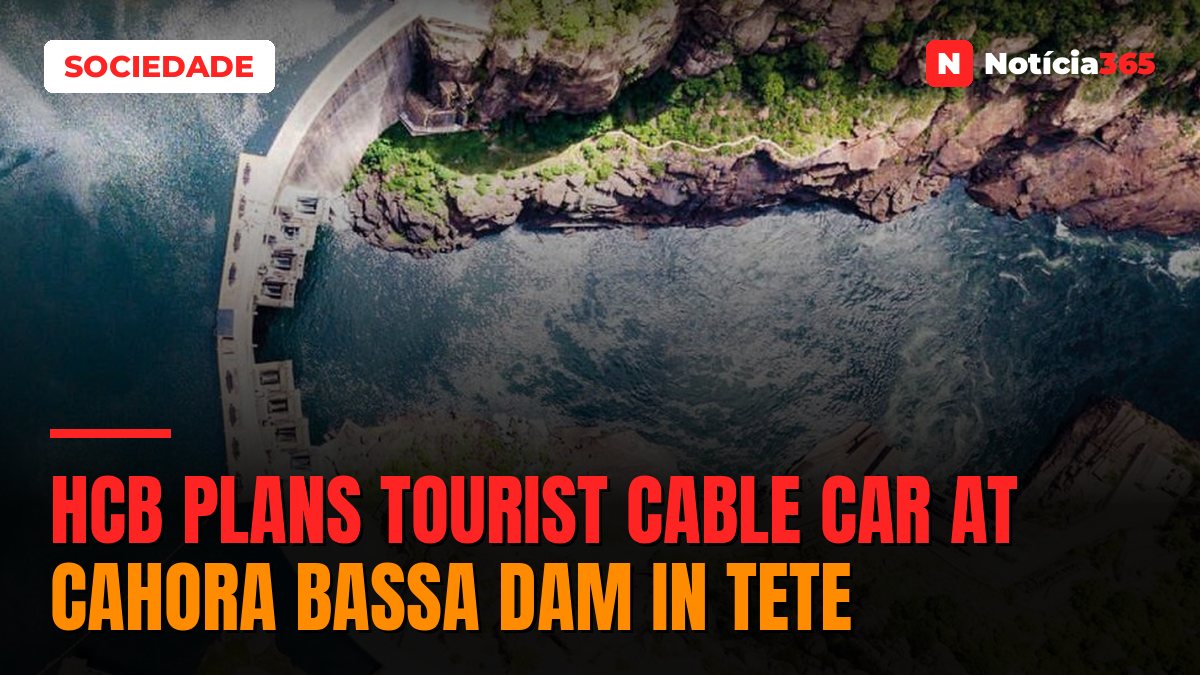

Hidroeléctrica de Cahora Bassa (HCB) is preparing to install a large-capacity tourist cable car in the town of Songo, Tete province, central Mozambique, in an initiative aimed at strengthening the tourism potential of the region and unlocking the value of areas surrounding the Cahora Bassa dam — one of Africa's largest hydroelectric infrastructures.
According to Lusa, the company has launched a call for expressions of interest for the pre-qualification of specialised consulting firms, which will be required to provide technical assistance across the acquisition, installation, and commissioning phases of the future cable car. The project envisages the engagement of a consulting firm to oversee all stages of implementation, from technical, economic, and operational feasibility studies through to equipment installation, testing, certification, and the commencement of operations.
Under the terms of reference, the selected consultant will be required to assess different technological solutions, define the cable car alignment, identify station locations, and determine the complementary infrastructure needed for the system to function. The contracted firm will also be responsible for supporting HCB in procurement procedures, works supervision, technical team training, and knowledge transfer, with a view to ensuring the future operation of the equipment.
Companies wishing to participate in the tender must demonstrate proven experience over the past ten years in comparable projects, including tourist cable cars, urban gondola systems, and other technically complex cable transport infrastructure. The deadline for submitting expressions of interest is 3 November, after which a selection process will determine the firms eligible to participate in subsequent contracting phases.
The initiative forms part of a broader tourism development strategy that HCB has been pursuing in the Cahora Bassa region, seeking to leverage the historical, environmental, and scenic potential of Songo and the areas surrounding the dam.
In May 2026, the company announced the preparation of a Tourism Master Plan for Songo and the surrounding areas, acknowledging the need for structured planning instruments capable of promoting the use of existing tourism assets. At the time, HCB identified the absence of such instruments as one of the factors limiting the valorisation of local heritage and the attraction of investment into the tourism sector.
The tourism promotion strategy also encompasses other initiatives, including a technology museum project — the design process for which was launched in 2025 — with the objective of preserving and publicising the history of the construction and operation of the Cahora Bassa dam. The town of Songo, built to support the dam's construction, is located approximately five kilometres east of the hydroelectric infrastructure, on a plateau situated at more than 700 metres above sea level, overlooking the Zambezi valley. Its location and landscape characteristics are among the attractions HCB seeks to develop through its new tourism projects.
As previously reported by Diário Económico, the Tourism Master Plan aims to create conditions to attract investment and promote the tourism potential of the region.
The Cahora Bassa dam, constructed between 1969 and 1974, began commercial operations in 1977 and currently has an installed capacity of 2,075 megawatts (MW). The infrastructure accounts for more than 80% of Mozambique's electricity generation and exports power to several countries across southern Africa.
The Cahora Bassa reservoir, considered the fourth largest in Africa, covers approximately 2,700 square kilometres and stretches for around 270 kilometres along the Zambezi River. The cable car project remains at a preparatory stage; no investment figure or construction timeline has been disclosed.
Source: Diário Económico
Original article: https://www.diarioeconomico.co.mz/2026/10/22/oilgas/energia/tete-hcb-prepara-instalacao-de-teleferico-turistico-na-vila-do-songo/