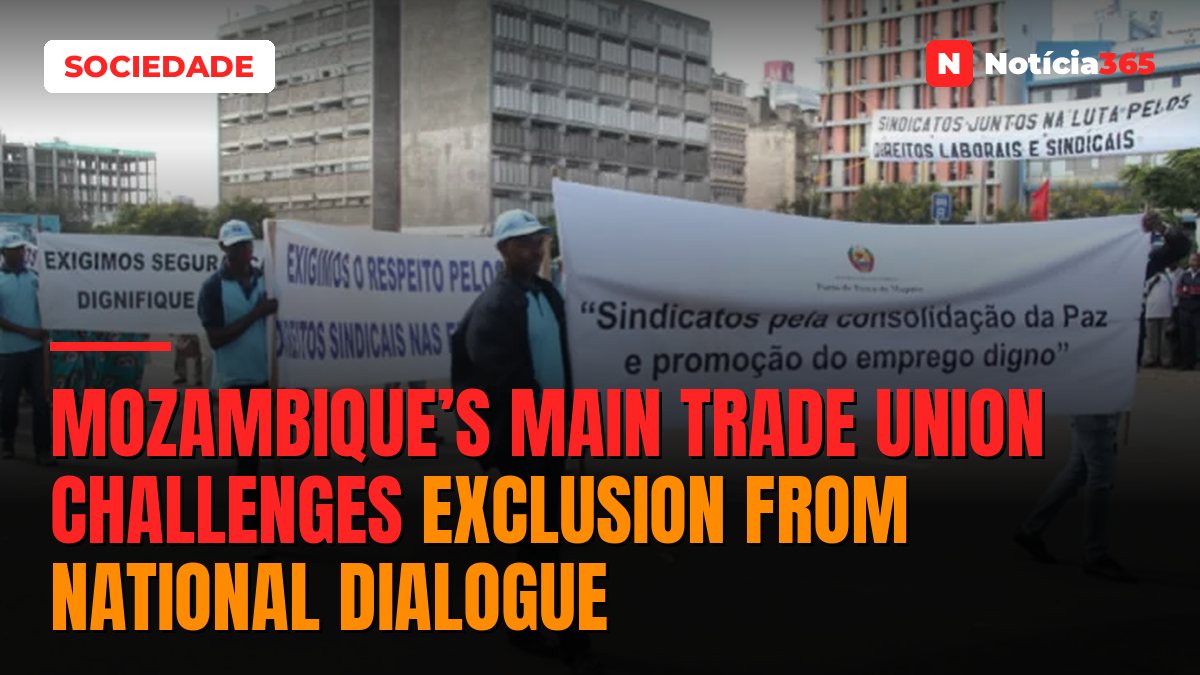

Mozambique’s largest trade union federation, the Organização dos Trabalhadores de Moçambique – Central Sindical (OTM-CS), has formally contested its exclusion from the country’s inclusive national dialogue process, calling for greater and more structured participation of organised labour in decision-making and major investment projects.
The position was presented on Tuesday (13) in Maputo by OTM-CS Secretary-General Damião Simango during an address to President Daniel Chapo at celebrations marking the federation’s 50th anniversary.
Simango stated that OTM-CS has been excluded from multiple consultation and concertation processes, despite representing the interests of workers, and expressed frustration that other organisations are heard on certain matters while the country’s principal trade union federation is left out. “The inclusive national dialogue travelled as far as the diaspora to hear other compatriots, while excluding the voice of the workers we represent on our own soil,” he said, referring to the federation’s absence from the Technical Commission for Inclusive Dialogue (Cote), established in 2025 under the agreement to pacify the country following the post-electoral crisis.

Simango called for a more structured role for OTM-CS in social concertation and in national, regional, and international economic forums, particularly in debates on macroeconomic policy. In his view, development policies must address not only the interests of capital, but also the human, social, and labour dimensions, so as to ensure a balanced articulation between employers and workers.
The federation also argued that workers should be involved in major investment projects from the earliest stages, with particular attention to the creation of decent employment, vocational training, and respect for labour rights and the rights of local communities. “We are in favour of foreign investments that regard human capital as their greatest asset, and not merely profits,” Simango declared, adding that natural resources should, wherever possible, be processed within national territory into semi-finished or finished products.
At the same ceremony, President Daniel Chapo called for greater respect and recognition of workers, whom he described as fundamental to achieving economic independence and advancing the country’s development.
The head of state said that increases in productivity and exports, as well as reductions in imports, must be accompanied by measures to protect the health and safety of workers. “Productivity cannot be achieved at the cost of the worker’s life or health,” Chapo said, emphasising that occupational health and safety must remain central to labour policy and corporate responsibility.
The President also highlighted the need to strengthen vocational training and professional qualification in order to prepare workers for technological transformation and shifts in the labour market. He further called for greater recognition of workers in the informal sector through the creation of opportunities and strengthened social protection, and urged companies to invest in professional capacity-building, innovation, and productivity gains.
Source: Diário Económico
Original article: https://www.diarioeconomico.co.mz/2026/10/14/desenvolvimento-2/otm-cs-contesta-exclusao-dos-trabalhadores-do-dialogo-nacional-inclusivo/