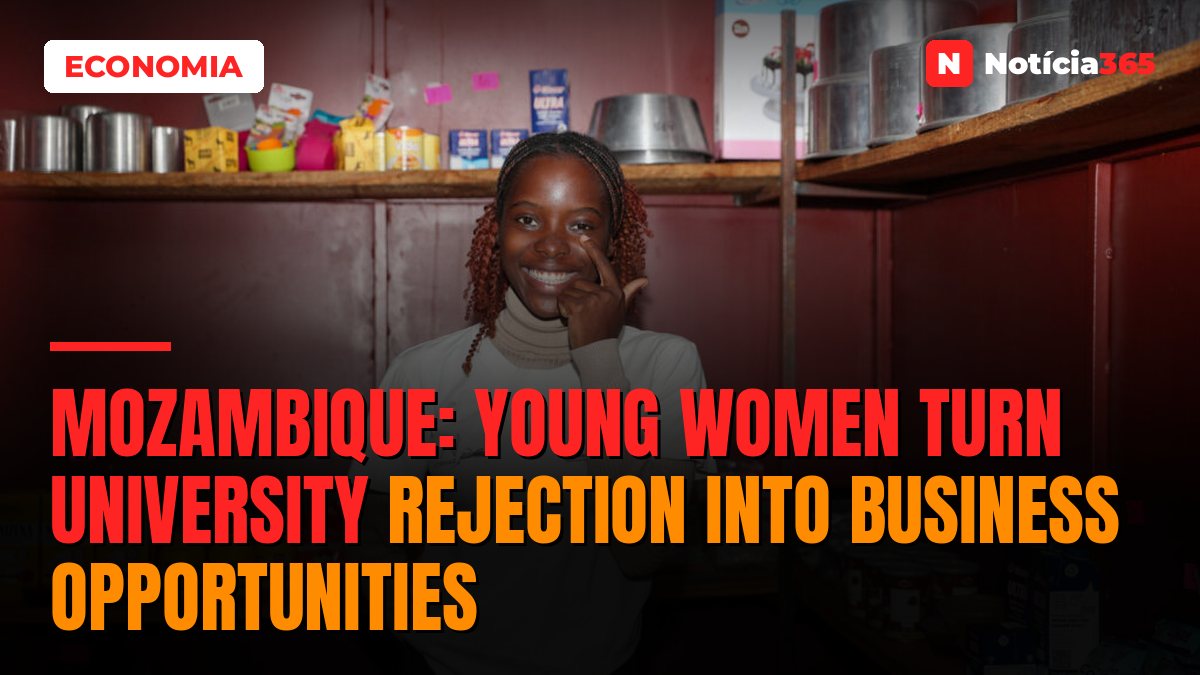
Maputo, 26 October 2026 (Lusa) – Margarida Pirilão, 19, turned the disappointment of failing to gain admission to university into an opportunity, opening a shop selling baking supplies on the outskirts of Maputo with support from a project run by the Portuguese organisation Helpo.
Among the aluminium cake tins, food colouring and bags of flour arranged on the shelves of the small shop she opened in the Possulane neighbourhood of Marracuene, about 30 kilometres from Maputo, Margarida Pirilão is trying to build an alternative path towards her dream of becoming the first university graduate in her family, a dream postponed when she failed to gain admission to university.
“It was very, very sad, because I had built up expectations (…). After finishing secondary school, my dream really was to go to university,” she told Lusa, recalling one of the most difficult moments of her life.
For months, Margarida imagined herself in a university classroom studying accounting. After completing the 12th grade in 2024, she applied to several higher education institutions.
“If I had entered higher education at that time, I would have been the first person in my family to go to university. So it was also my parents’ dream for me to go to university,” she recalls.
Her frustration grew when she saw several friends being admitted while she remained at home, unsure what to do next.
“When we talked, they would say they had been admitted. Then I would think: they will carry on, and I will stay at home doing nothing. It will be a wasted year,” she recalls.
Every year, thousands of young Mozambicans finish secondary school hoping to enter higher education, but many are unable to do so because of the shortage of places at public universities, leaving them for months or years without studying or working.
Without a job and outside the education system, Margarida spent months caught between disappointment and uncertainty until she joined the Informar project in 2025, run by Helpo, a non-governmental development organisation based in Portugal. The initiative is aimed at young women who complete secondary school and face difficulties continuing their studies or entering the labour market.
One of the most significant moments in the training came when she was confronted with a difficulty she had been carrying with her since failing the university entrance examinations.
“I didn’t know how to deal with my emotions. When I wasn’t admitted, it was very sad; I even cried,” she recalls.
“After I completed the training, I was able to understand that everything has its own time,” she adds.
It was during this period that she began to consider an alternative. The idea for the business, budgeted at around 120,000 meticais (€1,600), emerged after she walked around her neighbourhood and spoke to residents about their everyday difficulties.
“I spoke to some women. They said that, to buy cake-making supplies, they had to go to the town centre; if they couldn’t find them there, they had to go to Zimpeto,” she explains.

Photo: Lusa/Lina Cebola
That was how she identified a need in the local market and decided to go ahead with the project. Today, the young woman already has regular customers and speaks confidently about the future. Her plans include expanding the business, creating jobs for other women and fulfilling her dream of attending university.
“I don’t intend to give up the business, but to pursue my dream of going into higher education,” she says.
Margarida’s story is not unique.
In the Benfica neighbourhood of Maputo city, Thelma Mande, also 19, faced similar doubts when she finished secondary school.
After completing the 12th grade in 2023, she found herself neither studying nor working.

Thelma Mande (R), 19, serves a customer at the grocery shop she set up in the Benfica neighbourhood of Maputo, Mozambique, on 29 September 2026. After completing secondary school and facing a period without studying or working, the 19-year-old turned support received through Helpo’s Informar project into a small business and intends to return to her studies next year. [Photo: Lusa/Lina Cebola]
Her aimless routine began to affect how she saw herself: “I felt I wasn’t doing anything that contributed to my future.”
Unsure how to turn her desire for financial independence into a concrete activity, she went through one of the most uncertain periods of her life.
“I sat at home and asked myself: what am I going to do with my life? What do I have to offer to improve my life and achieve my dreams?” she recalls.
According to the young woman, it was her mother who told her about the Informar project.
“My mother received a phone call from the Informar project and told me to try to get in and see what came of it,” she says.
Thelma accepted the challenge and eventually turned her period of uncertainty into a small grocery shop in the Benfica neighbourhood, which opened in March this year with funding similar to that received by Margarida.
“What marked me most was learning to recognise myself, to gain knowledge and to trust myself more,” Thelma says.

Photo: Lusa/Lina Cebola
For the young woman, the biggest change was not simply opening the business, but the way she came to see herself.
“I can look at myself in the mirror and say that I am the Thelma I wanted to be,” she says.
The change was also felt at home. Whereas she had previously depended entirely on her mother, she now contributes to household expenses.
“I was able to help my mother pay for some things at home, pay for gas and buy food,” she adds.
Her plans do not end with the grocery shop. Thelma wants to return to her studies next year and dreams of expanding her businesses.
“I intend to return to studying next year,” she says, adding that she would like “to start a business in another sector to create job opportunities for other young women”.
Margarida and Thelma are part of a group of young women selected from secondary schools in the capital, namely Noroeste 1 and Heróis Moçambicanos.
According to Marília Carlos, an Informar project trainer in Maputo, the initiative was launched following a study that sought to understand why many young women who complete secondary school end up without jobs and without continuing their studies.
“First, there is the barrier created by the way our education system is structured. There are 30 places [at universities] for more than 6,000 students,” she laments.
Carlos explains that the project operates in Maputo and Nampula and plans to train around 400 young women.
For Marília Carlos, one of the main difficulties facing young women is the lack of information about the alternatives available after secondary school, ranging from vocational training opportunities to access to higher education or the labour market.
“Often, young people don’t have a plan B. All right, I don’t get into university; what do I do with my life then?” she asks.
For the trainer, the project’s greatest achievement is not merely the creation of businesses or entry into employment, but the ability of young women to regain their confidence and realise that there are different paths to achieving their goals.
“An informed person, a person who has been equipped with skills, has the power to choose,” she concludes.