
What if an administrative task that currently takes hours could be completed in minutes? What if the analysis of documents, the organisation of information, and decision-making no longer consumed the bulk of a public servant’s working day? Artificial Intelligence (AI) promises to make these scenarios increasingly possible — but the decisive question for Mozambique is not simply what machines can do. It is what the state can do better with them.
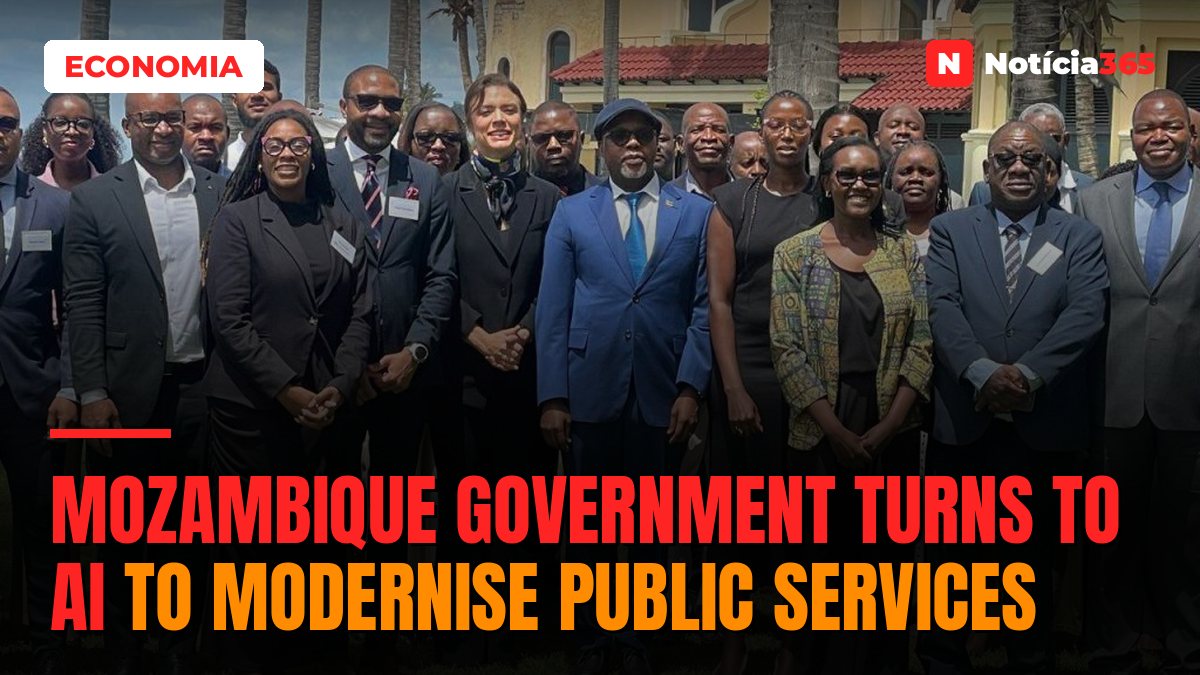
That was precisely the challenge put forward by Américo Muchanga, Minister of Communications and Digital Transformation, during a Google training session on Superintelligence (SI) and Artificial Intelligence held on Wednesday (29 January) in Maputo, under the theme AI for Governance. The initiative, developed in partnership with Google, the United States Embassy in Mozambique, and UpSkill Universe, marks the first time this training programme has been held in Mozambique, making the country the third in the region to host it. The programme aims to equip public servants with the skills to use artificial intelligence, cloud computing, and data systems in the modernisation of public administration.
“How can we serve citizens better, and be more productive and efficient?” the minister asked, advocating an approach that prioritises the opportunities technology presents rather than focusing exclusively on the fears it generates.
Muchanga argued that AI can help improve the performance of public institutions, stimulate business creation, generate employment, and contribute to economic growth.
However, the promise of greater productivity comes alongside risks that the government openly acknowledges. Muchanga warned of AI’s capacity to identify and exploit cybersecurity vulnerabilities, stressing that the same tools that help strengthen security can equally be used to compromise systems and networks.
The challenge, in his view, is to understand these vulnerabilities and harness the capabilities of the technology to prevent attacks, reinforce the resilience of digital infrastructure, and protect citizens.
Concerns also extend to the use of personal data, the confidentiality of information, and the possibility of discriminatory or erroneous decisions. “In the public sector, where an administrative decision can affect rights and opportunities, responsibility cannot be transferred to a technological tool. Artificial Intelligence must augment human capacity, not replace human responsibility,” the minister said.
To create the conditions for responsible use, Muchanga highlighted the establishment of the National Artificial Intelligence Commission, through Decree No. 14/2026 of 17 April, as well as the consolidation of a proposal for a National Artificial Intelligence Strategy. He also referenced the recent approval of the Cybersecurity Law and the Cybercrime Law as instruments forming part of broader efforts to strengthen protection in the digital space.
The potential to recover working hours was also highlighted by Abigail Dressel, Chargé d’Affaires at the United States Embassy in Mozambique, who presented the experience of the US State Department with State Chat — an AI tool used to support research, document drafting, and information synthesis.
According to US government data cited by the diplomat, users reported saving an average of approximately two hours of work per week. Taking into account the most common uses, the tool is estimated to save around 20,000 working hours per week across the department.
Dressel cautioned, however, that the technology does not replace the expertise of staff, nor does it eliminate the need to verify information and protect data. The objective should be to use the tools to work better — not simply to produce more documents in less time.
The diplomat also stressed that access to the internet does not, in itself, guarantee digital literacy. It is necessary to develop competencies to use these tools in a practical, effective, and responsible manner, taking into account the specific characteristics of institutions and communities.
From Google’s perspective, building the capacity of decision-makers and public servants is an essential part of this equation. Technology can only deliver sustainable results if institutions are prepared to use it and if the conditions exist to integrate it into the country’s development priorities.
Infrastructure, Data, and Skills: The Conditions for Progress
For Pren-T Silya Boa-Guehe, Google’s head of pan-African institutions, the potential of artificial intelligence in Mozambique depends on the ability to build an ecosystem that combines technology, public policy, infrastructure, and skills.
She argued that the adoption of these tools can open new possibilities for addressing local challenges, improving public services, and supporting the next generation of innovators and entrepreneurs. She warned, however, of the critical importance of quality data systems, robust cloud computing infrastructure, and policies capable of guiding innovation and managing associated risks.
The question of digital sovereignty is also gaining relevance in this process, as countries seek to understand how their data is managed and how they can develop the capacity to control and protect their digital assets.
From Google’s perspective, building the capacity of decision-makers and public servants is an essential part of this equation. Technology can only deliver sustainable results if institutions are prepared to use it and if the conditions exist to integrate it into the country’s development priorities.
Gori Yahaya, Executive Director and founder of UpSkill Universe, reinforced the importance of practical training in bringing public servants closer to these tools. The company, which has worked with Google for more than 11 years implementing capacity-building programmes across Africa, seeks to help professionals understand how AI can be applied to their day-to-day activities and to the challenges their organisations face.
Yahaya underlined that internet access must be accompanied by learning opportunities that allow participants to experiment with the tools, discuss their possibilities, and build confidence in their use.
Source: Diário Económico
Original article: https://www.diarioeconomico.co.mz/2026/10/29/trends/ai/governo-quer-ia-para-tornar-os-servicos-publicos-mais-eficientes/