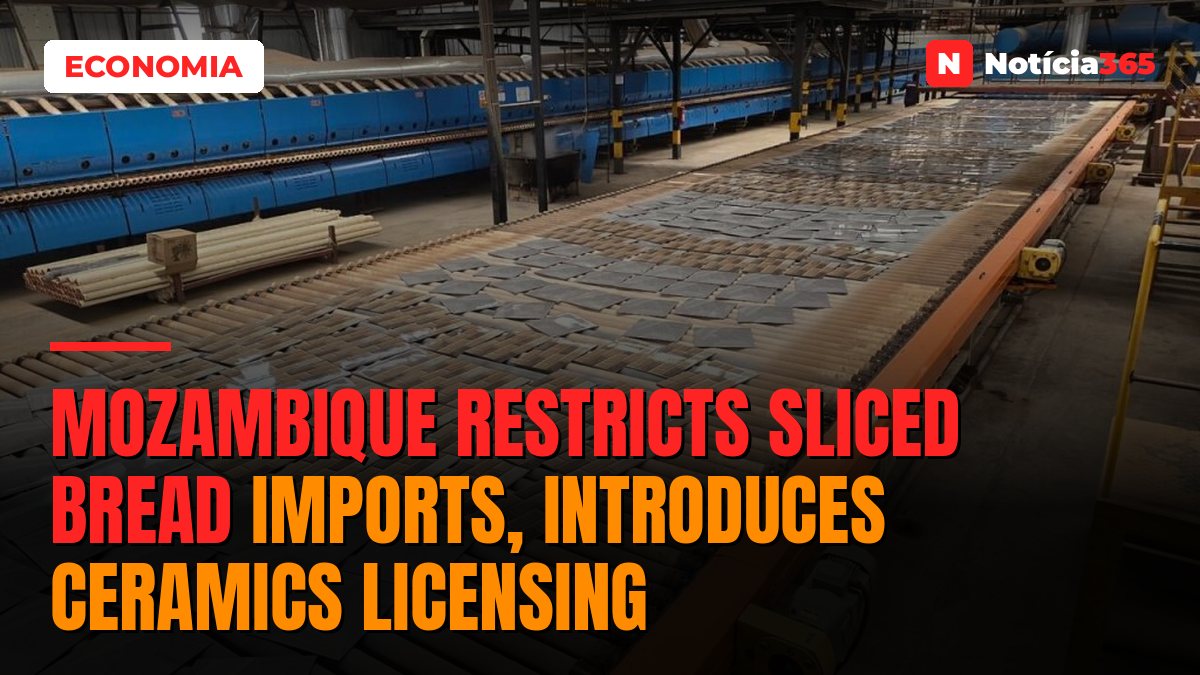

The Mozambican government has approved new rules governing the importation of sliced bread and ceramic products, aimed at protecting domestic industry and increasing the share of local production in the country’s supply chain.
The measures are set out in Ministerial Diplomas No. 87/2026 and No. 88/2026, published on Wednesday, 28 October, in the Boletim da República and signed by Economy Minister Basílio Muhate. Both regimes have an initial duration of 12 months, renewable for an equal period subject to an assessment of results.
Sliced Bread

Under the new rules for sliced bread, imports will be permitted exclusively to complement domestic supply, with authorised volumes capped at the shortfall not covered by local production.
The granting of import licences will require authorisation from the minister responsible for trade, following an evaluation of market needs and the impact of imports on domestic output. Importers will also be subject to mandatory registration and prior licensing.
The diploma further establishes an import levy equivalent to ten public-sector minimum wages per tonne, which must be paid before a licence is issued, in addition to customs duties, value-added tax (VAT), and other applicable legal charges.
The restrictions apply to imports regardless of origin, while safeguarding the specific provisions of international agreements ratified by Mozambique. The regime enters into force 30 days after publication.
Sliced bread imports rose by approximately 70% between 2023 and 2025, climbing from 1,100 to 1,900 tonnes.
Ceramic Products
For ceramic products, the government has introduced mandatory registration of importers and prior licensing for each individual transaction, with provision for the establishment of import quotas and reference prices for customs control purposes.
The allocation of quotas will take into account domestic productive capacity, market trends, importers’ track records, and the need to prevent market concentration. Unused quota allocations may be reviewed and redistributed.
The process will be coordinated by the national directorates responsible for Trade and Services, Industry, and Foreign Trade. Quarterly import plans will be based on national consumption, domestic production, industrial requirements, and available stock levels.
Importers of ceramic products must submit purchase orders at least two months in advance, specifying quantities, technical specifications, and ports of discharge.
Unlike the regime applicable to sliced bread, the rules for ceramic products entered into force on the date of publication, with a first review scheduled within a maximum of six months.
Any extension of either regime will depend on an analysis of its effects on domestic industry, competition, and the regular supply of the internal market.
Source: Diário Económico
Original article: https://www.diarioeconomico.co.mz/2026/10/29/negocios/governo-restringe-importacao-de-pao-de-forma-e-impoe-licenciamento-para-ceramicos/