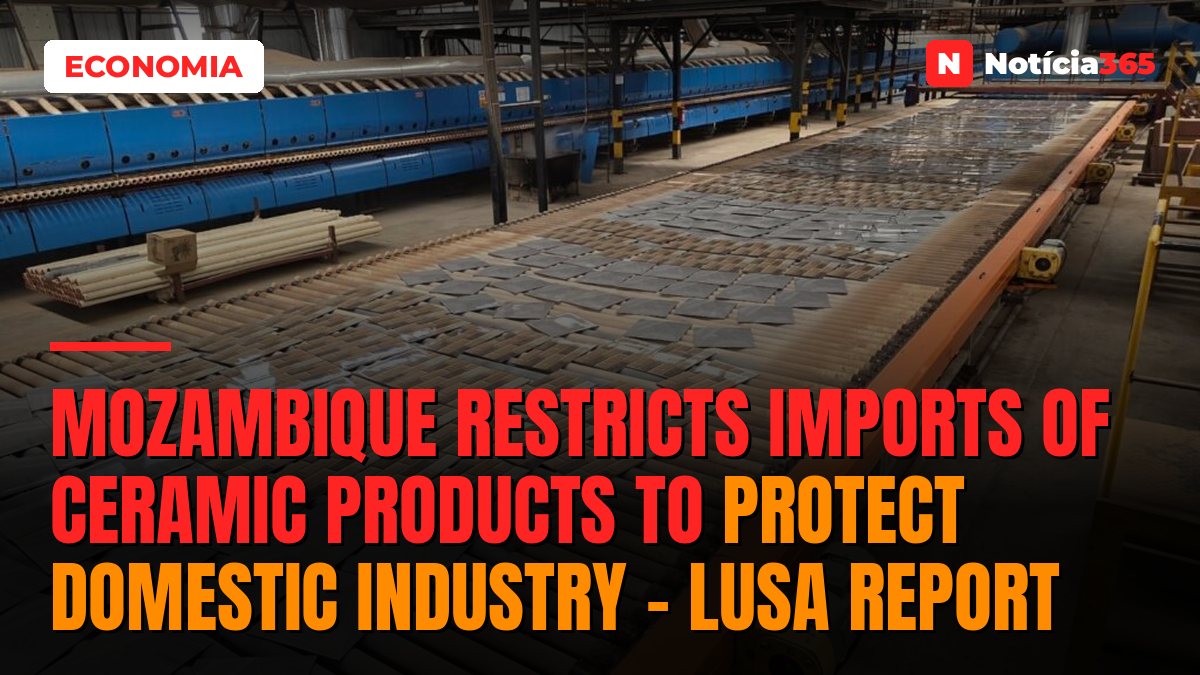
The Mozambican Government has approved restrictions on the import of ceramic products, subjecting foreign purchases to prior licensing, possible quotas and fees per tonne, a measure aimed at protecting domestic industry.
Through a decree from the Ministry of Economy, signed by Minister Basílio Muhate, published on Wednesday and consulted today by Lusa, a mechanism is established for the coordination, planning, regulation and monitoring of imports of ceramic products.
The decree, which is already in force, stipulates that the new regime aims at the “promotion and defence of domestic industry”, as well as the “strengthening of the State’s authority over import processes”, seeking to ensure a greater balance between domestic production and imported products.
READ: Mozambique prepares restrictions on sliced bread imports and regulates entry of ceramic products
The mechanism applies to ceramic products and covers importers, financial institutions, logistics operators, port and customs authorities and other parties involved in the import process. Among the main changes introduced is the requirement for importers to register and obtain prior licensing for each operation.
“This mechanism is made possible by the following procedures: mandatory registration of importers, prior licensing of each import operation, administrative management of import quotas, where applicable, and the establishment of reference prices for customs verification purposes,” the decree states.
The issuance of licences will now depend on payment of a fee corresponding to one public service minimum wage per tonne imported, with the Ministry of Economy able to establish administrative import quotas to regulate the volumes of foreign products entering the domestic market.
According to the decree, the quotas are intended to “discipline the flow of imports”, “ensure a balance between domestic production and imports” and “guarantee market supply”, taking into account factors such as domestic production capacity, market trends, importers’ track records and the prevention of excessive concentration.
Reference price system
The regime introduces a reference price system intended to combat under-invoicing and strengthen customs control mechanisms.
“The reference price constitutes a technical instrument for market regulation, intended to ensure transparency in import operations, prevent under-invoicing practices and promote fair competition conditions between imported products and domestic production,” it reads.
Reference prices will be calculated on the basis of domestic industry costs, international prices for similar products and other adjustment factors intended to ensure the “gradual and sustainable protection of domestic industry”.
The decree provides for preferential treatment for domestic manufacturers: “Preference is given to the purchase of domestically produced ceramic products, provided that their price does not exceed the price of imported ceramic products by more than 20%.”
Import planning will now be carried out quarterly by the competent authorities, taking into account domestic consumption, industry needs, domestic production levels, available stocks and market supply requirements.
Importers must submit annual import plans and submit order requests at least two months in advance. The decree establishes a sanctions framework including fines equivalent to 500 public service minimum wages per tonne imported, seizure of goods, suspension of economic activity for up to three years, withdrawal of licences and a ban on contracting with the State.
The decree, which will be reassessed in six months, excludes from its application ceramic products imported for domestic use, small private works, commercial samples and research and development activities, as well as companies established in Special Economic Zones and Industrial Free Zones.
O Governo aprovou os Diplomas Ministeriais n.º 87/2026 e n.º 88/2026, relativos à importação de produtos cerâmicos e às restrições temporárias à importação de pão de forma.
Baixe o diploma no link:
https://t.co/Dd4uxRg9jQ#IndustrializarMoçambique #madeinmozambique https://t.co/2pEYiEoRWU
— Ministério da Economia 🇲🇿 (@MinEcomz) October 29, 2026