The governor of the Mozambican province of Manica admitted on Monday, 19 October, that there are difficulties in controlling illegal mining at the “seis carros” mine, where deaths are repeatedly recorded, noting that the site once concentrated around 12,000 artisanal miners.
“Many officials went there to visit the ‘seis carros’ mine and see what was there, what is there and how many people were there. We even reached a point where there were more than 12,000 people mining at the ‘seis carros’ mine. And to this day, it is difficult for us to control the situation there,” Domingas Tomás said.
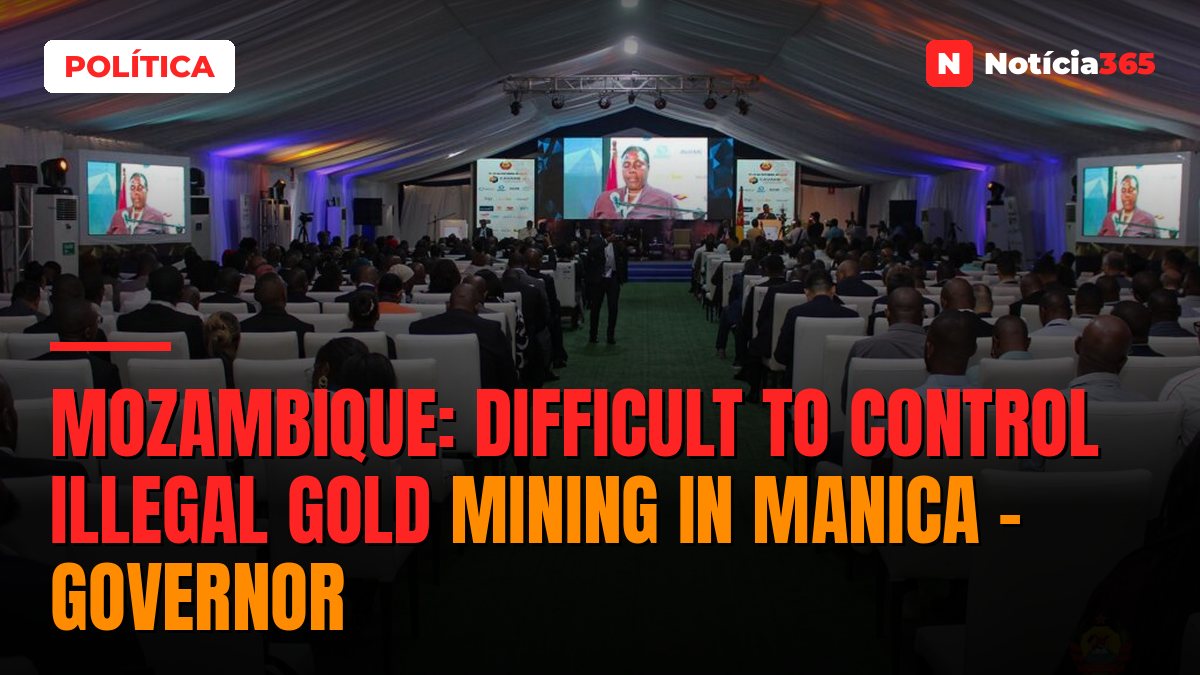
The governor was speaking at the Conference on Value Addition Based on Available Minerals and Energy Resources (CAVAME-d), organised by the government in the city of Nacala, Nampula province, in the north of the country. She stressed that the incidents at the mine result from artisanal mining carried out by Mozambican nationals.
In September, at least nine people died over three days as a result of land collapses associated with illegal mining in Vanduzi district.
According to the local government, the search for gold has led to a progressive increase in the area excavated in the “seis carros” zone, which is currently around 20 metres deep and 25 metres in diameter, while the concentration of thousands of artisanal miners increases the risk of collapses, especially during the rainy season.
To prevent such incidents, the governor of Manica wants to establish cooperatives to ensure more organised mining, acknowledging that the current mining model is leading to collapses and deaths.
“There are many pits there, and each person goes in as they see fit. And when those pits become numerous and interconnected, they cause deaths. So what the local government, in this case the provincial government, is doing in coordination with the district government is organising those people into cooperatives to mine gold more effectively, because the community is not prohibited from exploiting its own resource,” the governor said.
“The community should mine in an organised way so that it does not cause, first, harm to people and, second, environmental damage,” she added.
In the same remarks, she said that, for large-scale mining, it was time for the central government to resolve the electricity supply problem affecting companies.
“We understand that it is necessary to strengthen technical and vocational training geared towards the mining industry, and efforts are being made with technical and vocational institutes and universities to ensure the availability of qualified human resources,” she said, criticising the fact that mining concessions continue to be decided by the central government despite progress in decentralisation.
In September, Lusa reported that a multisectoral team led by the Mozambican Public Prosecutor’s Office in Manica province had begun an investigation into the deaths of nine people in a land collapse in an illegal mining area in Vanduzi district.
In the same month, Mozambican President Daniel Chapo said that approval of the regulations for the new mining law should make it possible to reorganise the sector and strengthen control of mining activities, including in Manica, to prevent accidents associated with illegal mining.
Chapo also pointed to the creation of a new state-owned mining company and the reopening of an organised mining cadastre as measures to reorganise the sector.
The CAVAME-d conference, organised by the Ministry of Mineral Resources and Energy (MIREME), is discussing strategies in Nacala to transform the country’s potential into local development projects.