For the third consecutive year, the government will allocate revenue from natural gas in the Rovuma Basin to finance so-called “structuring projects”, with the aim of improving “the living conditions of the population”. In 2027, just over 3,071.0 million meticais from liquefied natural gas (LNG) revenues will be allocated to projects in areas such as infrastructure, agriculture, renewable energy and industry.
It should be noted that this amount corresponds to 60% of liquefied natural gas (LNG) revenues and is channelled into the State Budget under the Sovereign Fund Law, which establishes the division of Rovuma gas revenues between the State Budget (60% during the first 15 years) and the Mozambique Sovereign Fund (40%).
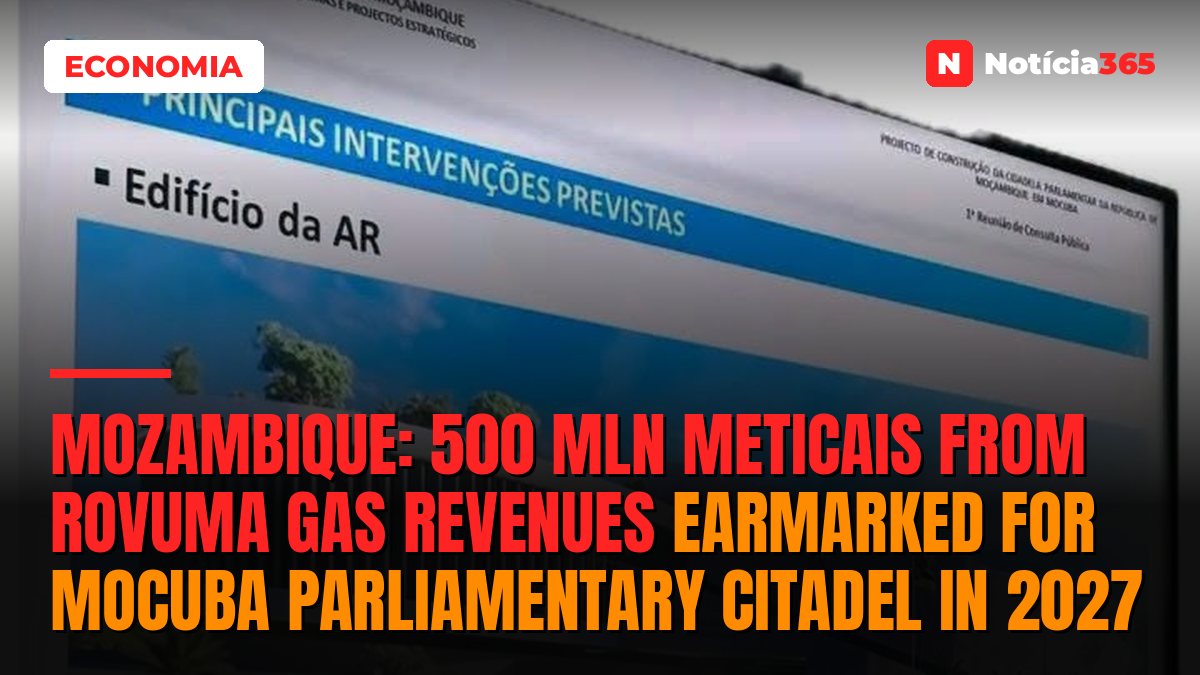
According to the proposal for the Economic and Social Plan and State Budget (PESOE) for 2027, approved by the government last week, 500 million meticais from the total amount earmarked will be spent on building a parliamentary citadel.
The initiative will be overseen by the Office for Reforms and Structuring Projects (not the Assembly of the Republic), an institution created by the Head of State and headed by João Machatine, former Minister of Public Works, Housing and Water Resources.
The PESOE document provides no details about the project, which is part of Daniel Chapo’s election promises and involves transferring Parliament from Maputo to Mocuba, in Zambézia province. The foundation stone for the future Parliamentary City of Mocuba was scheduled to be laid in October.

FILE – For illustration purposes only. [File photo: Conselho Executivo Provincial da Zambézia]
The money will also be used for the construction of dams and reservoirs, amounting to 230.60 million meticais; the construction of tax and revenue collection posts, worth 116 million meticais; the construction of compressed natural gas (CNG) filling stations, including the integration of this component into liquid fuel filling stations, and the electrification of the headquarters of administrative posts, at a total cost of 107.1 million meticais; and the construction of the Muera Dam in Cabo Delgado province, worth 10 million meticais.
It should be noted that, to date, the results of using Rovuma natural gas revenue for “structuring projects” have been unsatisfactory. Data from the PESOE implementation report for the first half of 2026, for example, show that only 37.37% of the budget allocated to projects financed with Rovuma natural gas revenue was executed during the first six months of the year.
Of the 2,943.4 million meticais allocated to “strategic projects aimed at boosting the country’s economic and social development”, only 1,099.90 million meticais was spent. Of the six projects identified, only the construction of the bridge over the Save River in Massangena, Gaza province, had its entire budget spent, amounting to 1,000 million meticais.
In 2025, the first year this measure was implemented, the government allocated 3,009.7 million meticais to carry out projects financed with revenue from Rovuma natural gas. However, more than half of the allocated amount was not spent.
According to the 2025 PESOE implementation report, only 1,333.58 million meticais was spent, equivalent to 44.3% of the total revenue allocated. In the document, the government does not indicate the reasons for the failure to carry out the projects. It merely states that they “were re-entered in the 2026 PESOE”. However, they do not appear in the most recent 2026 PESOE implementation report.
By Abílio Maolela
Source: Carta de Moçambique