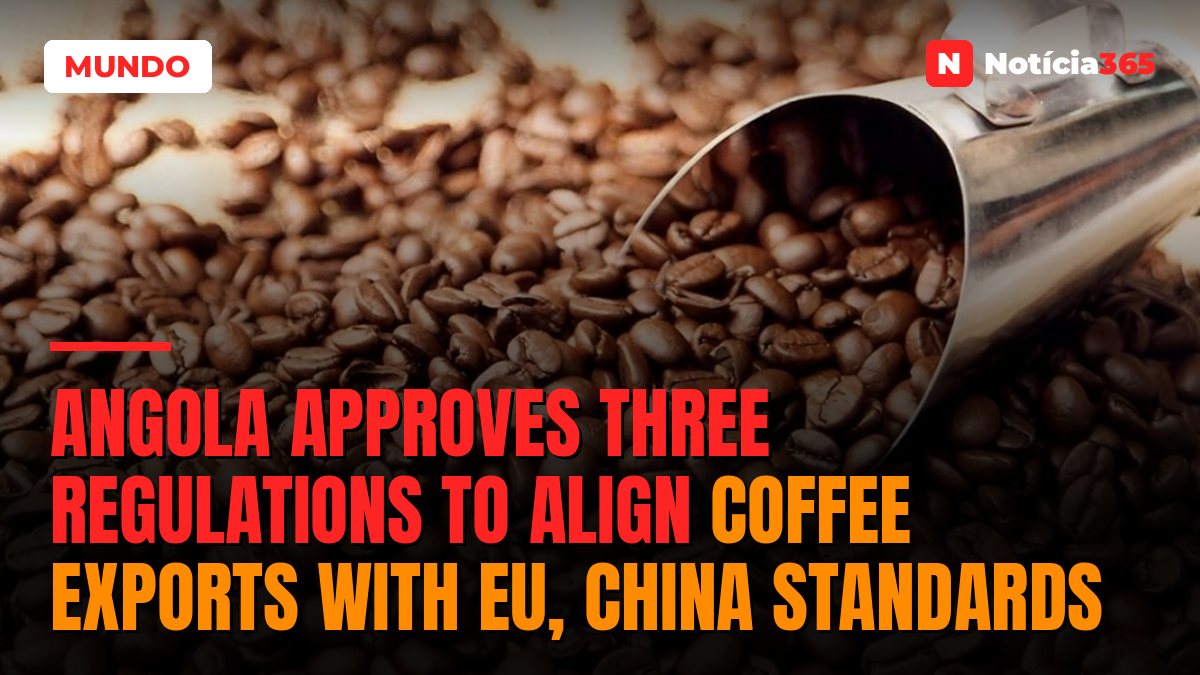

The Angolan government has approved three regulations aimed at strengthening quality standards, certification, and export procedures for coffee, as it moves to align domestic production with international market requirements — particularly those of the European Union and China. The announcement was made on Thursday, 12 November, by Vasco Gonçalves, Director-General of the National Coffee Institute (INCA), on the sidelines of a forum on coffee sector trade and competitiveness and Angola’s preparation for the EU Deforestation Regulation (EUDR).
According to the Portuguese news agency Lusa, Gonçalves was speaking at the margins of a meeting focused on the commercial competitiveness of the coffee sector and readiness for European rules designed to exclude deforestation-linked commodities from the EU single market.
Gonçalves explained that the three newly approved instruments establish rules for the adoption of good agricultural practices, the registration and accreditation of certifying companies, and the export of green coffee.

The EU regulation covers, in addition to coffee, commodities such as cocoa, palm oil, cattle, timber, soya, and rubber, as well as certain derived products, requiring that their sale on the EU market meet sustainability and traceability criteria.
“The European Union will no longer import products that are produced at the cost of deforestation, and there are a series of standards that must be met,” Gonçalves said.
The new European rules, initially proposed in 2021, are expected to enter into force on 30 December 2026 for medium and large enterprises, with an additional deadline of 30 June 2027 applying to most micro and small businesses.
To meet these requirements, the Angolan government is identifying and geo-referencing coffee producers’ plots, and is developing a digital platform designed to consolidate information on the location of agricultural units and volumes produced.
The tool, whose implementation is in its final stages, is expected to streamline data organisation and production traceability, enabling documentation of the origin of coffee destined for export.
“The main international markets are increasingly demanding,” Gonçalves stressed, adding that China is also expressing growing concern about the origin and production conditions of the agricultural goods it imports.
In this context, Gonçalves argued for the need to adapt the various stages of coffee production and commercialisation to the requirements of external markets, through closer coordination between the state and private operators.
As an example of progress already achieved, he disclosed that one Angolan company exported five containers of coffee this year in compliance with the requirements associated with the European regulation.
The INCA Director-General also argued that coffee production in Angola is far from being “a crop that is contributing to deforestation”, contending that shade-growing systems can actively contribute to environmental protection.
On the production side, Angola reached approximately 15,500 tonnes of commercial coffee in the 2025-26 agricultural campaign, representing growth of around 30% compared with the previous season, according to figures presented by Gonçalves.
Regarding exports, Gonçalves indicated that the country expects to market around 5,000 tonnes of coffee on international markets, generating estimated revenues of US$15 million.
Portugal remains the primary destination for Angolan coffee, followed by Italy, Germany, Spain, and China.
Source: Diário Económico
Original article: https://www.diarioeconomico.co.mz/2026/11/13/mundo/angola/angola-governo-aprova-tres-regulamentos-para-adaptar-exportacoes-de-cafe-as-exigencias-internacionais/