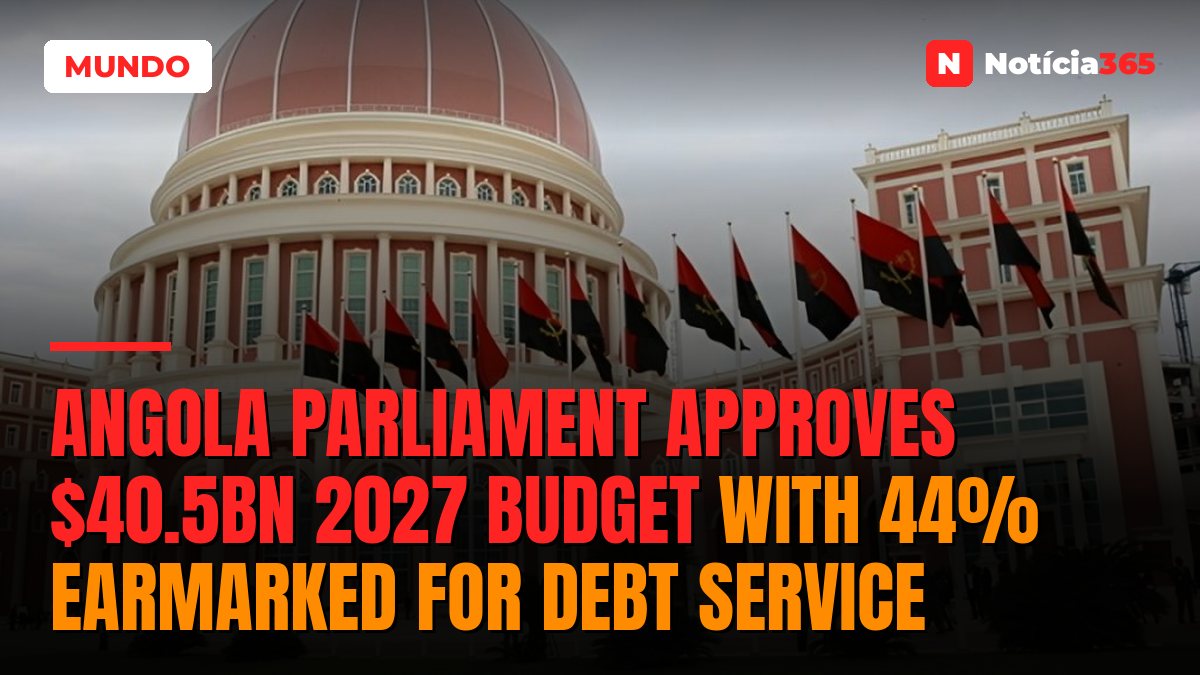

Angola’s parliament approved the country’s General State Budget (OGE) for 2027 on Thursday, passing the proposal at its general reading stage with 113 votes in favour and 65 abstentions. The budget is valued at approximately $40.5 billion and allocates around 44% of total public expenditure to debt service — a distribution that drew sustained criticism from opposition parties.
The document, which will be the last budget of the current legislative term, represents an increase of approximately $4.4 billion over the budget currently in force. It now advances to detailed committee scrutiny. During the parliamentary debate, opposition parties challenged the outsized share of resources directed at debt servicing, which is set to absorb the largest single portion of public expenditure in 2027 — surpassing, for the first time, spending on civil service wages, according to an analysis by Angolan financial newspaper Expansão.
The proposal also projects a fiscal deficit of approximately $8.4 billion, underscoring the state’s financing requirements. Against that backdrop, Navita Ngolo, parliamentary group leader of the National Union for the Total Independence of Angola (UNITA), questioned the high proportion of public resources reserved for meeting prior financial obligations and warned that the government would need to take on new borrowing to fund state expenditure.
UNITA justified its abstention by citing a deterioration in economic conditions for Angolan households, pointing to a loss of purchasing power exceeding 100% over the nine years of President João Lourenço’s administration. According to Navita Ngolo, between 2017 and 2027 the kwanza lost an average of 82% of its value against the dollar, while social expenditure per capita fell 33%, declining from $396 to $266.
Concerns over the weight of debt were also voiced by Nimi a Simbi, president of the National Liberation Front of Angola (FNLA), who expressed unease about the state’s capacity to meet the population’s social needs, particularly in access to education and healthcare.
The ruling People’s Movement for the Liberation of Angola (MPLA), by contrast, defended the executive’s proposal, highlighting a projected economic growth rate of 5.5% for 2027 and planned investment in the education, health, social protection, and housing sectors. The party also pointed to a strengthening of vocational training initiatives, the National Employment Fund, and youth entrepreneurship programmes as measures designed to expand opportunities for the population.
Joaquim António Carlos dos Reis Júnior, leader of the MPLA’s parliamentary group, argued that the budget should “contribute to macroeconomic stability, the protection of household incomes, the stimulation of domestic production, and the creation of opportunities for young people.” The party also signalled its openness to political dialogue aimed at completing the legislative package on the establishment of local municipalities in Angola.
The Social Renewal Party (PRS) voted in favour of the proposal; its president, Benedito Daniel, justified the decision by citing the social and economic priorities contained in the document. The Angolan Humanist Party (PHA) also voted in favour, with deputy Fernando Diniz emphasising the importance of institutional stability and continuity of public services in an election year.
The MPLA, which has governed Angola since independence in 1975, holds 124 seats in the National Assembly, while UNITA holds 90. The FNLA, PRS, and PHA each hold two seats. Angolans are scheduled to return to the polls in 2027 to elect the President of the Republic for the next term.
Source: Diário Económico
Original article: https://www.diarioeconomico.co.mz/2026/11/13/mundo/angola/angola-parlamento-aprova-oge-de-2027-com-44-da-despesa-destinados-a-divida-publica/