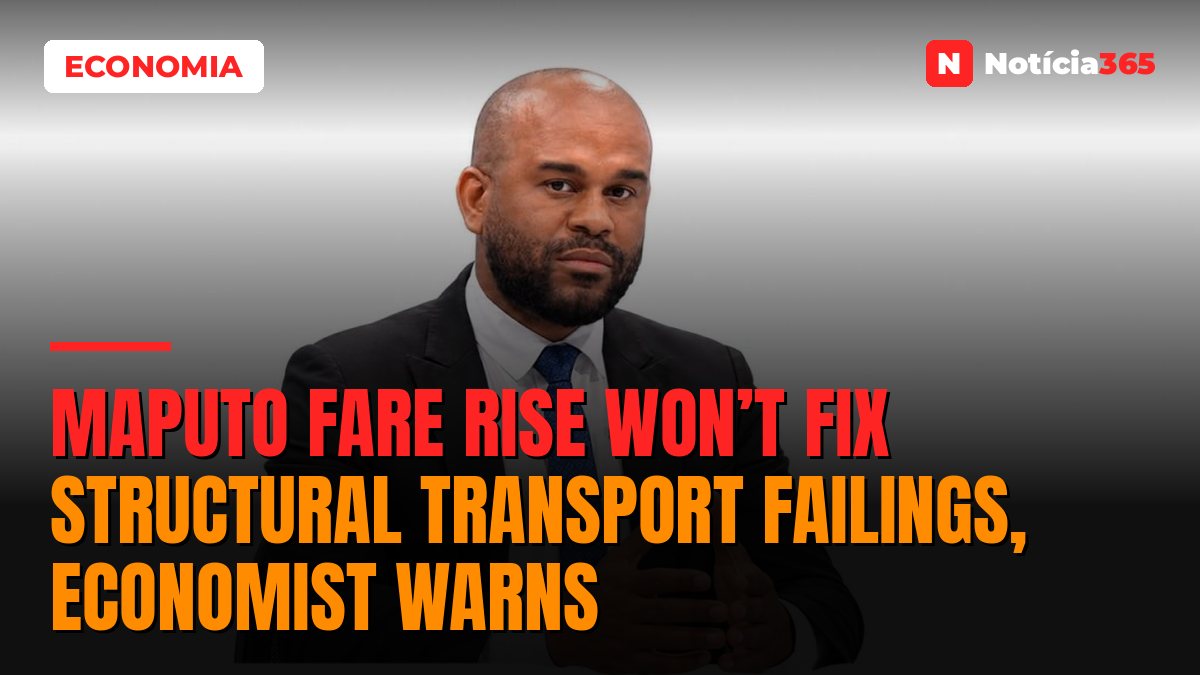

The increase in semi-collective passenger transport fares in the Greater Maputo Metropolitan Area may ease the financial strain on operators, but it does not resolve the structural problems that drive up the cost of running the service, according to economist Júlio Saramala. For passengers, the additional five meticais per trip could translate into an extra 220 to 440 meticais per month, hitting low-income households and commuters who rely on transfers particularly hard.
The Mozambican Federation of Road Transport Associations (FEMATRO) announced a five-meticais fare increase effective 7 November, citing difficulties in covering operational costs. The government, however, says it has yet to receive formal notification that negotiations have concluded. According to Council of Ministers spokesperson Inocêncio Impissa, talks are continuing through the Ministry of Transport and Logistics.
For Saramala, the pressure on fares builds well before the charge reaches the passenger. “The fare is the point at which these costs reach the passenger, but its formation starts earlier: in the acquisition and financing of fuel, in distribution, in vehicle maintenance, and in the efficiency of the operation itself,” he explained.

While the revision may help keep vehicles on the road, the economist cautioned that a price increase does not eliminate the underlying causes of the sector’s financial imbalances.
Despite FEMATRO’s announcement, the government says it has not yet received formal notification that the process has concluded.
Households Could Pay an Extra 440 Meticais per Month
Based on 22 working days, calculations presented by Saramala point to an additional monthly cost of 220 meticais for commuters making a single return journey. Where two transfers are required in each direction, the extra burden rises to 440 meticais.
The impact is likely to be felt most acutely among residents of peripheral areas and low-income families, for whom travel to work and school represents an expenditure that is difficult to cut.
“When income remains unchanged, a higher mandatory expense ends up being absorbed through cuts to other spending or savings,” he observed.
The erosion of disposable income could also affect small businesses by reducing their customers’ purchasing power. At the same time, traders and service providers who depend on these transport networks may face higher costs of their own.
“Small traders and service providers who use these routes may seek to pass the additional burden on to their prices. However, that capacity depends on the competitive environment and the purchasing power of their customers,” he explained.
The broader effect on inflation will depend on the weight of the services covered in the consumer basket and the scope of the fare revision. Saramala noted that an increase in passenger fares is not equivalent to a broad rise in freight transport costs, although both activities may face common pressures.
“Even if the impact on aggregate inflation is limited, the pressure on certain households could be significant,” he warned.
“When operators are compensated, it should be tied to verifiable activity, with clear criteria and predictable financing.” — Júlio Saramala, Economist
Higher Revenue Does Not Guarantee Operator Viability
On the operators’ side, whether the adjustment is sufficient will depend on the cost structure and revenue profile of each service. Beyond fuel, operators carry expenses for maintenance, tyres, spare parts, staff, financing, and fleet replacement.
“Compensating for only one of these components does not guarantee the viability of the operation,” Saramala said.
The economist drew a distinction between immediate cash-flow difficulties and sustainability challenges: an operator may manage to keep a vehicle running without having the resources to ensure maintenance or renew the fleet. In that scenario, “the imbalance persists and may once again translate into pressure for further fare increases.”
Moreover, higher fares do not guarantee a proportional increase in revenue, as some passengers may reduce their use of transport services.
“If the price rises and demand falls, part of the expected gain may be lost,” he observed. On shorter routes, walking could serve as an alternative for some users; on longer journeys, that option is more limited.
Transport costs also factor into the decision to accept a job offer, particularly when wages are low. “If that expense rises too far, some more distant opportunities may become unattractive, especially in low-paid employment,” he explained.
Switching to slower alternatives could increase fatigue, undermine punctuality, and reduce productivity. For more vulnerable households, higher transport costs could also impede access to health services and education.
Saramala stressed, however, that a reduction in transport supply also carries economic and social costs: the withdrawal of vehicles and irregular service equally constrain access to employment and other services.
The five-meticais addition could represent an extra burden of up to 440 meticais per month.
Social Passes and Better Route Coordination
To reconcile passenger protection with operator sustainability, the economist proposed support measures for the most vulnerable users alongside interventions aimed at improving sector efficiency.
Among the alternatives put forward are social travel passes with reduced fares, journey subsidies, and compensation for operators subject to transparent conditions.
“When operators are compensated, it should be tied to verifiable activity, with clear criteria and predictable financing,” he argued.
Saramala also advocated for transparent fare-revision criteria that would allow costs to be tracked over time and avoid emergency negotiations each time a new disruption occurs.
Over the medium term, he recommended better route coordination, priority circulation for collective transport, and fare integration, with the aim of increasing fleet productivity and reducing the costs associated with transfers. He also proposed a technical assessment of the fuel supply chain, including financing, storage, and distribution costs.
“The greater the capacity for forward planning, the less the need to respond to difficulties solely through fare increases or extraordinary subsidies,” he concluded.
Source: Diário Económico
Original article: https://www.diarioeconomico.co.mz/?p=557711