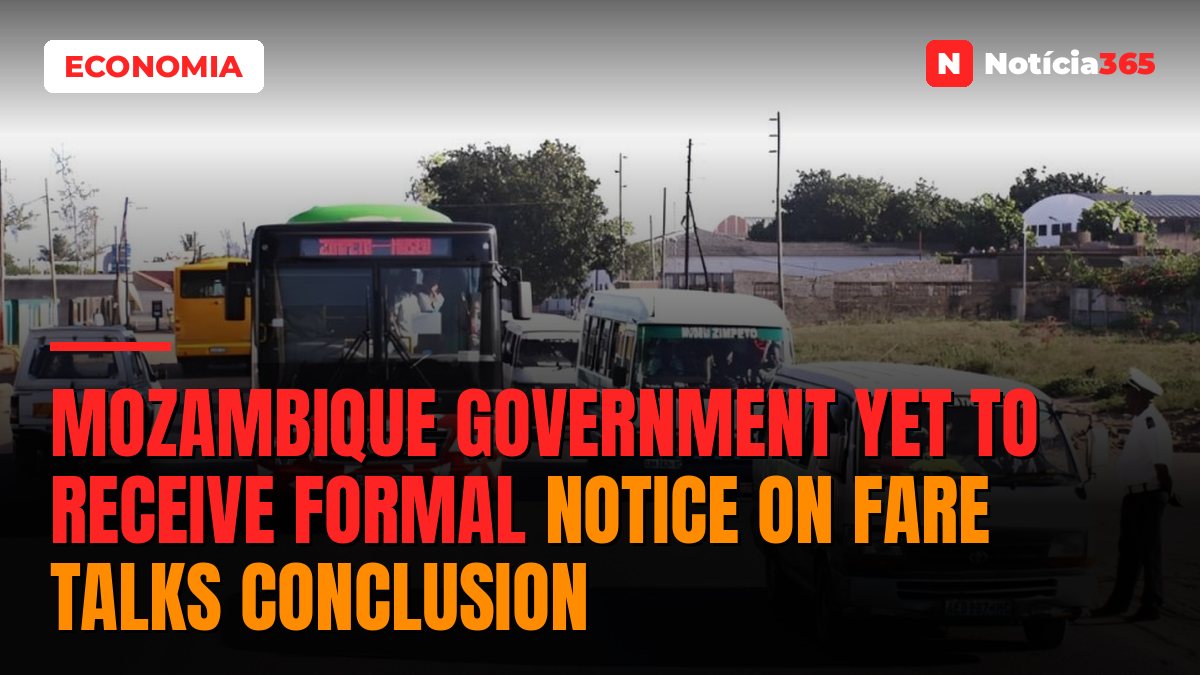

The Mozambican government says it has not been formally notified of the conclusion of negotiations with road transporters over a proposed fare revision, despite the announcement of a five-meticais increase set to take effect from 7 November in the greater Maputo metropolitan area.
According to the Lusa news agency, the position was stated by Cabinet spokesman Inocêncio Impissa at the close of a Council of Ministers meeting, after he was questioned about the decision announced by the Mozambican Federation of Road Transport Associations (Fematro).
According to the government official, talks are continuing through the Ministry of Transport and Logistics, which is overseeing the process and maintaining contact with transport sector representatives.
“Fematro said it is negotiating. There is a specific sector that is interacting with Fematro,” Inocêncio Impissa stated.
The federation announced its intention to raise fares on semi-collective passenger transport services in the Maputo metropolitan region by five meticais from 7 November, citing rising operational costs — particularly fuel prices — as the driving factor behind the decision.
Although it has yet to receive formal notification that negotiations have concluded, the government acknowledged the possibility of a tariff adjustment in response to the difficulties presented by operators.
“Fematro has also already mentioned that it is negotiating. So there is a specific sector that is interacting with Fematro,” Inocêncio Impissa said.
“We have been announcing that, eventually, the possibility of these updates may be opened depending on the effort that has effectively been made by the transporters,” the spokesman declared.
Transporters have linked rising operational costs to surging fuel prices on international markets, in a context shaped by tensions in the Middle East and disruptions to maritime traffic through the Strait of Hormuz.
Inocêncio Impissa nonetheless reiterated that the government intends to continue ensuring subsidised public transport in order to reduce the impact of mobility costs on the population.
“We have also been ensuring that public transport will be available to citizens at subsidised prices, which have been set precisely to ensure that the majority of the population continues to have access to transport at an affordable price,” he said.
“We have been announcing that, eventually, the possibility of these updates may be opened depending on the effort that has effectively been made by the transporters,” Inocêncio Impissa added.
The government’s position follows an admission on 13 October that it would not be able to maintain subsidies to transporters indefinitely to offset fuel price increases, with officials arguing that alternatives must be found to address rising operational costs.
On that occasion, Inocêncio Impissa explained that the financial support extended to operators was temporary in nature and was in place between June and August of this year, a period during which the government had anticipated an improvement in conditions on international energy markets.
The prolongation of international tensions and their impact on energy markets has since altered that outlook. “It will eventually be unsustainable to continue subsidising indefinitely,” the official declared, reiterating that the government would continue to seek solutions to protect public transport users.
Source: Diário Económico
Original article: https://www.diarioeconomico.co.mz/2026/11/04/economia/executivo-ainda-nao-recebeu-comunicacao-formal-sobre-fim-das-negociacoes-com-transportadores/