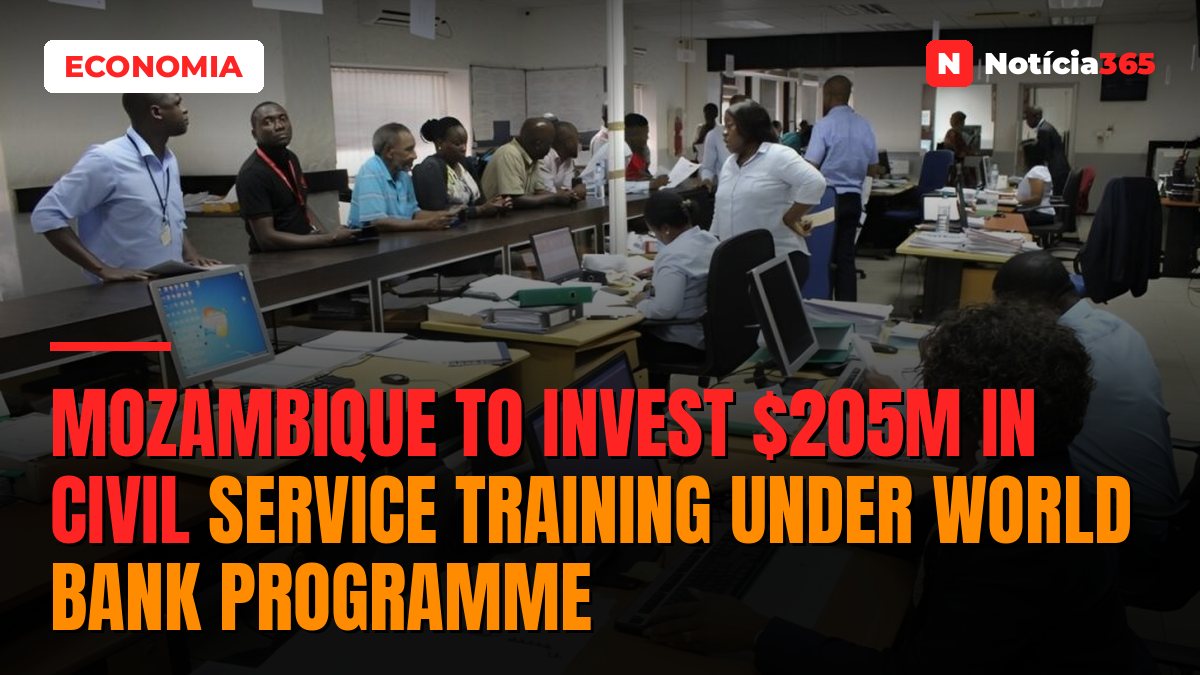

The Mozambican government plans to invest approximately US$205 million in a civil service training initiative known as ‘Moz Próspera 2026-2031’, a World Bank-financed programme designed to strengthen the skills of public administration personnel, according to the Mozambique Information Agency.
The announcement was made in Maputo by the Minister of State Administration and Public Service, Inocêncio Impissa, at the close of the 31st ordinary session of the Council of Ministers. The programme involves the ministries of State Administration and Public Service, Finance, Health, and Education and Culture.
According to Inocêncio Impissa, the initiative stems from studies and analyses conducted in collaboration with the World Bank on service delivery capacity within the public administration. The minister explained that many civil servants entered the public service without specific initial training and had not benefited from regular capacity-building opportunities — a situation the programme seeks to address.
The minister noted that ‘Moz Próspera has been in preparation and discussion for approximately two years, with a technical meeting scheduled for November for the submission of the proposal to the World Bank. Financing will be made available in phases, contingent on the completion of planned milestones and the results achieved during implementation.’
Inocêncio Impissa also highlighted the mobility of civil servants across sectors as one of the factors contributing to the placement of public servants in roles incompatible with their professional competencies.
As part of the broader modernisation of the public administration, the government has been developing human resources management systems, including life-proof mechanisms and personnel administration and recruitment platforms. According to the minister, the integration of these tools allows procedures to be automated and facilitates candidates’ access to public recruitment processes.
The minister also recalled that in May 2026, the government approved the establishment of a School of Governance, conceived as a centre for the continuous training and capacity-building of civil servants, including in the dissemination and application of government policies.
Source: Diário Económico
Original article: https://www.diarioeconomico.co.mz/2026/10/29/economia/governo-vai-investir-205-m-na-formacao-de-funcionarios-publicos/