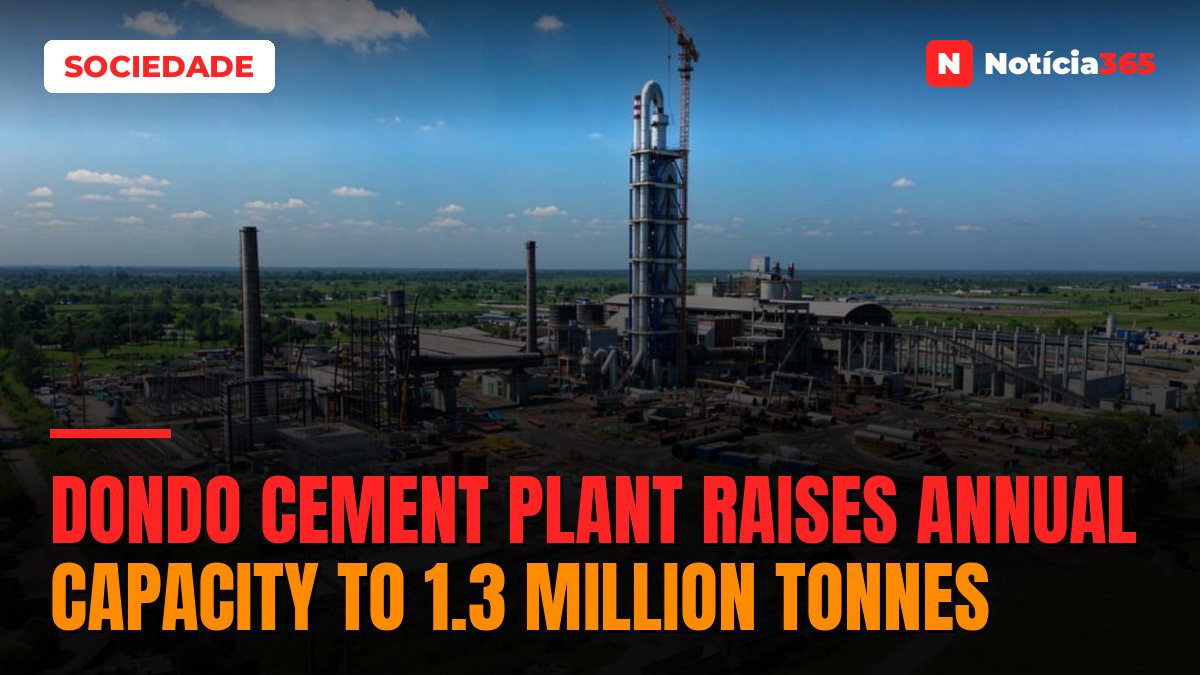

The Dondo cement factory in Sofala province has increased its annual grinding capacity from 750,000 to 1.3 million tonnes following the commissioning of a new clinker production line. Clinker is the essential raw material in cement manufacturing. The expansion is expected to reduce Mozambique's dependence on imports and strengthen the supply of cement to the domestic market, particularly in the country's central region.
The new industrial unit, capable of producing 3,000 tonnes of clinker per day, became operational in October 2026 following the completion of an expansion and modernisation project that began in May 2025. According to Jornal Notícias, construction works were carried out by China Railway No. 20 Bureau (Mozambique), Lda., as part of an investment aimed at upgrading the plant's industrial infrastructure and increasing its productive capacity.
The expansion represents a capacity increase of approximately 73%, raising annual cement grinding output from the previous 750,000 tonnes to 1.3 million tonnes. The initiative reinforces Mozambique's installed industrial capacity and has the potential to improve the availability of construction materials for residential, commercial, and infrastructure projects.
The expansion also includes the installation of a five-megawatt electricity generation system that harnesses residual heat from the production process. The technology is expected to improve the plant's energy efficiency and reduce its reliance on electricity from external sources. The factory is currently owned by Huaxin Cement, a Chinese industrial group that controls Cimentos de Moçambique. It is one of the oldest units in Mozambique's cement industry, having been founded in 1949.
In September 2024, Cimentos de Moçambique announced a US$60 million investment plan to modernise and expand the Dondo unit. The project envisaged the installation of a clinker kiln, a new vertical cement mill, and bagging equipment, as well as the creation of approximately 200 direct jobs.
The commissioning of the new production line is expected to allow the factory to increase the availability of locally produced raw materials and strengthen cement supply to central Mozambique, contributing to the expansion of the country's national industrial capacity.
Source: Diário Económico
Original article: https://www.diarioeconomico.co.mz/2026/10/19/negocios/empresas/fabrica-de-cimento-do-dondo-aumenta-capacidade-de-producao-para-13-milhao-de-toneladas/