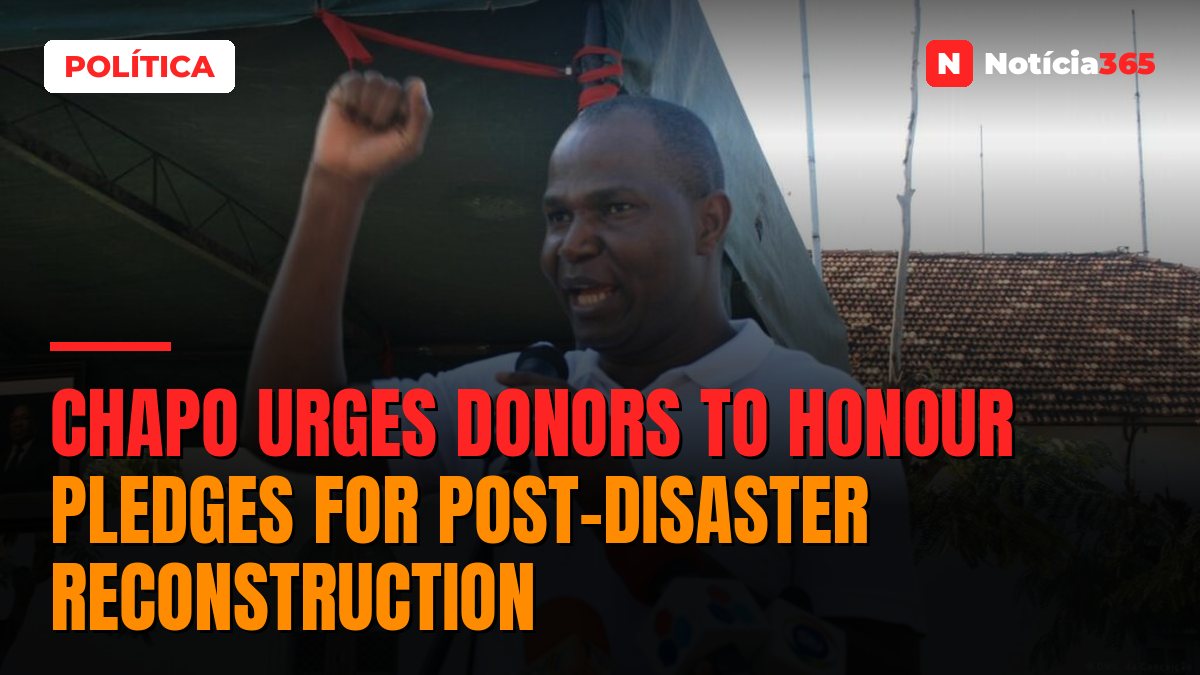

Mozambique's President Daniel Chapo has called on international partners to honour financial commitments made to support the reconstruction of areas affected by natural disasters, highlighting a significant gap between funds pledged and those actually disbursed, according to the Mozambique Information Agency.
Chapo was speaking on Thursday, 15 October, at the opening of the First International Congress on Humanitarian Action and Cooperation, held in the city of Beira, Sofala province, against a backdrop of persistent extreme weather events across the country.
He recalled that, following the passage of cyclones Idai and Kenneth in 2019, an international donor conference announced approximately $10.2 billion to support reconstruction efforts. More than seven years on, however, only around one third of that amount had been disbursed.

"The gap between announced commitments and funds made available constitutes an obstacle to recovery efforts and to the capacity to respond to the needs of affected populations," Chapo said.
The president also referred to damage caused by more recent floods and inundations, noting that the government is mobilising approximately $1.6 billion to finance reconstruction.
In his address, he advocated strengthening prevention mechanisms, community preparedness, and coordination between public institutions and humanitarian partners. He also underscored the importance of early warning systems, spatial planning, and investment in resilient infrastructure to reduce the impact of disasters and protect lives.
UN calls for faster humanitarian response
The United Nations Resident and Humanitarian Coordinator in Mozambique, Catherine Sozi, called for a faster, more coordinated humanitarian response that is closer to affected communities, warning of rising assistance needs, intensifying climate disasters, and persistent insecurity in the north of the country.
"Humanitarian action is a shared responsibility and must be led at the national level," she said, stressing that it falls to the government to lead the response, while the United Nations and international partners should support that leadership and strengthen national capacities.
Sozi also stressed the need to bring resources and decision-making processes closer to communities, as well as to strengthen early warning systems to enable anticipatory action. To that end, she advocated mobilising predictable financing and improving coordination before disasters occur.
She further appealed for greater international support for climate adaptation and the pursuit of durable solutions to the crises affecting Mozambique.
Congress establishes international research network
Boaventura Aleixo, rector of Universidade Licungo, highlighted the scientific and institutional dimension of the congress, which was conceived to promote the sharing of experiences and the building of partnerships among universities, public institutions, humanitarian organisations, civil society, and international partners.
He announced the presentation of 85 papers across six thematic areas, and the creation of the International Network for Research and Humanitarian Action, whose initial headquarters will be based in Mozambique at Universidade Licungo.
The initiative aims to ensure continuity in research, training, and cooperation in the field of humanitarian action. The congress is also expected to be held every three years on a rotating basis across participating countries and universities.
Source: Diário Económico
Original article: https://www.diarioeconomico.co.mz/?p=552882