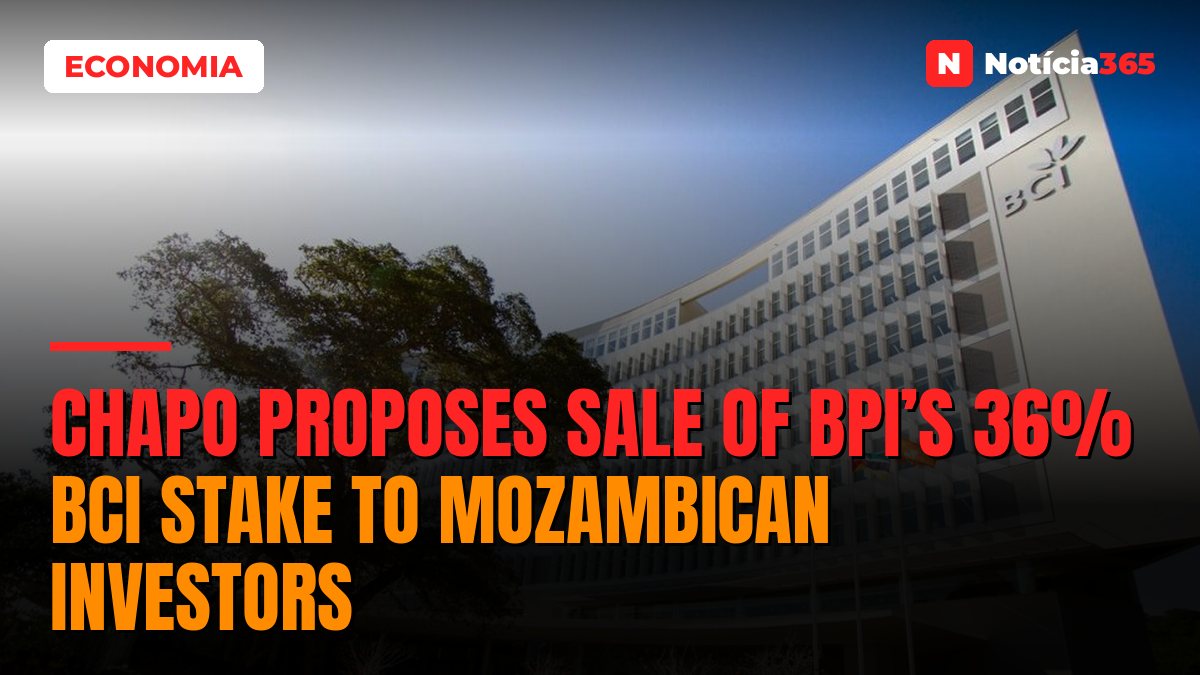

Mozambican President Daniel Chapo has proposed that the approximately 36% stake held by Portuguese bank BPI in Banco Comercial e de Investimentos (BCI) be sold to Mozambican investors, including individual citizens, companies and domestic institutions. Under the proposal, 11% of the capital would be made available to the general public, with the remaining 25% allocated to institutional and corporate investors, seizing on BPI's announced intention to exit the shareholder structure of Mozambique's largest bank.
The initiative was unveiled on Wednesday (14) in Maputo, at a ceremony marking the 28th anniversary of the Bolsa de Valores de Moçambique (BVM), where the head of state argued for greater national participation in the capital of the country's leading financial institutions. "The Government has been seeking to create conditions so that the 36% stake currently held by BPI represents an opportunity to broaden the presence of Mozambican investors, including citizens, companies and institutional investors, while respecting the legally required evaluation, negotiation and authorisation procedures," Chapo said.
According to the President, the acquisition of BPI's stake could strengthen the position of domestic investors within the banking system. The Government also intends to involve the bank's management and employees in discussions around the transaction.
In practical terms, the initiative aims to transfer BPI's holding — equivalent to 35.67% of BCI's capital — to Mozambican investors without necessarily altering the positions of the remaining shareholders. BCI has a share capital of approximately US$156 million and is controlled by Caixa Participações, part of the Portuguese Caixa Geral de Depósitos (CGD) group, which holds 51% of shares. BPI is the second-largest shareholder, followed by CGD, which directly holds 10.51%; the remainder of the capital is dispersed among minority shareholders.
Chapo argued that BPI's exit should be used as an opportunity to increase Mozambican ownership of the financial sector, giving citizens and domestic companies greater access to ownership of economically significant institutions. He also expressed a desire that, in the near future, Mozambicans would be able to say that BCI is "truly from here" — a reference to the bank's commercial slogan.
The proposal was framed within the Government's broader strategy to develop the capital markets and increase the presence of domestic investors in the country's leading companies. Mozambique needs "a deeper, more liquid capital market capable of offering instruments suited to the needs of companies and investors", Chapo said.
Legislative Reforms to Support National Ownership
The President also announced that the Government is refining legislation applicable to banks, insurers and other companies deemed strategically important to the national economy, with the objective of facilitating greater Mozambican capital participation. The amendments are expected to respect the prudential and regulatory requirements of the financial sector in order to preserve institutional stability and investor confidence. "We want this experience, should it materialise as envisaged, to demonstrate that the capital market can play an important role in the economic nationalisation of corporate ownership, without compromising investor confidence, financial stability or the competitiveness of institutions," he declared.
CGD Reaffirms Commitment to BCI
Last May, CGD chief executive Paulo Macedo reaffirmed the group's interest in maintaining its stake in BCI, despite BPI's announced departure. Following a meeting with Daniel Chapo, the executive stated that CGD intended to remain in the bank "for as long as the authorities consider it appropriate and for as long as we are welcome", also acknowledging the possibility that BCI could eventually be listed on the BVM.
BCI Retains Market Leadership Despite Profit Decline
According to the bank's most recent annual report, BCI maintained its leadership of the Mozambican banking system in 2025, with approximately 2.5 million customers. However, profits fell 40.3% to around US$56.4 million, a decline the bank attributed to increased impairments linked to sovereign debt exposure following a deterioration in sovereign risk, as well as extraordinary costs related to the reimbursement of fees.
The transaction remains under review and is subject to negotiations between the parties and the necessary regulatory approvals. The price, the timeline for the share sale and the conditions of participation for Mozambican investors have not yet been announced.
Source: Diário Económico
Original article: https://www.diarioeconomico.co.mz/?p=552854