
President Daniel Chapo on Thursday called for stepped-up investment in natural disaster prevention and risk reduction, appealing to the international community to mobilise climate finance and honour commitments made by developed nations to support countries most vulnerable to climate change. He also disclosed that the government is seeking funding for a post-flood reconstruction plan estimated at approximately US$1.6 billion.
Chapo made the remarks at the opening of the 1st International Congress on Humanitarian Action and Cooperation (CIAHC-2026), held in the city of Beira, Sofala province, where he underscored the importance of strengthening mechanisms for prevention, preparedness, and response to extreme climate events. "We need to strengthen the early warning system, prepare communities, improve land-use planning, invest in resilient infrastructure, and develop institutional capacities that allow us to anticipate risks, mobilise resources, and coordinate interventions before, during, and after disasters," he said.
Chapo noted that Mozambique remains particularly exposed to extreme natural phenomena — including tropical cyclones, floods, and inundations — whose increasing frequency and intensity pose mounting challenges to community safety, infrastructure preservation, and economic development. He argued that prevention must play a central role in public disaster risk management policies in order to reduce the human, social, and economic impacts of natural disasters. "Because to prevent is to protect lives, to prepare is to reduce vulnerabilities, and to rebuild with resilience is to protect our future," he declared.
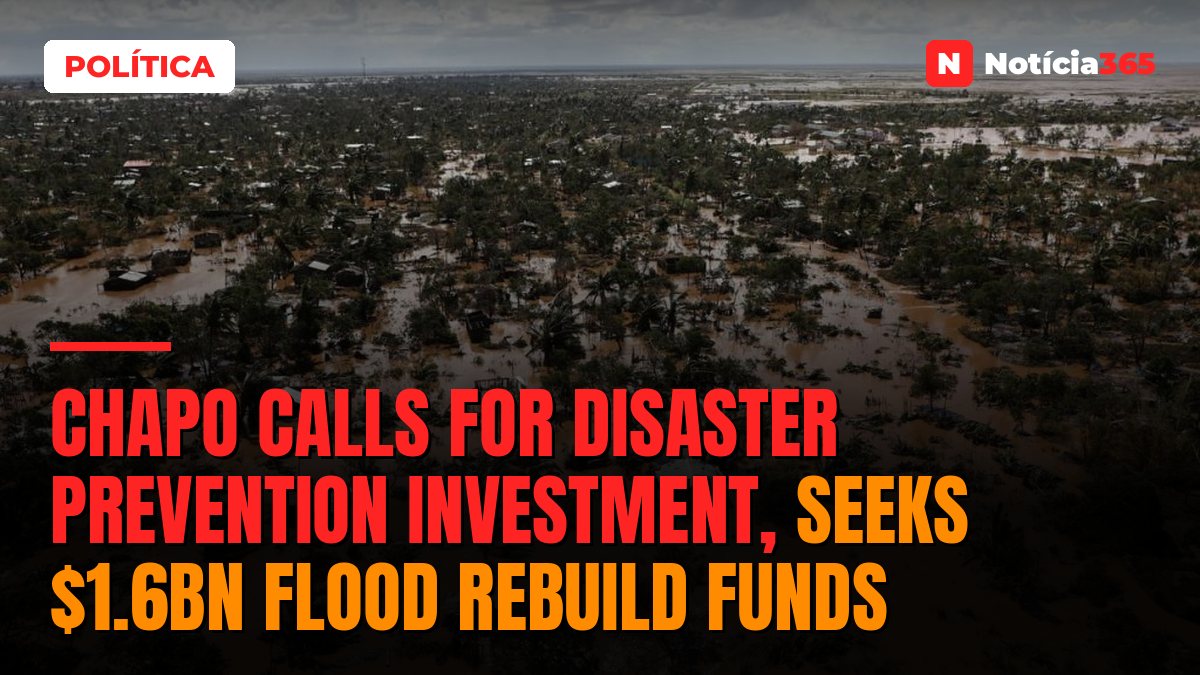
The president said the government is actively seeking financing for a reconstruction plan covering regions affected by recent flooding in the south of the country. "We are currently mobilising resources to fund a reconstruction plan budgeted at approximately 1.6 billion dollars," he explained.
In the same address, Chapo called on the international community to give greater priority to climate justice and advocated for financing mechanisms capable of meeting the needs of countries most exposed to the effects of climate change. "One of the issues we would like to see discussed at this International Conference is climate justice and climate finance," he said.
Chapo also highlighted the role of Local Risk and Disaster Management Committees, which he regards as fundamental to preparing and protecting communities and mitigating the impacts of natural disasters. "In Mozambique, our secret to success is the Local Risk and Disaster Management Committees," he said.
Also at the congress, the rector of Licungo University, Boaventura Aleixo, announced the creation of the International Network for Research and Humanitarian Action — a platform designed to strengthen cooperation among universities, research centres, and humanitarian assistance institutions, with its initial headquarters in Mozambique. According to the rector, the initiative aims to sustain scientific and institutional cooperation beyond the congress, promoting research, training, and knowledge-sharing on humanitarian challenges. "CIAHC-2026 represents not only the first edition of a congress, but the starting point for an international and permanent process of research, training, and humanitarian cooperation," he said.
The two-day event brings together representatives from ten countries and is expected to feature 85 scientific papers across six thematic areas, including disaster risk management, conflict, population displacement, humanitarian financing, and social inclusion.
At the same occasion, the United Nations Resident Coordinator in Mozambique, Catherine Sozi, warned of a deterioration in humanitarian needs linked to the effects of climate change and the continued insecurity in Cabo Delgado province. "Humanitarian needs are increasing. Climate disasters are intensifying. Conflict and insecurity in northern Mozambique continue to cause the displacement of communities," she said. Sozi cautioned, however, that this rising need is occurring against a backdrop of increasing pressure on available financial resources. "Yet resources are becoming ever more limited," she added.
Source: Diário Económico
Original article: https://www.diarioeconomico.co.mz/?p=552831