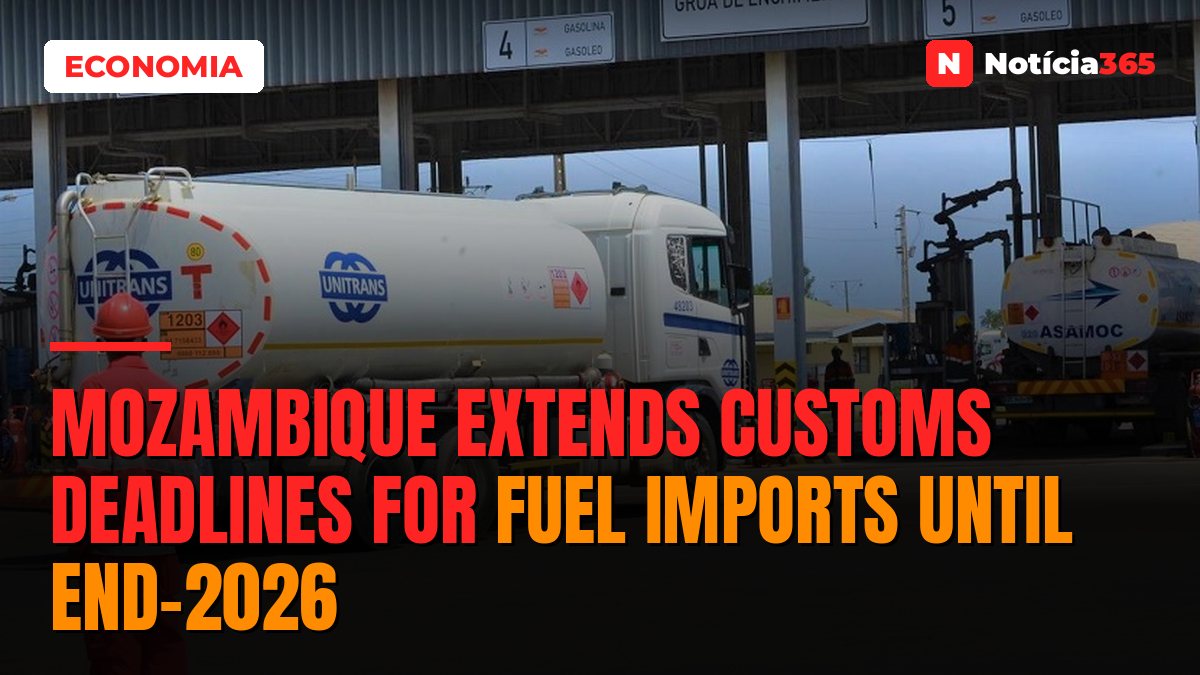

The Mozambican government has temporarily extended deadlines for warehouse entry declarations and customs clearance of petroleum products, an exceptional measure designed to simplify import procedures that will remain in force until 31 December 2026.
The measure is set out in Ministerial Diploma No. 80/2026, published by the Ministry of Finance, which establishes new rules for fuels destined for domestic consumption against a backdrop of recent supply constraints, according to Lusa.
Under the diploma, warehouse entry declarations must be submitted within a maximum of 30 calendar days from the end of the discharge of products at the destination customs post. The deadline may be extended by a further 15 days upon authorisation from the competent authorities.

The document also stipulates that customs clearance of petroleum products must be processed within a maximum of 65 calendar days, with the possibility of a 15-day extension upon submission of duly justified grounds. The new rules further require that operators responsible for imports notify Customs of the arrival of goods up to five days before discharge.
For the duration of the exceptional regime, deadlines previously established under the general customs clearance regulations applicable to these goods are suspended. According to the Ministry of Finance, the measures are provisional and exceptional in nature, applicable until the end of the year.
The decision comes several weeks after queues were recorded at petrol stations in Maputo and other provinces at the end of September. At the time, the Ministry of Mineral Resources and Energy attributed the disruptions to logistical difficulties during an extended weekend that affected the loading and distribution of fuels.
In response, the government announced reinforced operations at the Matola Terminal to accelerate the loading of fuel tankers, assuring that available reserves were sufficient to supply the city of Maputo until the arrival of a vessel carrying 8,000 tonnes of petrol.
The September disruptions followed a supply crisis recorded between April and May that affected several regions of the country, with long queues at petrol stations, temporary pump closures, and difficulties in supplying consumers and transporters.
At the time, the government attributed part of the difficulties to the impact of the Middle East conflict on international energy markets and supply chains. According to the government, approximately 80% of fuels imported by Mozambique originated in that region and transited through the Strait of Hormuz.
The Bank of Mozambique also acknowledged difficulties in accessing foreign exchange to finance fuel imports, pointing to capacity limitations among some companies in the sector.
Data from the central bank indicate that the country spent US$236.4 million on fuel imports in the first quarter of 2026, down 1.4% from US$239.6 million recorded in the same period of 2025.
In May, in response to the effects of the supply crisis and rising international prices, the government increased administered fuel prices. The measure resulted in a 45.5% rise in the price of diesel and a 12.1% increase in the price of petrol.
Source: Diário Económico
Original article: https://www.diarioeconomico.co.mz/?p=552177