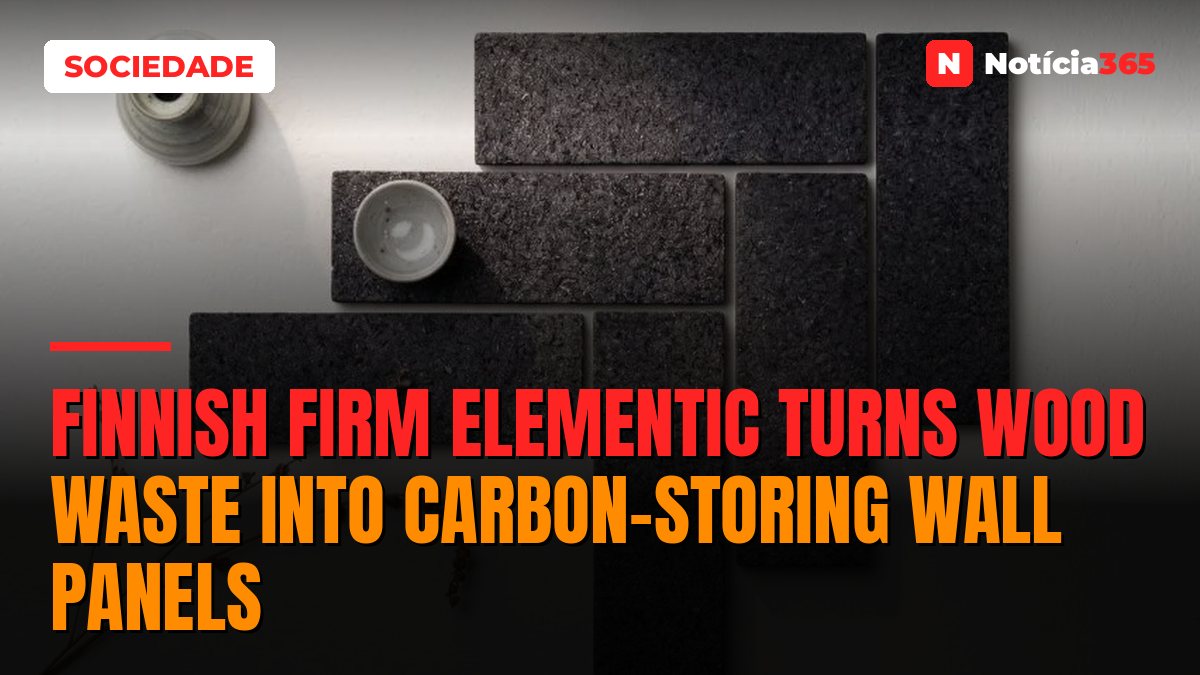

Finnish company Elementic has developed a wall cladding produced from lignin — a natural component of wood — that the manufacturer says is capable of storing the equivalent of approximately 2.4 kilograms of carbon dioxide (CO₂) for every kilogram of material. Branded MO6, the product aims to offer an alternative to conventional wall coverings by drawing on a raw material sourced from the timber industry.
Lignin is a substance found in the cell walls of plants, where it provides rigidity and structural strength to wood. Despite its abundance, a significant portion of the lignin separated during industrial processing is burned as fuel for energy generation, largely because of the difficulties involved in applying it to other uses.
To convert this raw material into a construction product, Elementic developed a patented treatment and purification process using a bioreactor. The result, according to the company, is a solid compound that is lightweight, durable, and fire-resistant.

The manufacturer highlights MO6’s high carbon concentration and maintains that, under appropriate conditions, the material could retain that carbon over extended periods — potentially thousands of years.
“It is quite a challenging material, but we love lignin because it is a raw material that is very rich in carbon,” said Johanna Normiala, brand lead for MO6.
MO6 is currently sold in the form of panels for wall cladding in dry interior spaces, available with either smooth or rougher textured finishes.
Elementic identifies hotels, restaurants, and architecture and interior design projects as potential markets for the product. The company is also developing bricks based on the same technology, with the aim of broadening its application in the construction sector.
Harnessing lignin opens new uses for an industrial by-product that would otherwise be combusted as fuel or carry lower economic value.
According to the Ciclo Vivo website, the carbon retention capacity is one of the main environmental attributes presented by Elementic in a sector that is responsible for a significant share of global greenhouse gas emissions.
However, the actual climate benefit of MO6 depends not only on the carbon embedded in the material itself, but also on the emissions associated with the extraction and processing of the raw material, manufacturing, transportation, and the product’s end-of-life disposal.
A comprehensive assessment of its environmental impact therefore requires consideration of the cladding’s full life cycle.
Source: Diário Económico
Original article: https://www.diarioeconomico.co.mz/?p=551433