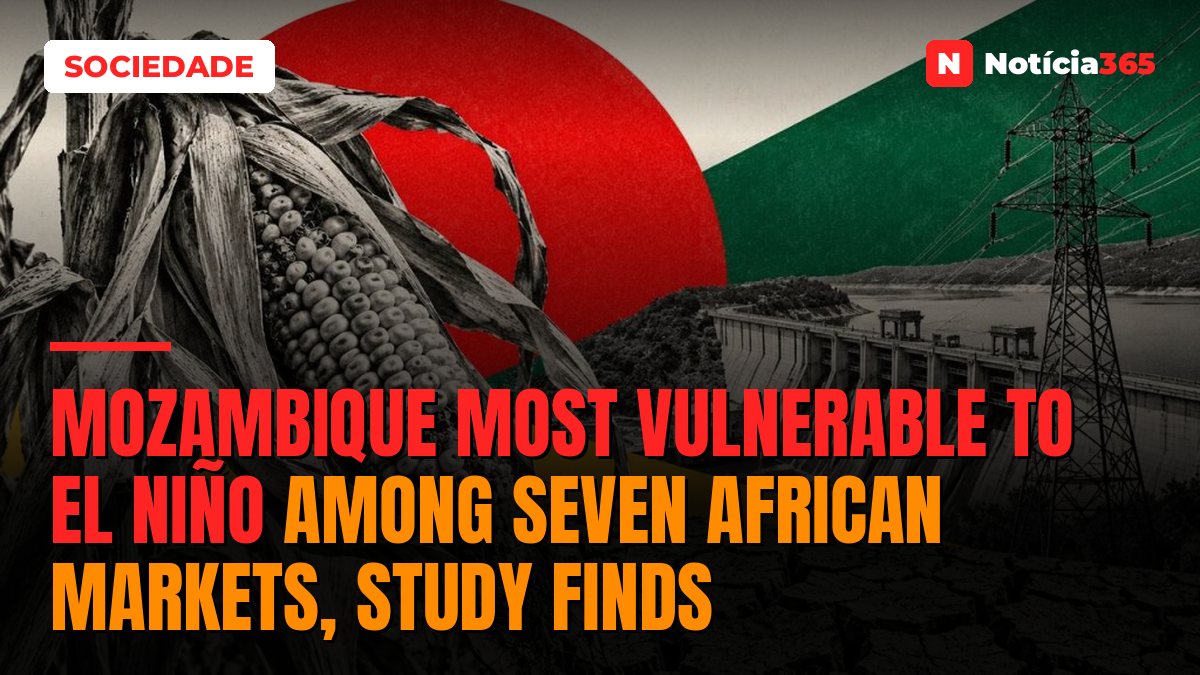

Mozambique has the weakest structural capacity to withstand the effects of a severe El Niño event among seven Sub-Saharan African countries assessed in a new report, owing to chronically low cereal productivity and heavy dependence on hydroelectric power generation. The finding is contained in a report by FurtherMarkets, published in October 2026, which warns of potential disruptions to agricultural output, food supply, electricity generation, and logistics corridors during the 2026-27 growing season. Nigeria also features among the most exposed markets.
Titled El Niño's Fault Lines in Africa, the study examines the vulnerability of seven African economies to a potential intensification of the climate phenomenon, drawing on agricultural, energy, and logistics indicators.
According to the document, projections from the United States National Oceanic and Atmospheric Administration (NOAA), cited by the authors, pointed to a probability exceeding 90% of very strong El Niño conditions materialising by the first quarter of 2027. The report further notes an 83% probability of the phenomenon reaching historic intensity, with temperature anomalies above 2.5 degrees Celsius between October and December 2026.
Based on the data presented, Mozambique recorded cereal productivity of 776 kilograms per hectare in 2024, the lowest among the seven countries analysed.
Agriculture accounted for 25.6% of gross domestic product (GDP) in 2025, while hydroelectric generation represented 83% of the country's total electricity output in 2024.
According to FurtherMarkets, this combination heightens the economy's exposure to periods of insufficient rainfall, with potential consequences for food production and energy supply.
The report recalls the effects of the 2015-16 El Niño, during which Mozambique's maize production fell by approximately 35% year-on-year in 2016.
Data from the Food and Agriculture Organization of the United Nations (FAO), cited in the study, indicate that drought affected approximately 864,000 hectares of agricultural land and 459,000 farmers during that period. Flooding simultaneously affected 194,100 people.
The data presented reaffirm that Mozambique's cereal productivity of 776 kilograms per hectare in 2024 was the lowest among all seven economies examined.
South Africa and Ghana Record Highest Agricultural Productivity
In the regional comparison, South Africa recorded the highest cereal productivity in 2024, at 4,562 kilograms per hectare, followed by Ghana at 2,632 kilograms and Zambia at 2,318 kilograms.
Tanzania posted productivity of 1,872 kilograms per hectare, Kenya 1,693 kilograms, and Nigeria 1,558 kilograms, while Mozambique ranked last at 776 kilograms.
The study concludes that South Africa and Ghana face lower structural vulnerability in food production, although Ghana is exposed to logistical weaknesses.
Zambia and Tanzania are identified as particularly exposed to risks linked to hydroelectric output and weather conditions.
In Zambia, hydroelectricity accounted for 78.5% of electricity generation in 2024. During that year, power cuts reached as much as 12 hours per day in May, while the usable storage at Lake Kariba fell to 2.89% on 11 December.
In Tanzania, forecasts of above-normal rainfall in certain regions through to March 2027 raise concerns over potential flooding, flash floods, and landslides that could disrupt transport and regional trade.
Despite the risks identified, the report highlights several factors that could limit the scale of potential disruptions.
In Mozambique, annual food inflation slowed from 13.4% in June to 8.9% in August 2026, according to data from the National Statistics Institute (INE).
In Zambia, retail prices for maize grain and maize meal fell 25% year-on-year in March, reflecting ample domestic supply, according to FAO.
An above-average South African harvest, record maize production in Zambia, and food reserves accumulated in 2026 could also help offset potential agricultural losses across the region.
FurtherMarkets cautions, however, that the effects of El Niño remain uncertain and could vary significantly between countries.
The phenomenon may weaken before causing meaningful impacts on late-season crops or hydroelectric generation. Furthermore, disruptions associated with flooding and water scarcity could occur in localised areas without simultaneously affecting major markets.
The study also cites Absa Research, which warns that the intensity of El Niño in the Pacific does not directly allow for an assessment of the scale of economic damage in Africa, given that previous episodes produced markedly different effects on growth and inflation across individual countries.
Study Outlines Three Scenarios for 2026-27
FurtherMarkets presents three possible scenarios for the evolution of climate and economic risks during the 2026-27 season.
The first, assigned an estimated probability of 35%, envisages localised disruptions in southern Africa.
The second, considered the most likely by the authors at 45%, anticipates simultaneous disruptions across several trade corridors involving Mozambique, Zambia, Kenya, and Tanzania.
The third scenario, assigned a probability of 20%, contemplates broader pressure across multiple African markets, including risks to food and energy supply in West Africa.
These probabilities represent FurtherMarkets' own estimates and do not constitute official forecasts from meteorological authorities.
In light of the risks identified, the report recommends that companies and financial institutions strengthen preventive assessments of their exposure to potential supply chain disruptions, transport bottlenecks, agricultural production shortfalls, and electricity supply interruptions.
Source: Diário Económico
Original article: https://www.diarioeconomico.co.mz/?p=551297