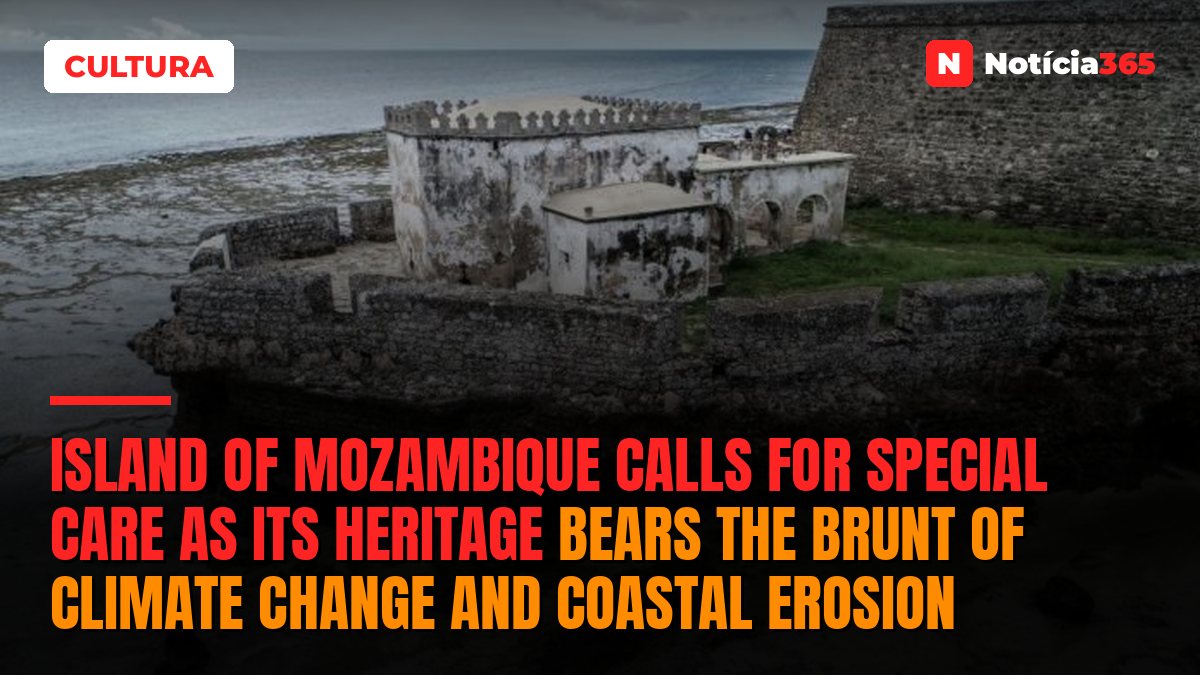
The iconic, historic Island of Mozambique, a UNESCO World Heritage Site for 35 years, is working to preserve its infrastructure and coastal areas while appealing to the international community for “special care” to protect this heritage.
“The warnings that the infrastructure is at risk stem from the times we are living in, which are marked by climate change. The island has suffered from recurring cyclones that cause destruction, not only to heritage infrastructure but also to homes. The island therefore has to become resilient to these effects of climate change,” Cláudio Zunguene, director of the Island of Mozambique Conservation Office, told Lusa.
On the east coast of Africa, the Portuguese built up the Island of Mozambique more than 500 years ago, in Nampula province, in the north of the country. The poet Luís Vaz de Camões once lived there, and in 1991 the island was declared a World Heritage Site by the United Nations Educational, Scientific and Cultural Organisation (UNESCO).
More than five centuries later, the island’s infrastructure is being affected by damp and poor sanitary conditions, with buildings showing cracks, paint peeling, walls displaying signs of wear and facades eroded by the action of water and the marine environment.
The island’s protective wall, known as the perimeter barrier, is also bearing the brunt of the force of the sea. Deterioration has been exacerbated by the effects of climate change, which in recent years have brought destructive cyclones to this stretch of land surrounded by the Indian Ocean.
According to the Conservation Office, concrete efforts are being made to make the island “resilient”.
“The state of conservation is reasonable, but we must be honest: it is not among the best. It is reasonable and presents many challenges, in which everyone’s role is important if we are to bring the island to a safe harbour,” Zunguene said.
“Regarding coastal erosion, the island rests on rock, and there are several specific locations here where the effects of climate change are clearly visible. Even at the fortress, near the Garden of Memory and on the island’s opposite coast, we feel the force of the sea, whose waters are becoming increasingly aggressive and eroding the perimeter barrier. This is the challenge we face: to curb the advance of climate change and coastal erosion,” he added.
Zunguene said that “a great deal of money” was needed to restore the perimeter barrier, which protects the island against encroaching waters. An assessment is currently being prepared to determine the amount required for the intervention.
The Conservation Directorate has been seeking funding to protect and restore the island’s infrastructure. It currently has a fund of US$392,000 (€341,000), provided by the World Monuments Fund, to rehabilitate the roof of the island hospital’s main building. The same funding will also make it possible to carry out restoration work on 15 macuti houses, traditional wattle-and-daub dwellings.
The beneficiaries of these interventions believe that the work helps preserve traditional homes and the island’s cultural identity.
In the Macuti quarter, in the heart of the Island of Mozambique, Saquina João makes no secret of her satisfaction at seeing her parents’ home restored and calls for more similar initiatives.
“I wanted to say thank you, because now we sleep in a place where, when it rains, we don’t have to get up to move so many things around. I also want to thank the people who helped us,” said the 19-year-old, explaining that before the rehabilitation the house was “rotten” and has now been renovated.
Tadi Momade, 61, is another resident whose home was rehabilitated after years of deterioration caused by damp and the decay of its roof. He said he had never given in to pressure to build a conventional house because he believed his current home preserved his family’s history.
“I was born into this house and found my parents living here. I am their heir and I have maintained the structure. I have no wish to change it because it is a relic and, because of its heritage value, I have to remain in this house,” Momade said.
“My wish is to maintain this structure. I am preserving the heritage and, since we are listed by UNESCO, we must preserve these buildings (…) For us, this is our culture. I have seen several houses disappear,” he added.
The district government acknowledges that climate change, including cyclones and floods, as well as deterioration caused by damp, is affecting the island’s heritage. According to the authorities, the impact is also being felt in tourism, with at least 15 establishments, including hotels, restaurants and guesthouses, already having closed.
“Funding of this kind may not be available, but it is something the Government is increasingly seeking with its partners in order to maintain the island,” said Jasmim Raúl Acabar, permanent secretary of the district government.
“It is a challenge because investment cannot be considered only at island level, but also on the mainland (…) As for how much is needed, I cannot give a figure. It is far too early to say at this stage, but the island needs substantial investment to maintain itself,” she added.
The first seat of the Portuguese colonial Government, recognised for its distinctive urban fabric, historic fortifications and unique blend of African, Arab, Indian and Portuguese architectural and cultural influences, the Island of Mozambique has around 92,000 inhabitants. Local authorities say they are focusing on raising community awareness to reduce the deterioration of the heritage, while awaiting the mobilisation of additional resources for conservation projects.
For the Conservation Office, preserving the island requires an effort that goes beyond national borders.
As a World Heritage Site, we have felt special care from the international community through UNESCO and other organisations. What we would like is for them to continue paying close attention to the island, because it really needs special care in the face of climate change,” Cláudio Zunguene concluded.