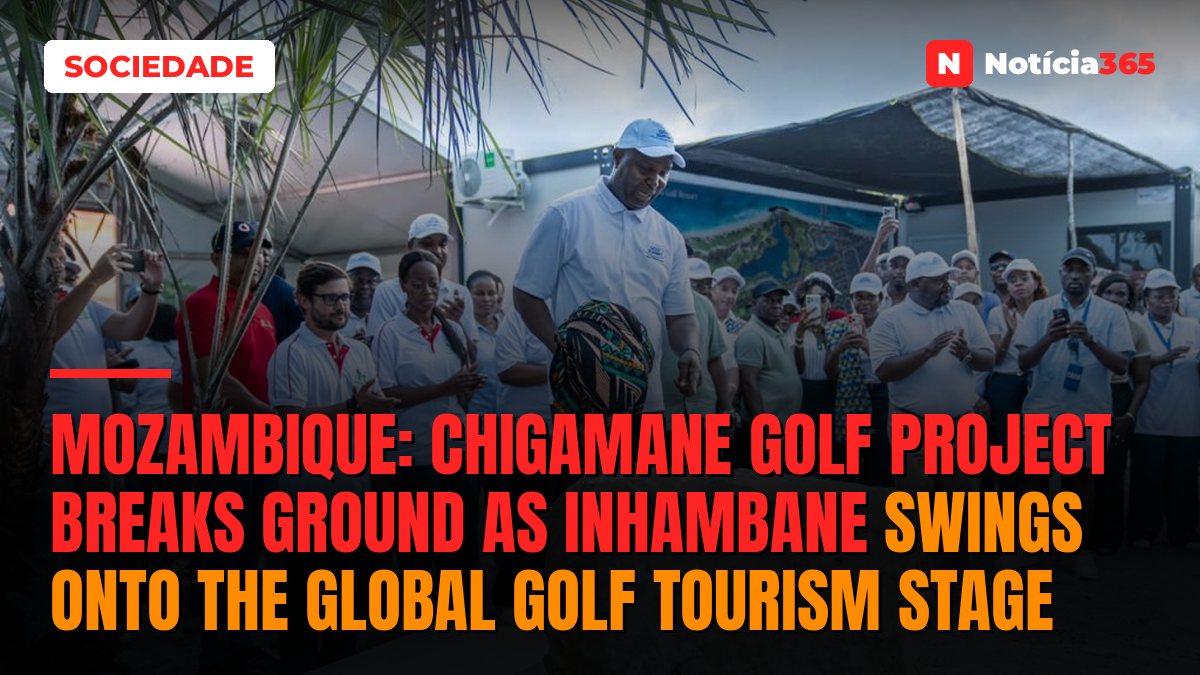
The Mozambican Government has announced plans to transform Chigamane, in Vilankulo district, into a new golf tourism destination through a project whose construction began on Saturday and which aims to strengthen the tourism offer, attract visitors and create local jobs.
The initiative was announced by the Presidency following a ceremony in Chigamane, a locality in the tourist district of Vilankulo, Inhambane province, where Mozambican President Daniel Chapo laid the foundation stone for the construction of the golf courses
In a statement, the Presidency said the development represents an investment in diversifying Vilankulo’s tourism offer, seeking to strengthen the district’s ability to attract visitors and consolidate its position as a leading destination in national and international tourism markets.
The initiative aims to attract tourists from various regions of Mozambique and countries such as South Africa, Zimbabwe, Tanzania and Zambia, thereby laying the groundwork for local economic growth, business development and greater participation by national operators in the tourism value chain,” the statement said.
The Chigamane golf project forms part of the broader strategy adopted by the Government to develop golf tourism in Inhambane province. In October, the Government approved the regulatory framework for the new Special Zone for Golf Tourism (ZETG), designed to attract domestic and foreign investment and develop a high-value-added tourism segment.
Established by Decree No. 56/2026, Mozambique’s Special Zone for Golf Tourism covers the districts of Vilankulo, Inhassoro, Massinga, Jangamo, Zavala and Govuro, with the possibility of being extended to other areas of Inhambane province in the future.

Photo: Ministério da Economia
The decree sets out the objective of transforming Inhambane into an ‘international centre of excellence in golf tourism, high-standard hospitality, sophisticated leisure and specialised tourism investment’, while consolidating the province’s position as Mozambique’s ‘tourism capital and national tourism hub’.
Under this framework, projects approved within the Special Zone for Golf Tourism will benefit from a dedicated incentives regime, including access to land reserved for investment, tax benefits, non-tax guarantees and priority in the repatriation of dividends for foreign investors.
The model also provides for the creation of the Golf Tourism Development Fund (Fundo de Desenvolvimento do Turismo de Golfe, FDTG), intended to finance infrastructure, technical training, international marketing and promotion, golf tournaments, community programmes for young people, and initiatives focused on environmental sustainability and local content.
Management of the Special Zone for Golf Tourism has been entrusted to the state-owned National Agency for Integrated Tourism Development (Anditur), which is responsible for supporting investors, facilitating licensing procedures, issuing opinions on projects and seeking financing solutions for approved developments.

Photo: X/@daniel_chapo24
According to the statement released yesterday by the Presidency, the machinery and equipment required to carry out the works in Chigamane are already on site, allowing implementation of the project to proceed.
Beyond tourism, the investment is expected to generate economic and social benefits for local communities through job creation, particularly for young people and women, and the promotion of vocational training and skills development programmes.
Among the planned training areas, English-language training stands out, which the Government considers an important tool for improving the quality of reception and services provided to international visitors.
In July this year, Inhambane Governor Francisco Pagula told Lusa that the province planned to begin construction of its first golf course later in the year, with an estimated private investment of US$5 million. A second golf project was also under negotiation at the time, as part of the strategy to establish Inhambane as a regional reference for the sport.
GOLFE: UMA TACADA PARA O DESENVOLVIMENTO DE MOÇAMBIQUE 🇲🇿
Em Vilankulo, destacamos o turismo de golfe como motor de diversificação económica, atracção de investimentos e criação de emprego.
Queremos fazer desta indústria uma fonte de riqueza e prosperidade para os moçambicanos, afirmando Moçambique como destino de referência do turismo de golfe em África.
#VamosTrabalhar
— Presidente Daniel Chapo (@daniel_chapo24) November 7, 2026