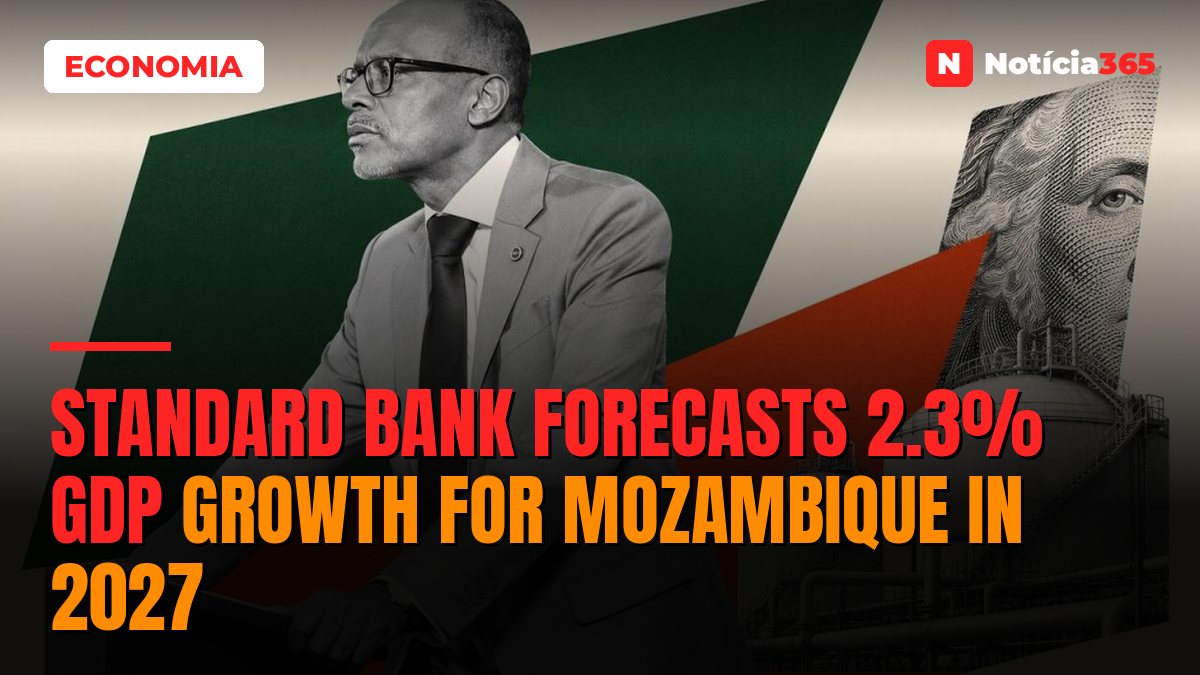

Mozambique's economy is projected to grow 2.3% in 2027, a rate below the country's population growth, according to Standard Bank. The forecast points to a recovery insufficient to raise GDP per capita, in a context where the bank considers fiscal adjustment inevitable and advocates greater exchange rate flexibility to address the country's foreign currency shortage.
Mozambique is expected to continue facing a slow recovery in 2027, constrained by pressures on public finances and imbalances in the foreign exchange market. For Standard Bank, stabilising the economy requires structural reforms regardless of whether a new financing programme with the International Monetary Fund (IMF) is concluded.
The assessment was presented by the bank's chief economist, Fáusio Mussá, at the 23rd edition of the Economic Briefing, held on 5 November in Maputo. The event focused on the conditions needed to restore investment and translate the potential of large-scale projects into broader economic growth.
"With or without a financing programme with the International Monetary Fund, a macroeconomic adjustment is inevitable," the economist stated.
GDP Growth Below Population Rate Limits Per Capita Recovery
Standard Bank anticipates real GDP expansion of approximately 2.3% in 2027, below the population growth rate of 2.7% cited during the presentation of the economic outlook.
If both figures materialise, real GDP per capita would decline by roughly 0.4%, based on a calculation by Diário Económico. This result follows from a comparison between output growth and population growth and does not constitute an independent forecast published by the bank.
The distinction is significant: an economy can expand in aggregate terms without increasing average output per person. GDP per capita also does not directly measure household income or the distribution of the benefits of growth.
Mozambique, 2027. Projected real GDP growth: 2.3%; population growth reference: 2.7%. Source: projections and figures released at the Standard Bank Economic Briefing.
Debt and Foreign Currency Shortage Constrain Investment
Fáusio Mussá identified fiscal consolidation as an important condition for improving the state's access to financing. He also advocated greater exchange rate flexibility in response to the foreign currency shortage and its implications for business activity, particularly outside the natural resources sector.
For companies, the availability of foreign exchange has direct operational consequences, affecting the procurement of equipment, raw materials, and services from abroad. Greater exchange rate flexibility could, however, entail adjustments in import prices, with the scale of such effects depending on the measures adopted and market responses.
Official data help frame the pressure on public finances. According to the PESOE balance sheet for the third quarter of 2026, central government debt rose from approximately 1.091 trillion meticais at end-2025 to 1.138 trillion meticais in September.
During that period, the domestic component increased from 474.5 billion to 573.6 billion meticais, rising to represent 50.4% of the total, compared with 43.5% at the end of the previous year.
Central Government debt stock, in billions of meticais. Source: Ministry of Planning and Development, PESOE Balance Sheet for the Third Quarter of 2026. Context added by Diário Económico, distinct from Standard Bank projections.
Gas Projects Could Accelerate GDP, but Fiscal Benefits Will Be Gradual
Over the medium term, Standard Bank acknowledges that progress on liquefied natural gas projects in the Rovuma Basin could push economic growth to double-digit rates from the final quarter of 2028.
That outlook is contingent on the projects being realised and their respective timelines being met. The reference to that quarter should not be interpreted as a forecast of double-digit growth for 2028 as a whole.
The economist also cautioned that the expansion associated with gas is unlikely to immediately generate a substantial increase in public revenues or employment. Economic diversification and stronger participation by other sectors therefore remain necessary to broaden the benefits of investment.
Reforms and Financing at the Centre of the Debate
The event featured a panel with Alfredo Mutombene, National Director of Fiscal and Financial Analysis at the Ministry of Finance, and Olamide Harrison, the IMF's resident representative in Mozambique, focused on fiscal sustainability and the conditions for a new investment cycle.
In the bank's public account of the debate, Mutombene framed the plan under discussion with the IMF as a national agenda. Harrison highlighted the country's growth potential despite its macroeconomic challenges.
The central question running through the event was whether the conditions for stability and financing can be established before the large gas projects begin delivering more meaningful benefits to the broader economy.
Source: Diário Económico
Original article: https://www.diarioeconomico.co.mz/2026/11/06/economia/economic-briefing-standard-bank-anteve-ajustamento-macroeconomico-em-mocambique-em-2027/