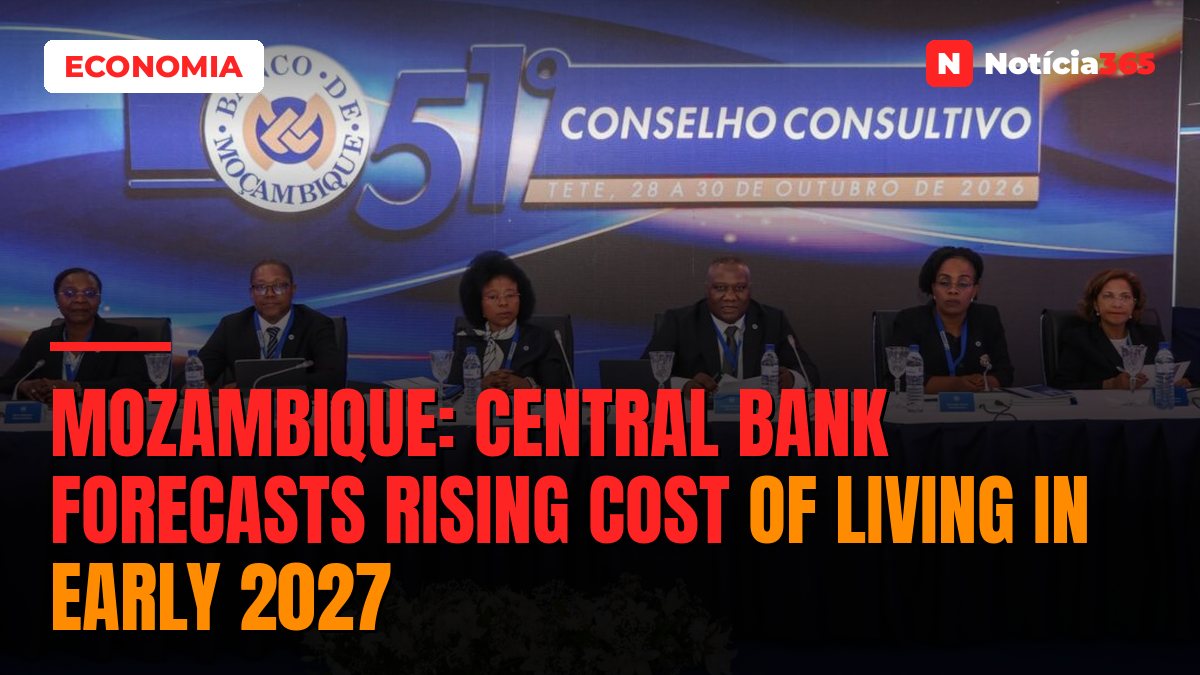
The Bank of Mozambique expects the economy to continue its moderate recovery in 2027 and over the medium term, driven by the performance of agriculture, the extractive industry and services. However, it forecasts a generalised rise in prices, and a consequent increase in the cost of living, in the first quarter of 2027 due to domestic and external factors.
The warning was issued on Wednesday by Bank of Mozambique Governor Felisberto Navalha during the opening of the institution’s 51st Consultative Council, being held in Tete province. “With regard to prices, we anticipate some pressure in the short term and a slowdown in the medium term,” Navalha said.
According to the central bank governor, domestic factors behind the rising cost of living include uncertainties over the scale of imported inflation, the evolution of public debt and government arrears, as well as the impact of climate shocks, particularly the El Niño phenomenon. “Externally, there are uncertainties about the duration and magnitude of the effects of geopolitical tensions in the Middle East and Europe on international trade flows, the global supply of goods, and international fuel and food prices,” Navalha added.
Should these scenarios continue to worsen, the Bank of Mozambique says it may reverse its current monetary policy stance. “In addition to monetary policy measures, fiscal consolidation, improvements to the business environment and other structural reforms remain essential to sustain a rapid economic recovery and promote job creation in our country,” the governor stressed.
In addition to his projections for 2027, Navalha said in his speech that Mozambique’s economy was continuing to grow at a moderate pace in 2026, but that this was “still insufficient to bring about an improvement in the population’s living conditions”. He recalled that, following the 0.2% contraction recorded in 2025, the economy grew by just 1.7% in the second quarter of 2026, remaining below its potential and the country’s poverty reduction objectives.
Navalha also recalled that, after annual inflation accelerated from 4.41% in April to 7.51% in June, reflecting adjustments to liquid fuel prices, it slowed to 6.31% in September.
READ: Mozambique: Economy grows 1.7% in Q2, below its potential and country’s poverty reduction goals
The central bank governor also reported that the financial system remained sound and resilient. He said that in September, the banking sector’s solvency ratio stood at 29.0% and its liquidity ratio at 55%, both above regulatory minimums, while non-performing loans remained at around 7.0%.
In the foreign exchange market, the Bank of Mozambique has recorded high volumes of foreign currency purchases and sales associated with natural gas and extractive industry projects, amid exchange rate stability.
“By September 2026, foreign currency purchases by commercial banks had reached US$6.50 billion, an increase of US$859 million compared with the same period in 2025, while sales to customers reached US$6.41 billion, an increase of US$718 million,” Navalha reported.
However, the Bank of Mozambique governor said that difficulties in accessing foreign currency had also been reported, highlighting weaknesses in the functioning of the market and in the distribution of available liquidity within the system.
“Nevertheless, we wish to report that the country maintains a reasonably comfortable level of international reserves, equivalent to around five months of imports of goods and services, excluding large projects,” the governor said.
It should be noted that this is the first Consultative Council chaired by Navalha as governor of the Bank of Mozambique.
By Evaristo Chilingue
Source: Carta de Moçambique