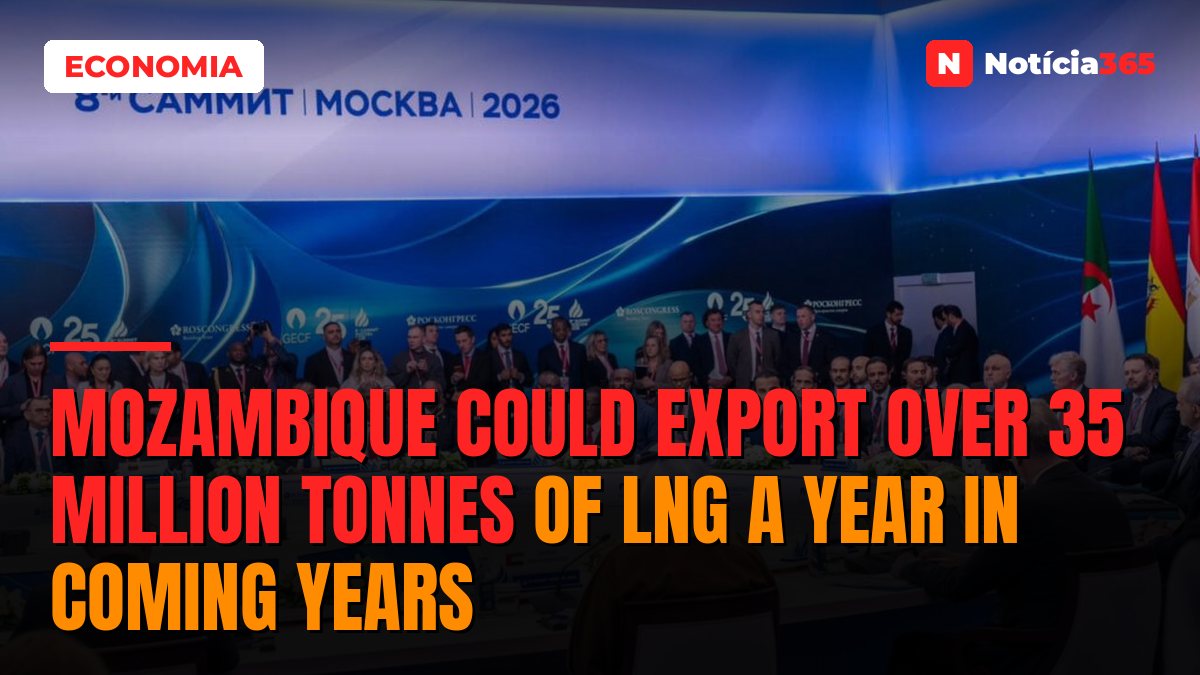
President Daniel Chapo said in Moscow on Tuesday that, in the coming years, Mozambique could achieve an export capacity of more than 35 million tonnes of liquefied natural gas per year, strengthening the country’s position in the international market.
Speaking at the 8th Summit of Heads of State and Government of the Gas Exporting Countries Forum (GECF), in Moscow, Russia, Daniel Chapo said that the projects under development in the Rovuma basin, off the coast of the northern province of Cabo Delgado, should consolidate the country’s position as one of the emerging players in the global energy sector.
“When these projects are fully operational in the coming years, Mozambique could achieve an export capacity of more than 35 million tonnes of liquefied natural gas per year, establishing itself among the significant producers in the international market,” he said.
The President recalled that when Mozambique joined the GECF as an observer in 2022, the country was preparing to begin liquefied natural gas exports from the Rovuma basin: “Today, Mozambican gas is already reaching international markets, contributing to the diversification of supply sources and global energy security.”
In his speech, Chapo argued that the exploitation of natural resources should serve not only exports but also domestic economic transformation.
“We want the gas that comes from the depths of our land and our sea to be transformed into energy that lights up Mozambique, bringing light to our schools and health units, producing fertilisers that strengthen agriculture and generating jobs for our young people and women,” he said.
The head of state said the country was promoting “a paradigm shift”, moving from an economy based on resource extraction to a model based on value creation, industrialisation and economic sovereignty.
He also considered that the gas industry should generate direct benefits for the population through job creation, technology transfer and business development.
Daniel Chapo highlighted the expansion of access to electricity, indicating that national coverage had risen from 30% in 2018 to 70% currently, while the objective of achieving universal access by 2030 remained in place.
The President also advocated a “just, balanced and inclusive” energy transition, arguing that international financing mechanisms should recognise countries’ different development realities and allow for the responsible use of natural gas in complementarity with renewable energy.
Addressing GECF member countries, Chapo proposed four priorities for the future of the sector: “a more stable and predictable international gas market”, technology transfer and training of personnel, investments that promote the local transformation of resources, and an energy transition that reconciles environmental protection and economic development.
Mozambique has three approved projects to exploit the natural gas reserves in the Rovuma basin, classified among the largest discoveries worldwide in recent decades.