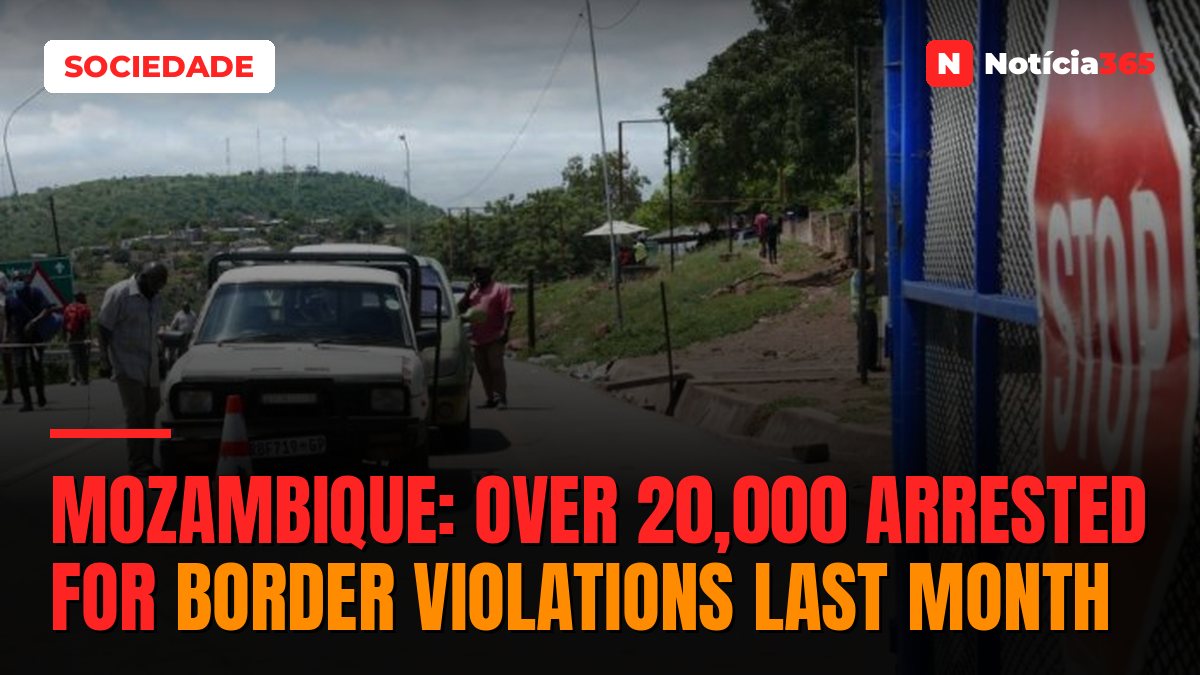
More than nine out of ten arrests made by the Mozambican police last month were related to border violations, which accounted for 20,243 of the 21,369 people detained in the country during this period.
An analysis of the weekly operational reports from the Police (PRM) indicates that arrests for immigration offences accounted for around 95% of all incidents recorded between 19 September and 18 October.
During the period under review, the PRM detained 5,237 people between 19 and 25 September, 5,516 between 26 September and 2 October, 5,366 between 3 and 9 October and 5,250 in the most recent week, totalling 21,369 detentions, equivalent to an average of around 5,342 per week.
Of these totals, 4,757 arrests for border violations were recorded between 19 and 25 September, 5,237 in the following week, a further 5,237 between 3 and 9 October and 5,012 in the most recent period, making a total of 20,243 cases, with the remainder relating to other offences.
Data from 2025 indicated that the PRM were making more than 600 arrests for border violations every week, again with no reference to nationalities. The country shares land borders to the north with Tanzania, to the north-west with Malawi and Zambia, to the west with Eswatini and to the south with South Africa.
The significance of these incidents comes at a time when the Government is once again prioritising migration management within the security sector.
At the opening of the 16th Coordinating Council of the National Migration Service (SENAMI) – the body responsible for migration control, the issuance of travel documents and the management of citizens’ entry and exit movements – which has been taking place since Wednesday in Beira, in the centre of the country, the Minister of the Interior, Paulo Chachine, called for a more efficient migration administration geared towards the public interest.
“Citizens expect efficiency, investors predictability, tourists convenience and the State security. These expectations must be reconciled through a professional migration administration focused on the public interest,” stated the minister, arguing that SENAMI should be a “strong, modern, professional, efficient and citizen-centred” institution.
“Capable of protecting our border entry points, ensuring effective migration management, combating migration-related crime and providing high-quality services to citizens,” he noted.
On the same occasion, Chachine highlighted the need to strengthen Senami’s internal control mechanisms, referring to a case uncovered this year involving officials suspected of illegally facilitating migration procedures.
The minister called for greater rigour in the oversight of services, increased surveillance at points deemed most vulnerable, and the acceleration of the digitisation of procedures to reduce the risks of document fraud.
“SENAMI must continue to strengthen the mechanisms for issuing, controlling and verifying documents, keeping pace with technological developments and international standards to reduce the risks of forgery, counterfeiting and fraudulent use of our travel documents,” he argued, calling on SENAMI to be “he guarantor of state security” and “an expression of Mozambique’s hospitality”.
The operations leading to the arrests were carried out by the PRM in coordination with the National Criminal Investigation Service (SERNIC) across the whole country. In its weekly bulletins, the force described the country’s operational situation as “relatively calm and under control,” highlighting actions to maintain public order, prevent crime and enforce immigration controls.