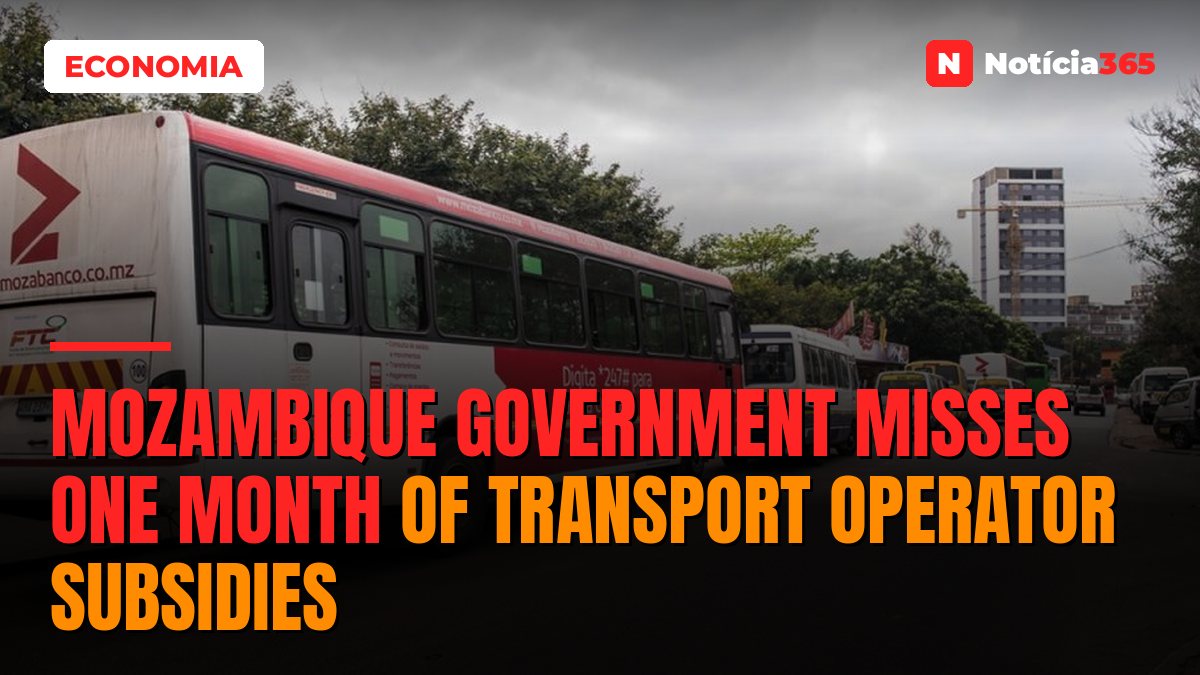

The Mozambican government still owes semi-collective passenger transport operators in the Maputo Metropolitan Region one month of subsidy payments — covering July — under a support scheme designed to offset higher operating costs following a sharp rise in fuel prices.
The Agência Metropolitana de Transportes (AMT), cited by Jornal Notícias, confirmed that the subsidy, originally planned to run for three months, was suspended after only two monthly payments, having proved financially unsustainable. The development has paved the way for a review of public transport fares.
Iracema Mascarenhas, AMT’s administrator for technical affairs, said the subsidy was intended to ease the burden on operators but the government was unable to guarantee continuity of payments.

“The subsidy for semi-collective transport operators was implemented to relieve operating costs following the fuel price increases. However, it became unsustainable, to the point where the government was only able to pay for two months,” she said.
Mascarenhas added that a fare adjustment, currently under negotiation with operators affiliated to the Federação Moçambicana das Associações dos Transportadores Rodoviários (Fematro), could be announced within days, once consensus is reached.
The fare revision will be accompanied by enforcement measures, coordinated with the Municipal Police, to combat the overcharging of passengers above established tariffs and the shortening of routes. The AMT also plans to use passenger complaints to identify potential irregularities.
The government recently acknowledged that it may discontinue road transport subsidies, warning of the difficulty of sustaining support measures indefinitely in the face of rising fuel costs. The position comes as operators push for fare increases, citing worsening operating and vehicle maintenance costs.
According to the spokesperson for the Council of Ministers, Inocêncio Impissa, the prolonged conflict in the Middle East and disruptions to oil shipments through the Strait of Hormuz have undermined expectations, and warned that maintaining subsidies for an indefinite period risks becoming fiscally untenable.
Pressure on fares intensified following the fuel price increase on 7 May, when diesel prices rose 45.5% and petrol prices climbed 12.1%.
Between April and May, the country faced supply difficulties, with long queues at fuel stations, restrictions on fuel sales, and a reinforced police presence at some service stations.
In September, Fematro had already warned of a possible proposal to raise tariffs by 20 meticais, citing financial difficulties stemming from rising operating costs and unpaid subsidies.
Despite acknowledging the possible end of support measures, the government has yet to announce a definitive decision or a timeline for their withdrawal. Any fare revision remains subject to assessment by the competent authorities.
Source: Diário Económico
Original article: https://www.diarioeconomico.co.mz/?p=554758