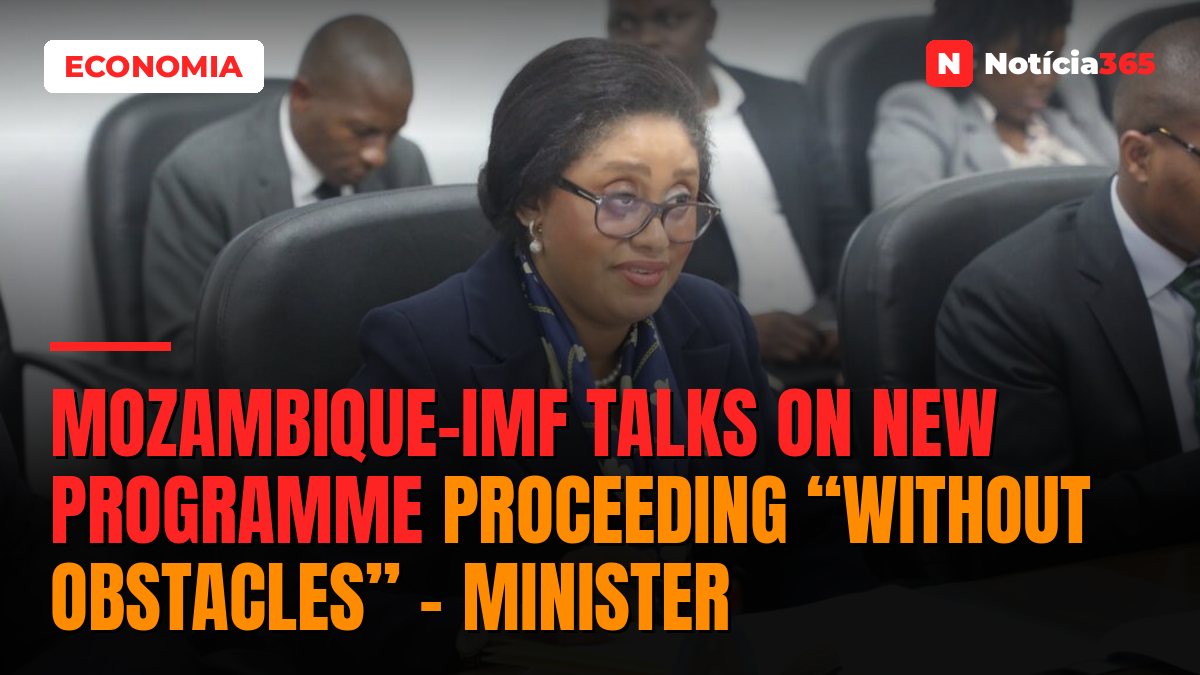
The Mozambican Government said today that negotiations for a new programme with the International Monetary Fund (IMF) were proceeding without significant obstacles to reaching an agreement by the end of the year.
In an interview with Lusa in Bangkok during the IMF and World Bank annual meetings, Mozambique’s Minister of Finance, Carla Loveira, said the process was progressing satisfactorily.
“We can say that we are moving forward (…) with significant steps. On Mozambique’s side, we have provided all the information required by the International Monetary Fund and have also presented the Mozambican Government’s political commitment,” she said.
According to the minister, the talks fall within the Government’s objective of strengthening macroeconomic stability, fiscal discipline and good governance.
Carla Loveira added that a new IMF mission was scheduled for November or early December, which she considered crucial to the progress of the negotiations.
Asked about the reforms advocated by the IMF to ensure debt sustainability and correct fiscal and external imbalances, Carla Loveira said the Government was committed to a fiscal consolidation plan.
According to the minister, the programme is based on modernising revenue collection, controlling public expenditure, improving debt management, strengthening social protection and promoting monetary and exchange-rate stability.
The plan also includes measures to improve the business environment and strengthen transparency and the fight against corruption.
“It is a robust plan; it covers all the dimensions necessary for macroeconomic stability, greater fiscal discipline and good governance,” she maintained.
On the shortage of foreign currency, the minister refused to link the negotiations with the IMF directly to a possible devaluation of the metical.
“The first need is to ensure more in-depth reflection to identify the circumstances the country may be experiencing that have led to some shortage of foreign currency,” she explained, adding that the IMF and the World Bank would provide technical assistance to the Bank of Mozambique to assess how the foreign exchange market operates and identify any additional measures.
The minister also highlighted that, compared with the same period last year, the foreign currency available on the Mozambican market had increased by more than US$500 million (€445.5 million).
Among the planned initiatives is the operationalisation of a Bloomberg platform designed to improve monitoring of the supply and demand for foreign currency in the financial system.
The consolidation plan also includes measures to improve the business environment, accelerate investment in sectors considered strategic, such as energy, transport, agriculture, agro-industry and tourism, and strengthen mechanisms for transparency, combating corruption and preventing money laundering.
The minister also defended Mozambique’s decision to repay around US$700 million in debt to the IMF ahead of schedule.
“We believe that the debt should be recorded in the State Budget rather than in the monetary accounts,” she said.
According to Carla Loveira, the decision will make it possible to structure future financing more appropriately and improve the interpretation of the monetary accounts.
The IMF estimates that Mozambique’s real gross domestic product (GDP), following a contraction of 0.2% in 2025, will grow by 1% in 2026 and accelerate to 2% in 2027.
The projections put Mozambique’s growth below the average of 4.5% forecast for sub-Saharan Africa in both years.
The IMF also forecasts average annual inflation of 5.6% in 2026 and 6.8% in 2027, following an estimated 4.4% in 2025.
Regarding the external accounts, the IMF projects a current account deficit equivalent to 41% of GDP in 2026, followed by a reduction to 37.8% in 2027.