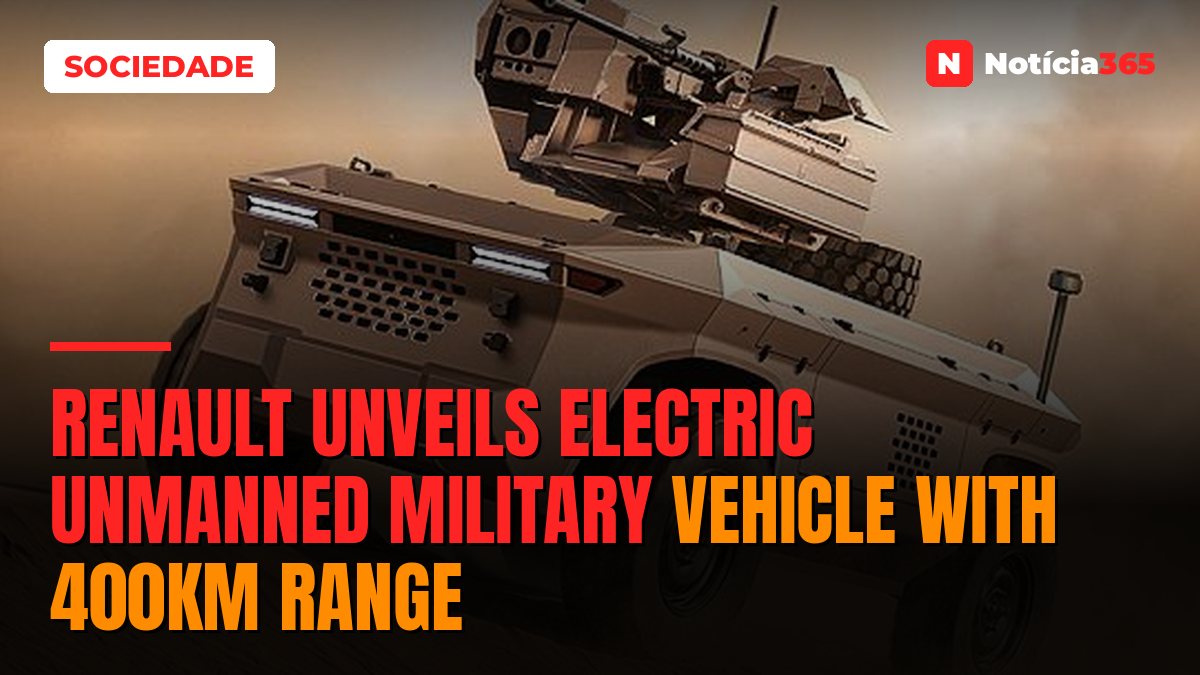

French automotive group Renault has unveiled an electric unmanned vehicle designed for military and civilian operations in high-risk environments, developed in partnership with Belgian industrial group John Cockerill. Named the Forefront Concept, the platform is expected to offer a range of approximately 400 kilometres and a payload capacity of up to one tonne, enabling remote mission execution and reducing the exposure of military personnel in conflict zones.
Similar in size to a small city car, the all-terrain vehicle was developed to support operations in dangerous or hard-to-reach locations. Planned applications include the transport of equipment and supplies, casualty evacuation, surveillance and reconnaissance, combat support, and the detection and neutralisation of drones.
The platform may also be deployed in civilian missions, including the protection of sensitive infrastructure such as industrial facilities and nuclear power plants, as well as civil protection operations.
The Forefront Concept is fitted with two electric motors, four-wheel drive and four-wheel steering, features that enhance manoeuvrability on rough terrain. Electric propulsion also enables quieter operation, an advantage in missions requiring discretion.
According to the manufacturers, the vehicle is expected to achieve a range of approximately 400 kilometres, which can be extended through a range-extension system.
Although designed for remote operation, the Forefront integrates an architecture that will allow autonomous driving capabilities to be developed. Renault is responsible for the mobility platform and its future industrialisation, while John Cockerill handles the development of remote control systems, autonomy functions, and military equipment integration.
The modular structure allows the vehicle to be adapted to different missions, including the installation of surveillance systems, drone detection and countermeasure equipment, and a remotely operated weapon station.
One of the project’s key features is the use of components already employed in the automotive industry, which account for approximately 70 per cent of the platform’s parts. According to Jean-Luc Maurange, chief executive of John Cockerill, this approach could reduce development and production costs to roughly one tenth of initial estimates, while also facilitating large-scale manufacturing.
The strategy seeks to leverage Renault’s automotive production expertise, using proven components and existing supply chains to accelerate the development of equipment for the defence industry.
The project emerges against a backdrop of growing use of unmanned military systems, particularly in the war in Ukraine, where the intensive presence of drones has heightened risks for military personnel and increased demand for solutions capable of executing missions without direct human intervention.
Beyond military applications, those involved acknowledge that the Forefront could also be used in demining operations, disaster response, logistics, and intervention at high-risk industrial facilities.
Developed with input from the French Armed Forces, the vehicle is expected to participate in exercises and operational trials in the coming weeks to assess its performance and refine the platform’s capabilities.
Despite the announced potential, the Forefront Concept remains in a development and validation phase, with no production start date or commercial price yet disclosed.
Source: Diário Económico
Original article: https://www.diarioeconomico.co.mz/?p=559590