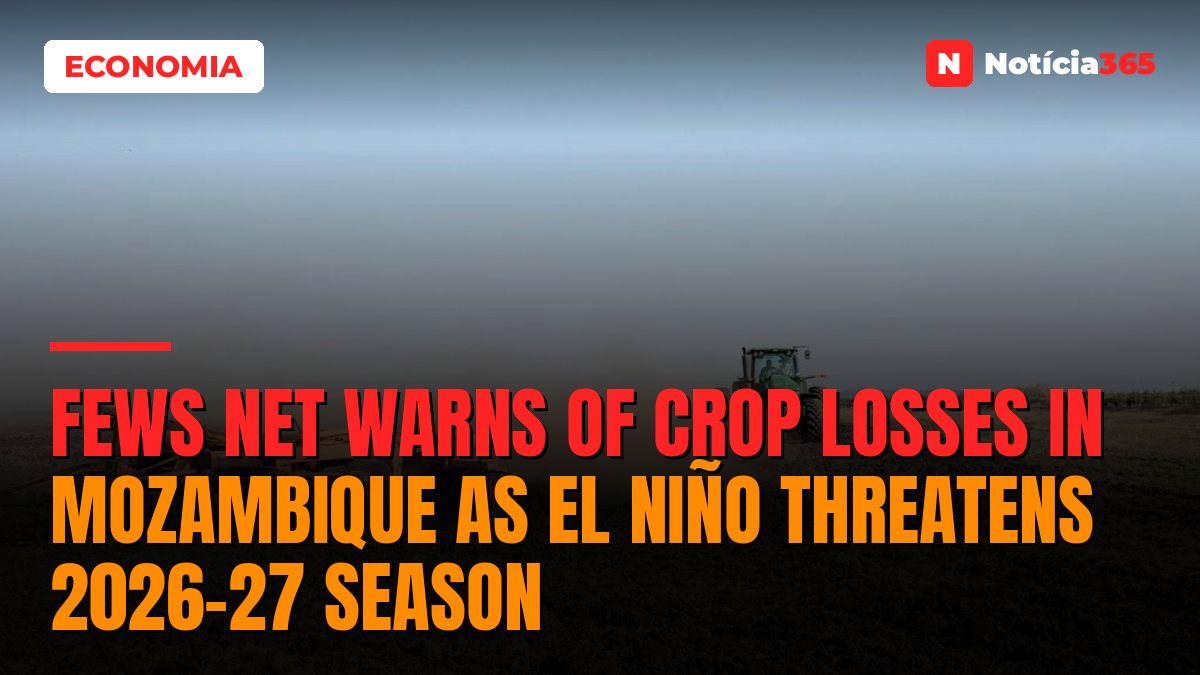

The Famine Early Warning Systems Network (FEWS NET) warned on Monday (9) of the risk of agricultural production losses in Mozambique during the 2026-27 growing season, citing forecasts of above-normal temperatures and below-average rainfall. The combination of these factors could compromise crop development, increase water demand, and deepen food insecurity in several regions of the country.
According to FEWS NET’s latest regional monitoring report, cited by Lusa, much of southern Africa is expected to experience above-average temperatures between October 2026 and April 2027, in a context shaped by the El Niño climate phenomenon, which is historically associated with reduced precipitation across the region.
The organisation explains that the combination of elevated temperatures and insufficient rainfall could intensify soil moisture loss, increase crop water requirements, and hamper agricultural production. “Above-normal temperatures are expected for much of the region between October 2026 and April 2027,” the document states, adding that “combined with rainfall deficits, higher temperatures will increase evapotranspiration and crop water needs.”

According to FEWS NET, these conditions could exacerbate the effects of a delayed onset of the rainy season and prolonged dry spells, compromising vegetation, pastures, and the availability of water resources critical to agricultural activity. The warning comes as Mozambican authorities already issued two heat wave alerts in November for the southern part of the country, with temperatures exceeding 40 degrees Celsius.
“FEWS NET is an international early warning network for food crises, funded by the United States, which monitors the evolution of climatic conditions, agricultural production, markets, and food security in vulnerable countries, including Mozambique.” — FEWS NET
The report also points to the strengthening of the El Niño phenomenon, whose influence could extend into the early months of 2027. According to the organisation, the probability of a strong episode persisting remains above 80%, a scenario historically associated with below-average rainfall across large parts of southern Africa.
Despite the unfavourable outlook for the upcoming agricultural season, current vegetation conditions vary across Mozambique’s regions. In the south of the country, vegetation cover remains in conditions considered well above average, reflecting the favourable rainfall recorded during the 2025/2026 growing season and rains observed in recent months.
Conditions are less favourable, however, in the central and northern regions, where FEWS NET identifies below-average vegetation levels and acknowledges the possibility of further deterioration should forecasts of insufficient rainfall be confirmed. Risks are particularly elevated for the period between December 2026 and February 2027, which corresponds to the typical peak of the rainy season, when water availability is critical for crop growth and development.
The document also notes that soil moisture levels remain above average in some areas of central and southern Mozambique, reflecting the positive effects of the previous growing season, while certain areas of the northeast present below-normal conditions.
On water resources, the organisation highlights signs of recovery in strategic regional infrastructure, noting that the Cahora Bassa reservoir recorded a significant increase in storage levels throughout 2026, following the effects of drought in previous years.
The latest warning follows a FEWS NET report released in October estimating that between 1.5 million and 1.99 million Mozambicans could require urgent food assistance by April 2027. The organisation notes, however, that good harvests recorded in 2026, household food reserves, and the relative stability of prices could help mitigate the effects of the difficulties anticipated for the upcoming growing season.
Source: Diário Económico
Original article: https://www.diarioeconomico.co.mz/2026/11/09/negocios/agronegocios/fews-net-alerta-para-risco-de-quebras-na-producao-agricola-devido-a-seca-e-ao-calor/