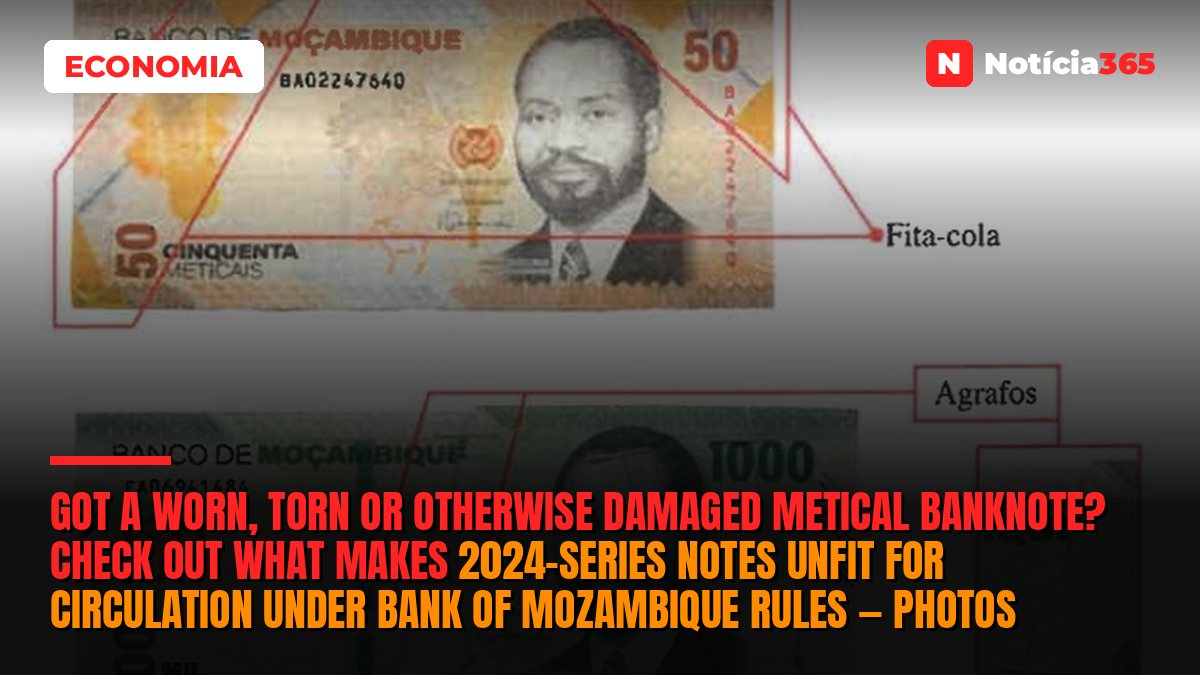
- Ever wondered whether that worn, torn or stained metical note in your wallet is still fit for circulation? You don’t need to work in a bank to find the Bank of Mozambique’s guidelines useful. Although the rules are aimed at financial institutions and professional cash handlers, they offer a handy way to understand what makes a 2024-series banknote – or, for that matter, one from an earlier series – fit or unfit for circulation.
The Bank of Mozambique will withdraw from circulation banknotes from the 2024 series that are in poor condition, under a set of rules approved in July of this year and published on the central bank’s website on Friday, 6 November.
In the Circular No. 01/OEF/2026 of 12 June – Sorting criteria for 2024-series metical banknotes, the central bank explains that it has established criteria to guide banks and other financial institutions in identifying banknotes from the 2024 metical series that are fit or unfit for circulation.
“Credit institutions and financial companies which handle cash in the course of their activities, as well as entities professionally engaged in verifying the authenticity and quality of banknotes and handling them on behalf of those institutions, must sort metical banknotes according to the quality verification criteria set out in the circular,” the document reads.
According to the circular, banknotes will be assessed according to criteria such as dirt, discolouration, stains, graffiti, tears, holes, burns, shrinkage, creasing and loss of parts of their surface.

Screengrab: Banco de Moçambique
The rules stipulate that banknotes bearing writing, drawings, stamps or other markings that significantly alter their visual appearance must be considered unfit for circulation.
Banknotes with tears measuring four millimetres or more, holes larger than six square millimetres, burns, heat-induced deformation or those that have been reconstructed using glue, adhesive tape, staples or other materials must also be withdrawn.
Banknotes that are excessively crumpled, have suffered significant colour loss or are missing parts of their surface beyond the limits established by the regulator will also no longer qualify for circulation.

Screengrab: Banco de Moçambique
On the other hand, banknotes with minor folds, folded corners or slight marks may remain in circulation, provided they retain their essential identification and authenticity features.
The Bank of Mozambique notice also establishes rules for the valuation of mutilated banknotes, providing for full or partial reimbursement of their face value, depending on the area of the banknote that remains intact and whether its authenticity can be verified.
The new rules apply to the 2024 series, introduced in June of that year and currently circulating alongside the other metical banknote series.

Screengrab: Banco de Moçambique
According to its 2025 financial statements, the Bank of Mozambique spent 3.055 billion meticais (€41 million) on the production of banknotes and coins that year, 13% less than the 3.512 billion meticais (€47.1 million) recorded in 2024, when the new family of banknotes and coins was introduced.
The central bank’s annual report also states that banknotes and coins in circulation totalled 74.9 billion meticais (€1.005 billion) at the end of 2025, 12.2% less than the 85.3 billion meticais (€1.145 billion) recorded a year earlier, reflecting an apparent normalisation following the increase associated with the introduction of the new series.
When presenting the new currency, the then Governor of the Bank of Mozambique, Rogério Zandamela, explained that central banks tend to review banknotes and coins in circulation periodically to adapt them to new design and security requirements, as well as other contextual considerations.
According to Zandamela at the time, the 2024 series retained the 1,000, 500 and 200 metical banknotes in paper and the 100, 50 and 20 metical banknotes in polymer. For coins, the 20-centavo and five-centavo denominations were withdrawn, while the remaining denominations currently in circulation were retained.