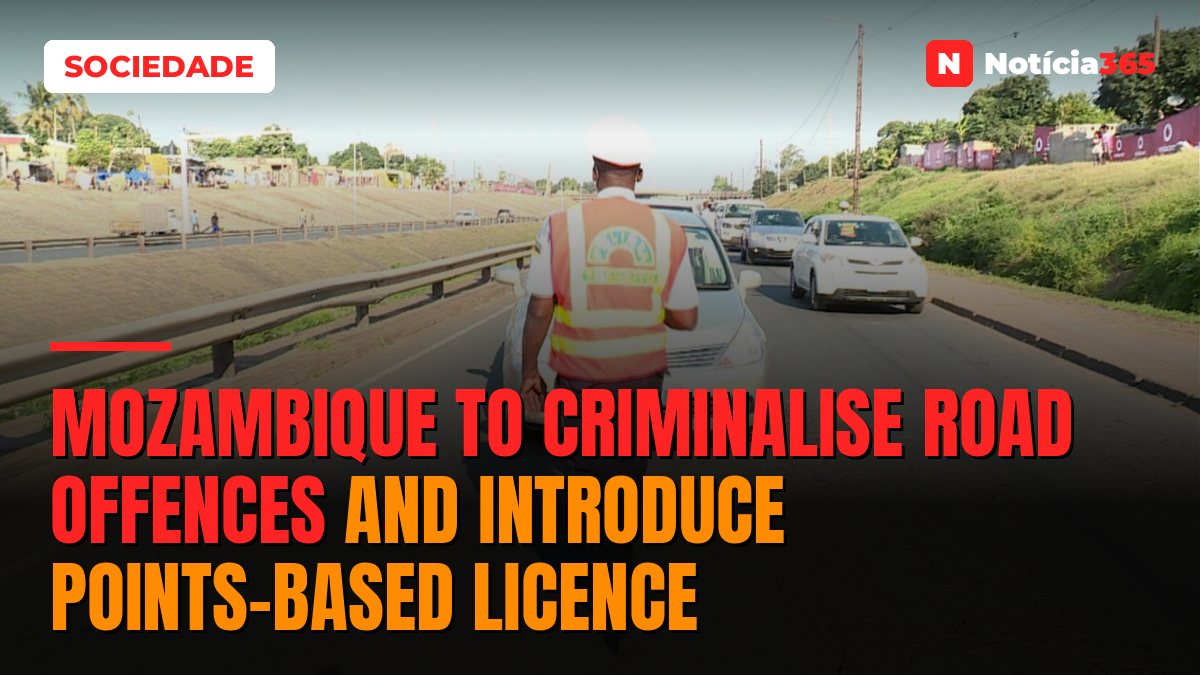

The Mozambican government is set to overhaul the country's Road Code, introducing criminal penalties for certain offences, harsher sanctions for high-risk behaviour, a points-based driving licence system, and the installation of road surveillance cameras. The revision was authorised on Friday, 6 November, by the Assembleia da República — 15 years after the legislation was last updated.
The legislative authorisation bill was approved by consensus and in final form by all four parliamentary benches. According to Minister of Transport and Logistics João Matlombe, cited by Lusa, the revision aims to align road traffic rules with national and international traffic dynamics, technological advances, and the demands of sustainable mobility.
Among the principal changes envisaged is the criminalisation of practices currently treated only as administrative infractions. Matlombe cited the intentional blocking of roads by motorists as one of the behaviours that should carry criminal consequences, given the economic and social harm caused, including restricted access to hospitals.

The government also intends to increase penalties for high-risk behaviour, notably driving under the influence of alcohol or psychotropic substances and the use of mobile phones while driving. The minister said the measure seeks to strengthen motorist accountability and counter the normalisation of traffic violations on the country's roads.
The revision further provides for the introduction of a points-based driving licence system, which will allow authorities to track each driver's infraction history and monitor the frequency of violations. The government presents the mechanism as an instrument to reinforce road discipline and contribute to a reduction in traffic accidents.
In the area of enforcement, the government plans to install surveillance cameras to capture infractions committed on public roads, including speeding and failure to observe traffic lights at intersections. According to Matlombe, the electronic devices should improve driver accountability and the efficiency of road law enforcement.
The new legal framework is also expected to cover rules for new vehicle categories, including electric vehicles, and to strengthen oversight of drivers of public passenger and freight transport — particularly on long-distance routes — in a context of high road fatality rates.
In the same parliamentary session, the legislature approved a legislative authorisation for the government to create an Aeronautical Register Code, designed to strengthen legal certainty for operators, financial institutions, and lessors, as well as to facilitate access to financing and aeronautical leasing, thereby creating conditions for the renewal of the national fleet.
Parliament also approved the Merchant Marine and Related Activities Bill, which seeks to consolidate and update sectoral regulations, strengthen maritime safety and regulatory capacity, and broaden the tax base — particularly in the oil and gas industries. Matlombe noted that over the past 18 months, coastal shipping capacity has grown from two to 18 vessels, removing from the roads cargo that would otherwise have required approximately 14,000 trucks.
Source: Diário Económico
Original article: https://www.diarioeconomico.co.mz/2026/11/06/desenvolvimento-2/codigo-da-estrada-governo-preve-criminalizacao-de-infraccoes-e-introducao-da-carta-por-pontos/