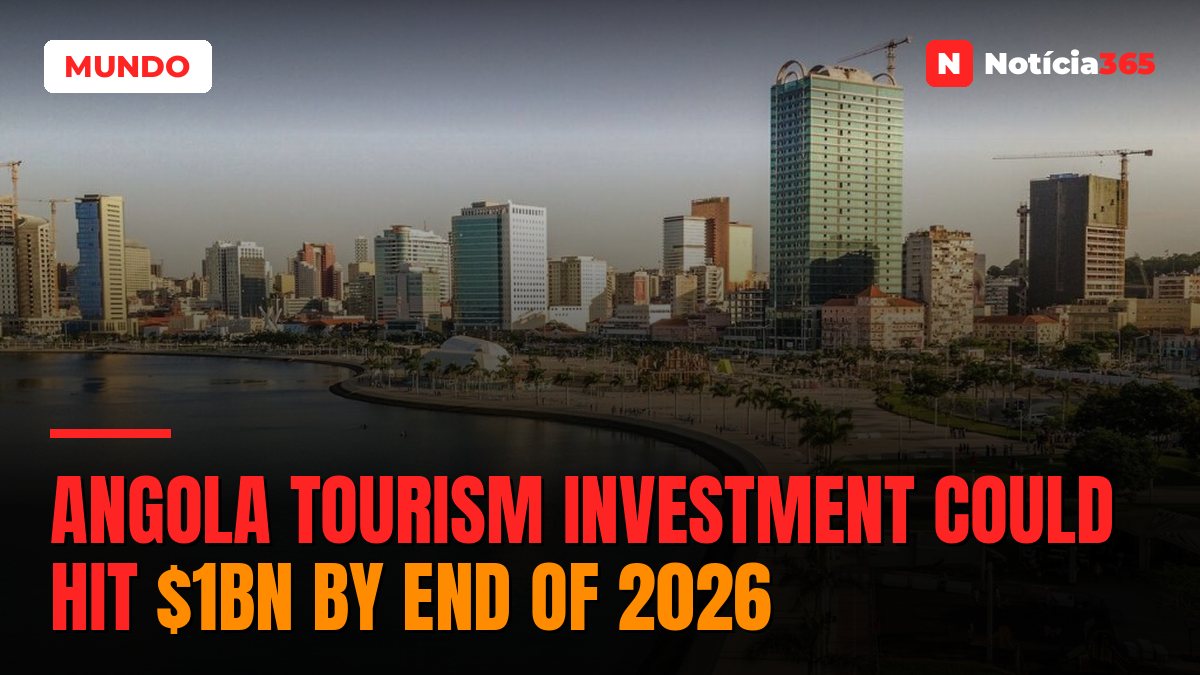

The Angolan government expects investment in tourism support infrastructure to reach one billion dollars by the end of 2026, provided that new projects currently under review by the Presidency of the Republic receive approval. The funding is intended to improve access and visitor conditions at the country’s main tourism zones, as part of a broader strategy to diversify the economy and attract international visitors.
According to the Secretary of State for Tourism Asset Management and Concessions, Josemar Afonso, investment completed so far this year already stands at approximately $850 million. “We have more proposals awaiting approval at the level of the Presidency, and once we have that approval, we can quickly reach the billion,” the official said, quoted by Lusa.
The funds are earmarked for the construction and improvement of essential infrastructure, including roads, sanitation systems, water supply, electricity, and telecommunications, with the aim of facilitating access to tourism destinations and enhancing visitor reception conditions. Priority zones include Cabo Ledo, Okavango, and Serra da Leba.
The remarks were made during the World Travel Market (WTM), an international tourism trade fair held in London, where Angola participated with a dedicated stand promoting the destination, bringing together hotels, tour operators, and destination management companies.
Having previously featured at the International Tourism Trade Fair in Madrid in January, Angola is seeking to raise its profile among British market operators and position itself as a destination with strong potential in nature, adventure, and discovery tourism segments. The strategy draws on the country’s landscape diversity, encompassing deserts, beaches, nature parks, and safari areas.
“Camping in the Namibe desert is a unique experience,” Afonso said, adding that tourism has gained prominence within the country’s economic diversification strategy and represents one of the activities with the greatest potential to attract private investment and generate new business opportunities.
In 2025, Angola received more than 223,000 international tourists, a 28% increase compared with 2022, according to government data. Despite this growth, the executive has set a more ambitious target, aiming to reach one million international tourists.
“We have a target we call the psychological barrier — that is where we need to get to. The faster we get there, the better,” Afonso said, while acknowledging that “this will not happen overnight”.
Currently, around 70% of international arrivals are linked to business travel, while 23% correspond to leisure tourism — a distribution that underscores the importance of broadening the mix of reasons to visit the country.
On accommodation capacity, President João Lourenço revealed during his State of the Nation address in October that Angola has 1,577 hotel establishments and other lodging units, offering more than 31,000 rooms.
In 2025, the average occupancy rate reached 72% in hotels and 75% in other accommodation establishments. According to figures presented by the head of state, the sector generated revenues of $667 million and contributed to the creation of more than 9,000 jobs.
To stimulate growth in tourism activity, the government has adopted measures to facilitate the entry of foreign visitors, including visa exemptions for citizens of 99 countries, subject to applicable conditions.
Angola currently has direct air connections to destinations including Portugal, France, Cabo Verde, Maputo, Cape Town, Johannesburg, and Qatar, and is seeking to increase visitor capture from European markets — notably Germany, Switzerland, and Spain. Improving air connectivity forms part of the country’s international promotion strategy and efforts to enhance accessibility.
Despite the positive outlook, Afonso acknowledged that obstacles to Angola’s emergence as a recognised tourism destination persist, particularly around security perceptions among potential visitors.
“We still have to overcome questions about security in Angola. It clearly shows there is educational work we still need to do,” the official said.
Infrastructure improvement, enhanced accessibility, and international destination promotion thus remain the core priorities for increasing Angola’s tourism attractiveness and expanding the sector’s contribution to economic diversification.
Source: Diário Económico
Original article: https://www.diarioeconomico.co.mz/2026/11/06/mundo/angola/angola-investimento-no-turismo-pode-atingir-mm-ate-final-de-2026/