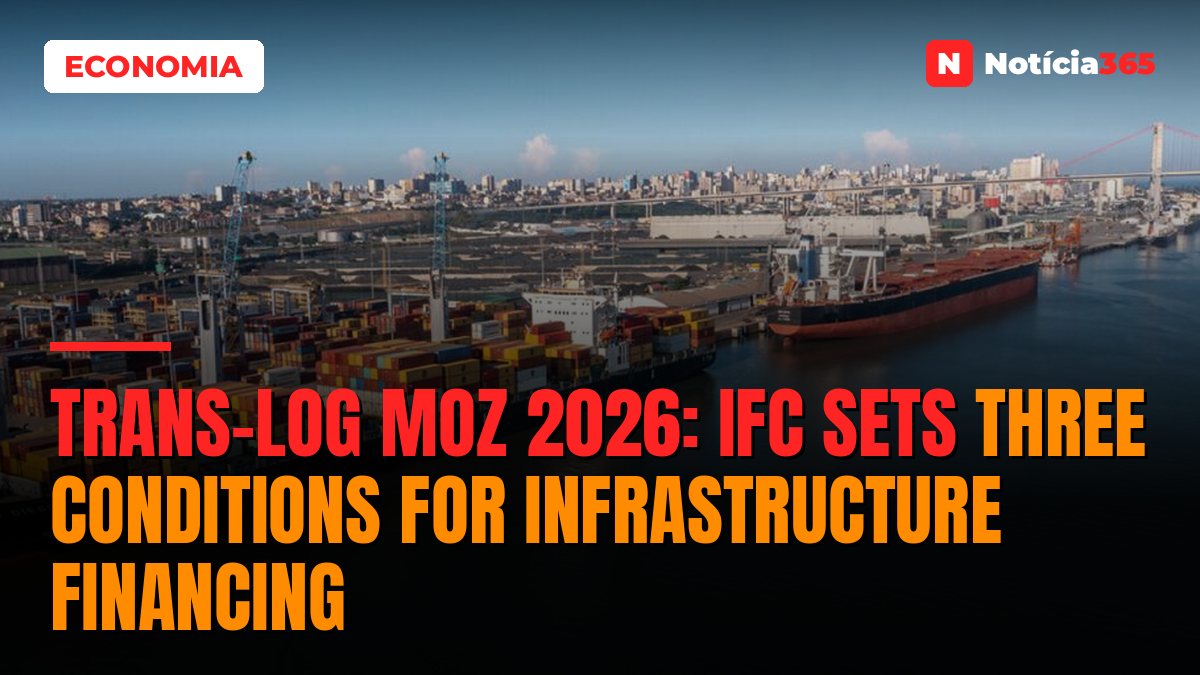

Economic and financial viability, sponsor capacity, and contract quality are three fundamental conditions for financing infrastructure projects, Tiago Almeida, Senior Investment Officer at the International Finance Corporation (IFC), the World Bank Group's private sector development arm, said on Thursday, 5 June, in Maputo.
Almeida was speaking on the second and final day of the Mozambique Transport and Logistics Investment Forum and Exhibition (TRANS-LOG MOZ 2026), where he outlined the principal criteria that financiers apply when assessing projects.
The first condition is the existence of a sound economic and financial foundation demonstrating the viability of the investment. "There must be an economic and financial rationale for the project," he said.

The second relates to the experience and technical and financial capacity of project sponsors. According to Almeida, financial institutions seek to ensure that the entities responsible for project execution have the resources and competencies to address difficulties that may arise, particularly in complex projects with long development timelines.
Beyond delivering the investment itself, sponsors must be capable of finding solutions to problems and guaranteeing operational continuity.
Contracts and Risk Allocation
The third criterion concerns the contractual conditions underpinning the investment, particularly in concessions and public-private partnerships. Almeida highlighted "the bankability of the contracts that give substance to the project" — that is, their capacity to offer conditions that allow financing to be secured.
In road infrastructure, the concession contract is of particular importance in defining responsibilities and distributing risks between the public and private sectors. For the IFC representative, those risks should be assigned to the entities best placed to manage them.
Almeida also drew a distinction between financing new projects and supporting companies or concessions already in operation. The latter benefit from an operational track record and revenue-generation history that can facilitate assessment by financiers.
He explained that the IFC participates in both the financing of new concessions and the refinancing of existing projects, adapting financial structures to the characteristics and needs of each investment.
The remarks were made during the panel "Financing Projects: Brownfield Assets and Greenfield Projects", moderated by João Guirengane of Standard Bank Mozambique. The term greenfield refers to projects developed from scratch, without an operational history.
Also participating were Jacob Flewelling of the United States International Development Finance Corporation (DFC); Fadzai Musoni of Africa50; Adriano Lamas of Opaia; and Alex Van Niekerke of Trans African Concessions (TRAC). The debate focused on infrastructure financing mechanisms and the allocation of risks associated with investments.
The inaugural edition of TRANS-LOG MOZ concluded on Thursday after two days of discussions in Maputo. The event brought together government officials from Southern African countries, investors, financial institutions, and economic operators to discuss infrastructure financing, the modernisation of logistics corridors, the reduction of transport costs, and regional trade integration.
Source: Diário Económico
Original article: https://www.diarioeconomico.co.mz/?p=558797