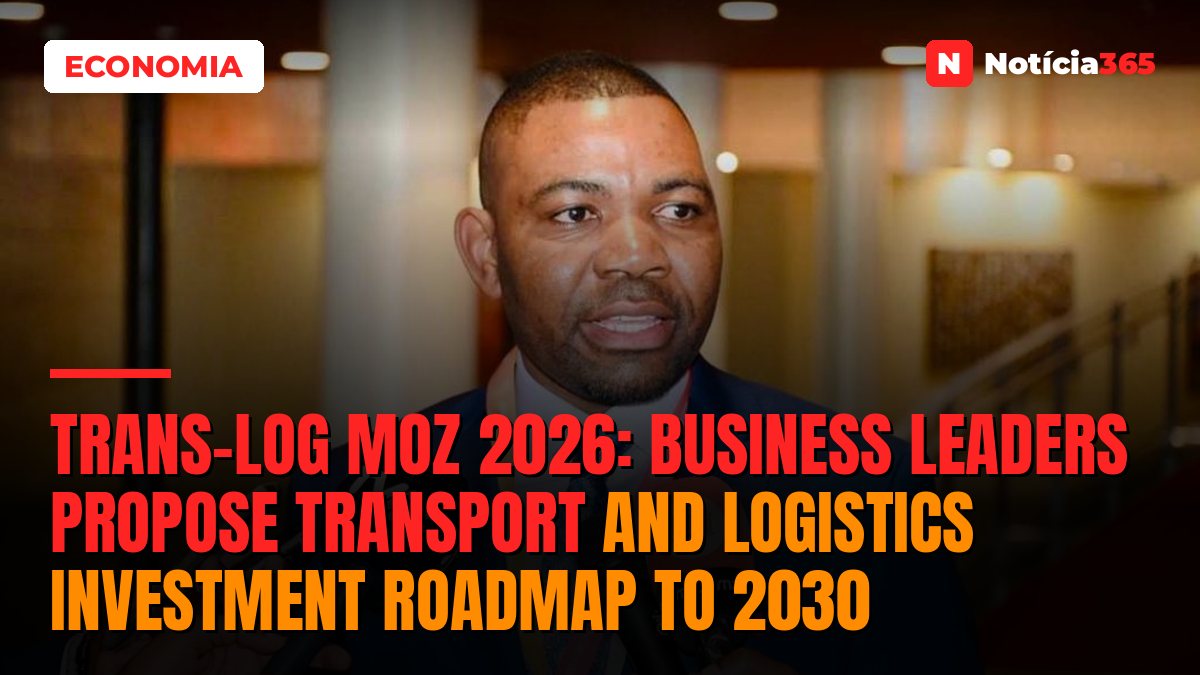

The Confederation of Economic Associations of Mozambique (CTA) on Wednesday called for the development of a transport and logistics investment roadmap covering the period 2026 to 2030, encompassing priority projects, operational cost-reduction targets and project-execution monitoring mechanisms. The proposal is aimed at strengthening the competitiveness of Mozambique's logistics corridors and advancing trade integration across southern Africa.
The initiative was presented by CTA Vice-President Onório Manuel during the inaugural edition of the Mozambique Transport and Logistics Investment Forum and Exhibition (TRANS-LOG MOZ 2026), which brought together government representatives, investors, financial institutions and business operators from several countries in the region.
According to Onório Manuel, the roadmap should define investment priorities, identify the principal bottlenecks affecting transport corridor operations and establish commitments to improve connectivity between Mozambique and regional markets. "With a portfolio of priority projects, identification of key constraints and cross-border integration commitments," he said, arguing for the creation of a strategic instrument to guide investments through to 2030.
Onório Manuel noted that modernising the sector requires significant financial resources at a time when public financing is constrained, making greater participation by private investors and development partners indispensable. He argued it is "fundamental to create conditions to attract private capital and development financing, with sustainable business models and appropriately distributed risks."
For the CTA representative, one of the central challenges is converting investment opportunities into economically viable projects, underpinned by technical and financial studies that facilitate access to funding and enable implementation. "To investors, we need to present projects with identified demand, feasibility studies, capital requirements and clear operating models. We need fewer announced projects and more projects ready for financing and execution," he stressed.
CTA Targets Logistics Cost Cuts and Regional Trade Integration by 2030
Among the priority areas, the CTA highlighted the development of logistics terminals, grain storage infrastructure, cold-chain facilities, port equipment and rail transport, as well as the adoption of digital solutions to improve cargo management and tracking. Onório Manuel also underscored the importance of strengthening the connectivity of the Maputo, Beira and Nacala corridors to markets in the southern African interior through more efficient rail and road infrastructure and improved border procedures.
In his view, the competitiveness of logistics corridors depends not only on cargo-handling capacity but on the efficiency of the entire transport chain, from ports through to destination markets. "The competitiveness of a corridor is not measured solely by the capacity of its port, but by the cost, time and predictability with which goods reach their final destination. A railway with available capacity does not resolve the problem if equipment is lacking on the other side of the border," he explained.
The CTA therefore considers it essential that the roadmap include concrete logistics cost-reduction targets, measures to simplify border procedures and mechanisms to monitor project execution, ensuring that investments translate into tangible efficiency and competitiveness gains for businesses and for the national economy.
The inaugural edition of TRANS-LOG MOZ 2026 is taking place on 4 and 5 November at the Joaquim Chissano International Conference Centre in Maputo, bringing together government officials from southern African countries, domestic and international investors, financial institutions, business leaders and sector operators. The event is promoting discussions on investment opportunities, the modernisation of ports, roads and railways, infrastructure financing and the removal of trade barriers, with the objective of reinforcing Mozambique's competitiveness and deepening regional economic integration.
Source: Diário Económico
Original article: https://www.diarioeconomico.co.mz/?p=558147