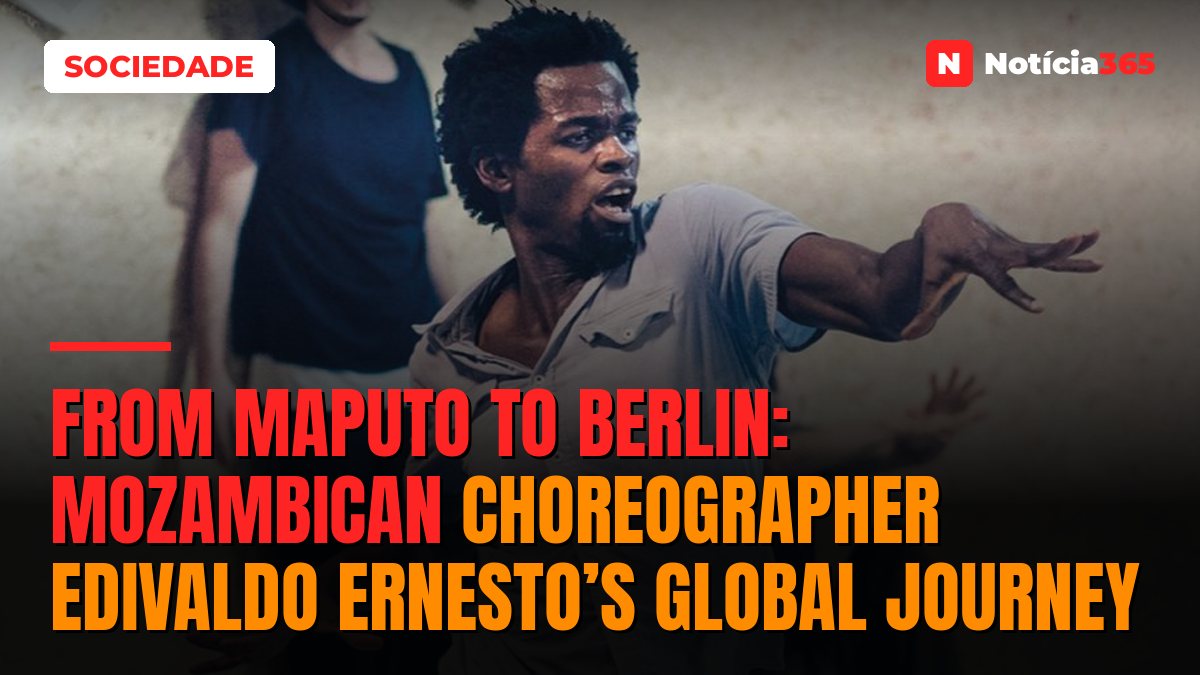

Edivaldo Ernesto speaks about Maputo with the detachment of someone who has lived abroad for nearly two decades — but also with the closeness of someone who never entirely left the city behind. It was in the Mozambican capital that he began dancing in 1997, and it was through traditional Mozambican dance that he found the path that would take him to Europe: first for short-term engagements, and later to Berlin, where he has built an international career as a dancer, choreographer, teacher and improvisation specialist.
Today, his name spans several countries. He spent years working with German company Sasha Waltz & Guests, collaborated with artists including David Zambrano, Hauschka and Marco Blaauw, created the solos Tears and Brace, and developed the Depth Movement and Next Level workshops, which he teaches across different parts of the world. Reaching Berlin also became an opportunity to carry the name and culture of his birth country with him.
From the Roots to the World

Edivaldo’s career began in traditional dance, with groups Tsemba and Ussoforal, before moving into contemporary dance with the company Esculturas Humanas. He also took part in a choreographic development programme between Maputo and Lisbon — an experience that brought him into contact with other artists and different ways of thinking about movement.
In 2005, he participated in the DanceWEB Scholarship at the ImPulsTanz festival in Vienna. Before settling in Germany, he also gained professional experience in Brussels and Amsterdam through his work with David Zambrano.
He arrived in Berlin in 2007. The city represented a new challenge but also a shift in how he approached his profession. For the first time, he encountered a far more intensive work routine — around six hours of training per day, five days a week. “It was something new for me. I had to adapt, observe, learn other languages, other ways of working and, at the same time, bring what I carried from Mozambique,” he said.
He worked with German company Sasha Waltz & Guests and collaborated with artists including David Zambrano, Hauschka and Marco Blaauw.
The adaptation extended well beyond the studio. The climate, food, communication and even the way people form social relationships were all challenges. But there was one space where Edivaldo felt at ease. “In the studio, when I was with my colleagues training and dancing, I felt happy, calm, protected. I felt at home,” he told E&M.
From Maputo to the Major Stages
Berlin ultimately became his primary professional base. Since 2007, Edivaldo has worked with the international contemporary dance company Sasha Waltz & Guests, taking part in numerous productions as both a permanent company member and a guest artist. Over the years, his credits have included Travelogue-Twenty to Eight, Continu, Metamorphoses, Sacre, In C, Beethoven and For The Time Being.
His collaboration with David Zambrano — Venezuelan dancer, choreographer and dance teacher — also became a central part of his trajectory, both as a performer and as an assistant.
His career, however, was no longer confined to performance. In 2015, he presented Tears, his first choreographic solo, which toured stages across Europe, Asia and South America, including France, Hong Kong, Italy, Germany, Greece and Brazil.
Five years later, the project I Can’t Breathe, developed with trumpeter Marco Blaauw, delivered another milestone: Edivaldo was named Best Performer by the jury of the Italian Danza & Danza Awards in 2020.
In 2022, he premiered Brace at the Kalamata Dance Festival in Greece. The piece delves into questions of memory, ancestry and identity, seeking to examine what existed before the borders that divided the peoples of the region. The production subsequently toured European and Brazilian stages.
For Edivaldo, these creations are also a way of seeking answers about his own origins. “In Brace, I tried to understand who we were before the borders, before those divisions in southern Africa. I wanted to look at our knowledge, at our ways of living and at what we carry with us today,” the choreographer said.
The Body Does Not Forget Maputo
Edivaldo does not see the distance as a rupture with Mozambique. “It made me value far more the fact of being Mozambican — our culture, our customs and our roots.” That influence also surfaces in his work. The movements he learned in childhood, the rhythms, the ways of living together and even certain memories find their way into the body, often without being reproduced literally. “The body holds things that our consciousness cannot always explain.”
“I do not want to be invited simply because I am African or Mozambican. I want my work and my artistic language to be the reason for the invitation. My origins are part of me, but they cannot be the only reason.”
A Path Back
Edivaldo remains acutely aware of the difficulties faced by artists in Mozambique and believes that Mozambican dance has real talent but continues to struggle to find the conditions it needs to develop. It was partly with that concern in mind that he created the M.A.P.A. project, in partnership with Projecto Utopia in the Mafalala neighbourhood of Maputo. The initiative provides training and an exchange of experiences with Mozambican dancers, an attempt to build bridges between artists working inside and outside the country.
Edivaldo acknowledges that he does not know whether he will ever return to live in Mozambique permanently. He says, however, that he would do so gladly if he found the conditions to continue developing his work and collaborating with local artists. In the meantime, he continues to travel, teach and create.
His schedule takes him across different countries and, in 2026, he returned to European and Brazilian stages while also bringing Depth Movement — his contemporary dance methodology — to new training spaces.
If he could take just one element of Mozambican culture to an international stage, his choice would be the Limbondo — not simply to reproduce its movements, but to explore its cadence, its music and its complexity.
Source: Diário Económico
Original article: https://www.diarioeconomico.co.mz/?p=553060