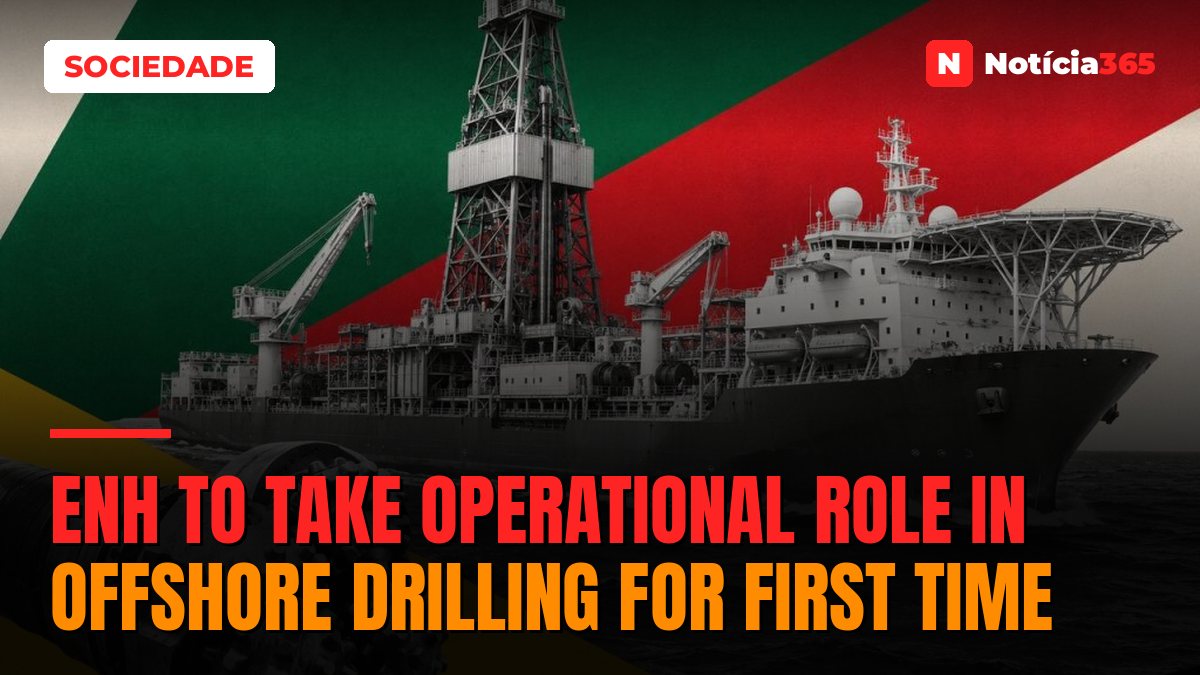

Mozambique’s state hydrocarbon company, Empresa Nacional de Hidrocarbonetos (ENH), will for the first time participate directly in offshore natural gas drilling operations, as part of the development campaign for the Coral Norte FLNG project in Block 4 of the Rovuma Basin, in Cabo Delgado province. The operation is expected to last approximately ten months and marks a significant step forward in the involvement of Mozambican companies and technicians in hydrocarbon exploration and production activities.
“ENH’s participation in this campaign represents a significant milestone for the development of local content in Mozambique’s hydrocarbon sector. For the first time, a Mozambican company with meaningful national participation is taking on a direct operational role in offshore drilling,” the state oil company said in a statement released on Monday, 2 November.
The campaign will be carried out through ENH-Saipem Drilling Company, a joint venture formed by ENH and Italian drilling and hydrocarbon services specialist Saipem, with the partnership designed to strengthen national participation in offshore drilling activities. The operation is a key step in the development of the Coral Norte project, which is led by Italian energy company Eni and is scheduled to come on stream in 2028. The SAIPEM 12000 drillship will be deployed to carry out the drilling work.

The vessel will be used in the development of the floating liquefied natural gas (FLNG) production unit, which will be installed in the northern section of the Coral reservoir. The operation will allow ENH to participate directly in offshore drilling activities, reinforcing its presence in one of the most technically demanding phases of the hydrocarbon industry.
“For the first time in the company’s history, we will be at the forefront of upstream offshore operations, which will be an opportunity to consolidate our technical capacity through the active involvement of Mozambican technicians in drilling activities,” said Rudêncio Morais, Chairman of ENH’s Board of Directors, as quoted in the statement.
According to Morais, participation in the campaign is part of ENH’s broader strategy to develop the technical and operational competencies needed to gradually assume greater responsibilities along the hydrocarbon exploration and production value chain.
Coral Norte expected to lift combined output to 7 million tonnes per year
ENH believes its involvement in the campaign will help consolidate national competencies and increase the participation of Mozambican technicians and companies in specialised operations. The initiative is also expected to contribute to strengthening the country’s technical capacity and to positioning national operators within regional and international energy markets.
The Coral Norte FLNG project follows on from the development of Coral Sul FLNG, the first floating liquefied natural gas unit to enter production in the Rovuma Basin, which had exported 135 LNG cargoes by August 2025. Once the new unit becomes operational, the combined production capacity of the Coral Sul and Coral Norte projects is expected to reach approximately 7 million tonnes per year.
Beyond expanding LNG production capacity, ENH expects Coral Norte to create new opportunities for domestic companies, promote the training of specialised technicians, and strengthen the value chain of Mozambique’s energy sector. The company believes the project could broaden national participation in an industry that demands high levels of technical expertise and financial capacity.
The concession contract for Block 4 was signed in 2006. Between 2011 and 2014, significant natural gas resources were discovered in the Coral, Agulha, and Mamba Complex reservoirs, estimated at approximately 2,400 billion cubic metres of gas. In the block, ENH represents the Mozambican state with a 10% stake, while KOGAS and XRG each hold 10%. The remaining 70% belongs to Mozambique Rovuma Venture (MRV), which operates the block and comprises international hydrocarbon companies Eni, ExxonMobil, and China National Petroleum Corporation.
Source: Diário Económico
Original article: https://www.diarioeconomico.co.mz/?p=557457