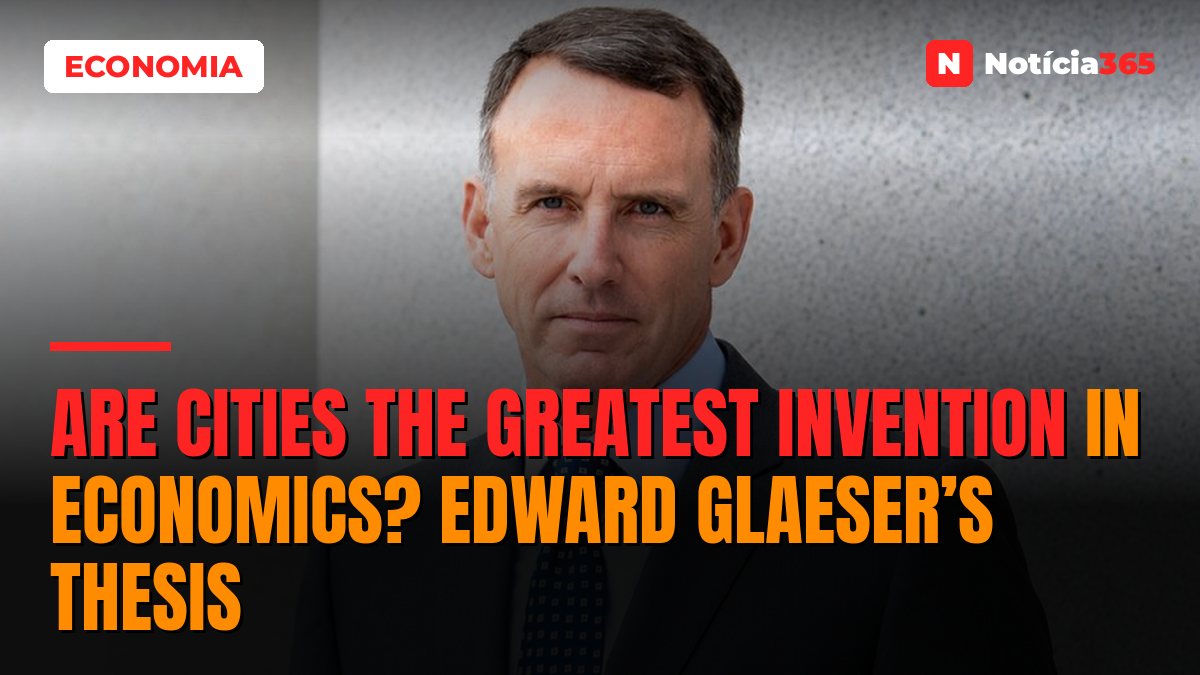

Cities are often seen as a consequence of economic development. Edward Glaeser argues the opposite: cities are what produce it. On World Cities Day, observed on 31 October, that thesis carries particular relevance for a country like Mozambique.
For decades, economics sought to explain national growth through the abundance of natural resources, industrialisation, international trade, or macroeconomic stability. Edward Glaeser proposed a shift in perspective. Rather than looking at countries, he turned his attention to cities as ‘the greatest invention in economics’. His conclusion: cities are not a consequence of wealth but one of its primary causes.
A professor of economics at Harvard University, Glaeser has spent more than 30 years studying cities — their economic history, demographics, and microeconomic dynamics. He has cross-referenced productivity, education, wages, employment, housing prices, and mobility. Rather than formulating abstract theories, he set out to understand why cities such as New York, London, or Singapore thrive while others, with comparable resources, fall into decline. The result — ‘Triumph of the City’, published in 2011 — is the most visible output of decades of research. His central thesis can be distilled into a single sentence: cities make people more productive because they bring talent into proximity.

Proximity Creates Wealth
Economics has always attributed value to technology, capital, and labour. Glaeser added a fourth element: proximity. When thousands of people live, work, and interact within the same urban environment, knowledge circulates faster, problems are solved more rapidly, and opportunities multiply. Economists refer to this as ‘agglomeration economies’.
When thousands live, work, and interact in the same urban space, knowledge flows faster and opportunities multiply.
Glaeser demonstrated empirically that workers in larger cities tend to be more productive and to earn higher wages than workers with comparable qualifications in dispersed, less densely populated areas.
Contrary to earlier assumptions, technology has not eroded this advantage. Even in the internet age, the most innovative companies continue to cluster in major urban centres. The reason, Glaeser argues, is straightforward: no digital platform can fully replicate human contact, the informal exchange of ideas, or the trust that grows from physical proximity.
Does Growth Drive Development — or Not?
In recent decades, Mozambique has experienced an accelerated process of urbanisation. This movement mirrors a broader global trend: Africa is projected to record the highest urban growth of any continent over the coming decades.
One of the virtues of Glaeser’s thinking is that it avoids a common misconception — that urban growth is synonymous with development. Cities can grow in population and built area without growing in productivity. They can concentrate poverty rather than wealth. Urban growth produces benefits only when it is accompanied by effective institutions, functioning markets, education, mobility, legal certainty, and private investment.
In Maputo, mobility remains constrained, access to adequate housing is insufficient, the informal economy predominates, and urban expansion continues without coherent planning. One of Glaeser’s most consistent findings is that the most successful cities are those that invest most heavily in people.
The Value of Quality Schools
Analysing decades of data on American cities, Glaeser found that the level of educational attainment in a population was one of the strongest indicators of a city’s capacity to develop. Human capital proved more decisive than geographical location, natural resources, or industrial specialisation.
This conclusion also offers a different lens through which to view Mozambique. Improving roads, ports, and transport infrastructure is essential — but insufficient. Without quality schools, cities will struggle to prosper.
Source: Diário Económico
Original article: https://www.diarioeconomico.co.mz/?p=553003