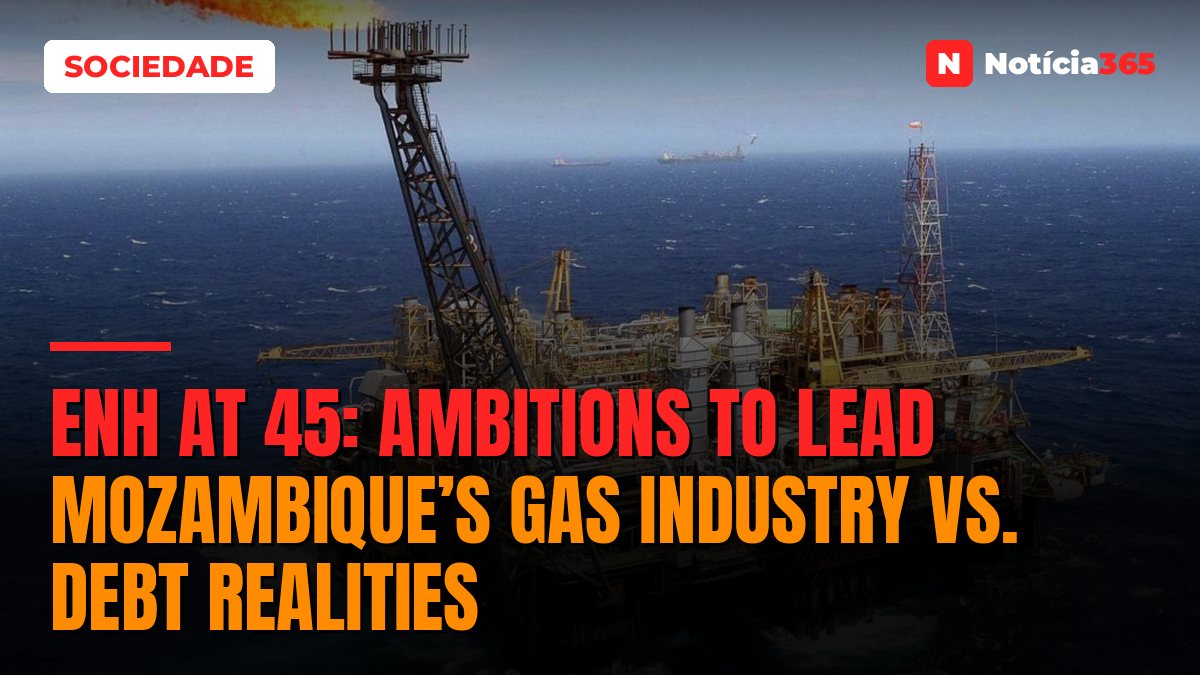

Empresa Nacional de Hidrocarbonetos (ENH), Mozambique’s state hydrocarbon company, is marking 45 years of existence at a moment when the country is beginning to convert its natural gas reserves into production and exports. Yet significant challenges remain: financing the state’s project stakes, generating revenues, expanding domestic energy access, and integrating local companies into the industry. Created to represent the state’s interests in the sector, ENH has evolved from promoting exploration to participating in major development projects — but the extent to which that presence has translated into tangible national wealth remains an open question.
Founded on 3 October 1981, ENH marked its 45th anniversary this year. As part of the celebrations, its leadership met with journalists on 30 October to present the institution’s track record and discuss industry challenges. The briefing, led by Board Chairman Rudêncio Morais, provided data on gas distribution, fuel production, local business development, and regulatory changes. Cross-referenced with information from the International Monetary Fund (IMF), the Centre for Public Integrity (CIP), the Centre for Democracy and Human Rights (CDD), and Sasol, these elements help assess the results of four and a half decades of activity.
From ENH’s Creation to Commercial Production
ENH was established through Decree No. 18/81 of 3 October, with responsibilities covering the exploration, development, production, transportation, processing, and distribution of petroleum and natural gas. In 1997, under Decree No. 39/97 of 12 November, it was reconstituted as a public enterprise with administrative and financial autonomy. That year, Issufo Anuar Dauto Abdulá was appointed Board Chairman and was reappointed in 2001. The reorganisation marked an important step in the company’s institutional consolidation.
Under Issufo Anuar Dauto Abdulá’s leadership, ENH advanced to the commercial development phase of natural gas. In October 2000, the government, ENH, and Sasol reached agreements on the development of the Pande and Temane fields in Inhambane province and the construction of a pipeline to supply both domestic and South African markets. Companhia Moçambicana de Hidrocarbonetos (CMH) was also established to secure Mozambican participation in the venture. With the development plan approved in 2002, commercial production began in 2004, making Pande and Temane the country’s first major operating gas project.
In 2007, Nelson Arnaldo Ocuane assumed the ENH chairmanship, a position he held until 2015. During this period, national participation in the Pande and Temane project gained new dimensions. In 2008, CMH opened part of its capital to Mozambican investors through the sale of 10% of ENH’s previously held stake, allowing more than 1,300 domestic shareholders to participate. In April 2009, shares began trading on the Mozambique Stock Exchange (BVM). Meanwhile, gas discoveries in the Rovuma Basin in 2010 opened new prospects for the sector while significantly raising the technical and financial demands placed on the company.
The expansion of Temane’s operations also marked this period. In May 2012, a project was inaugurated that increased gas processing capacity from 120 to 183 million gigajoules. In an interview published in 2014 by The Business Year magazine, Nelson Arnaldo Ocuane stated that ENH’s ambition was to become an operator in the domestic oil and gas sector within a 20-to-40-year horizon — a declaration that underscores one of the institution’s central challenges: moving from a position of project participation to the capacity to independently conduct exploration and production operations.
Rovuma: Major Discoveries, Greater Financial Commitments
In August 2015, Omar Ossumane Momade Mithá succeeded Nelson Arnaldo Ocuane as ENH chairman. His tenure, which ended in January 2020, coincided with preparations for the major liquefied natural gas (LNG) projects in the Rovuma Basin. In Area 4, the Coral Sul development plan was approved in 2016, followed by the Final Investment Decision (FID) in 2017. In Area 1, the Mozambique LNG project led by TotalEnergies reached its FID in 2019. That same year, the Rovuma LNG development plan was approved. ENH thus became a participant in international-scale ventures requiring billions of dollars in financing.
In January 2020, Estêvão Tomás Rafael Pale assumed the company’s chairmanship. During his tenure, which ended in August 2024, Coral Sul began production in 2022, enabling Mozambique to make its first LNG exports from the Rovuma Basin. In contrast, the Mozambique LNG project was suspended in 2021 due to the deterioration of security conditions in Cabo Delgado. This period was also marked by the launch of ENH’s new corporate identity in 2022 and by the need to manage the financial commitments associated with its stakes in the major projects.
In August 2024, Ludovina Bernardo became the first woman to assume the chairmanship of ENH’s Board of Directors, succeeding Estêvão Tomás Rafael Pale. Her tenure ended in May 2026, when Rudêncio Morais took the helm after having served as administrator for the exploration and production portfolio. The transition occurred as the country sought to accelerate Rovuma projects, develop new infrastructure in Inhambane, and increase gas utilisation in the domestic market.
The succession of leaders thus tracks the industry’s different phases: from institutional construction to commercial production, through to the expansion into the Rovuma Basin. Yet the scale of the projects has not been matched, in equal measure, by the development of the company’s technical and financial capacity. ENH continues to rely on international operators to lead its principal ventures — a limitation acknowledged by the current chairman.
“ENH is a company that still needs to assert itself, to present itself with confidence and be technically capable of discussing different issues with partners,” said Rudêncio Morais. He stressed the need to accelerate projects and strengthen the confidence of staff and partners. “Time is what we do not have,” he emphasised. His remarks indicate that, despite 45 years of existence, the company is still working to consolidate the competencies needed to take a more active role in the industry’s technical and operational decisions.
The Weight of Debt and the Long Wait for Revenues
ENH’s participation in the major Rovuma Basin projects has brought financial commitments far exceeding those of the Pande and Temane experience. Unable to fully fund its stakes from its own resources, the company relies on financing mechanisms whose repayment depends on future project revenues. An IMF report published in January 2026 estimated that ENH’s debt associated with LNG projects reached $4.6 billion at end-2024, equivalent to 19.6% of Mozambique’s gross domestic product (GDP). Of that amount, approximately $1.6 billion was linked to Coral Sul and $3 billion to the Golfinho-Atum project. The IMF also warned that the debt could reach $20 billion by 2045.
The challenge lies not only in the volume of debt but also in the share of revenues that will be required to service it. According to the IMF, approximately 80% of ENH’s net revenues from Golfinho-Atum could be directed to debt service, a proportion that could reach 90% for the Coral and Rovuma projects. This means that a stake in a project does not necessarily translate into funds immediately available to the state. Rudêncio Morais explained that under the previous model, ENH began bearing the costs of its participation following approval of the development plan. “The company would come in, conduct exploration, discover gas, complete the assessment and approve a development plan. From that point on, ENH paid for everything that was investment,” he said.
The consequences of this model were also examined by CIP, CDD, and Oxfam Mozambique in a study published in May 2026 titled “What Does Rovuma Gas Really Generate for Mozambique?”, which assessed the financial returns to the state from the Coral Sul FLNG project. The research estimates that Mozambique could collect between $4 billion and $5 billion over the project’s 27-year lifespan, depending on international gas prices — far below publicly stated projections of approximately $77 billion. The study also highlighted ENH’s debt of approximately $1.3 billion incurred to finance its stake in the project, noting that capital and interest repayments could limit net dividend distributions to the state until 2034.
The Pande and Temane experience offers a different reference point, given that the project has been in production for several years. At Sasol’s annual media briefing held in Inhassoro in August 2026, Mateus Mosse, the company’s Director of Corporate Relations, revealed that its operations had contributed more than $670 million in taxes to the state over the past 11 years. Over the same period, CMH’s stake in the venture generated more than $800 million. The company, established by ENH in 2000, currently holds a 25% participating interest in Pande and Temane, while Sasol Petroleum Temane holds 70% and the International Finance Corporation (IFC) holds 5%.
“ENH is a company that still needs to assert itself, to present itself with confidence and be technically capable of discussing different issues with partners.” — Rudêncio Morais
These results demonstrate that gas projects can generate both tax revenues and corporate returns, though the two sources of benefit must be distinguished. In 2025, Sasol Petroleum Temane contributed approximately $76 million in taxes, of which $66 million came from corporate income tax. By October of the same year, the state had received 159 million gigajoules of gas, both in kind and in cash, under the Petroleum Production Tax. Since 2013, approximately 297 million gigajoules — equivalent to 7.1 billion cubic metres — have been commercialised to supply the domestic market.
ENH’s own financial results also provide an indication of its revenue-generating capacity. According to the 2025 Annual Report, published in July 2026, the company recorded a net profit of more than 2 billion meticais, up from 1.7 billion meticais the previous year, representing growth of 18%. During the same period, it paid 1 billion meticais in dividends and 690 million meticais in taxes to the state. The improvement was attributed to increased revenues and natural gas sales and higher dividends from the Pande and Temane subsidiaries.
The Gas Reaching the Domestic Market and the Limits of Distribution
Beyond the major export projects, ENH is seeking to expand gas utilisation in the domestic market. During the media briefing, Rudêncio Morais disclosed that the company counts approximately 4,000 piped gas connections in Inhambane, covering areas such as Govuro, Vilankulo, and Inhassoro. In Maputo city and province, more than 1,000 households are connected to the network, alongside industrial units, restaurants, and hotels. The company intends to expand this infrastructure, particularly in communities close to production and processing sites, enabling more households and businesses to access natural gas.
Expansion, however, remains constrained by installation costs and the limited coverage of distribution networks. According to Rudêncio Morais, a connection in Maputo city can require an investment of between 100,000 and 200,000 meticais, including road excavation, reinstatement, and pipe installation. To reduce the burden on consumers, ENH absorbs the installation costs, charging a connection fee lower than the actual investment. “It is ENH itself that pays for the installation,” he explained. The chairman argued that market growth depends on building scale: “You need to create the scale.”
A further area of expansion is the use of compressed natural gas (CNG) for vehicles. According to data presented by ENH, between 3,000 and 4,000 vehicles are already using this fuel. However, the absence of refuelling stations along the main roads limits broader uptake. The company is working with the transport sector to develop solutions for installing supply points at various locations, with the aim of enabling gas-powered vehicles to operate beyond currently served areas and widening the economic uses of this resource.
Local Content: The Promise of Mozambican Business Participation
Transforming natural resources into national wealth also requires the participation of Mozambican companies and workers. In this area, ENH runs business development programmes, including the Link-up initiative, financed by the African Development Bank. According to Rudêncio Morais, the programme covers Sofala, Cabo Delgado, Inhambane, and Maputo, and has selected approximately 150 companies for training in areas including document management, accounting, and certification. Of these, 51 had already completed the certification phase. The company is also working with Banco Comercial e de Investimentos (BCI) to facilitate access to credit for small and medium-sized enterprises (SMEs) that secure contracts but lack the capital to begin work.
Despite these initiatives, the integration of domestic companies continues to face obstacles. Participation in major projects requires international certifications, financial capacity, equipment, and specialised workers, as well as compliance with technical and safety standards. The development of local suppliers therefore needs to keep pace with project timelines. Without these conditions, Mozambican companies risk remaining concentrated in lower-complexity services while higher-value contracts continue to be dominated by international operators.
New Legislation and the Prospect of Strengthening National Participation
The approval of a new legal framework for the sector could alter the terms of ENH’s participation in future projects. During the briefing, Rudêncio Morais explained that the new provisions introduce changes to the financing of the company’s stake, seeking to reduce the costs borne during project development phases. Under the previous model, ENH began assuming the costs of its participation share after the development plan was approved, even when commercial production was still years away — causing interest to accumulate before the company began receiving revenues.
The new legislation also envisages conditions for increasing ENH’s stake in projects. “Now, 15% is the minimum. The law itself states that it can go up to 40% in areas where the existence of commercially viable resources has been confirmed,” Rudêncio Morais explained. He added that in certain direct negotiation scenarios, higher stakes could be agreed. However, an increased equity position will only represent a real advantage if the company has the financial and technical capacity to support the investment, ensuring that greater project presence does not also result in excessive debt exposure.
Transparency and Accountability: The Other Challenge of 45 Years
An assessment of ENH’s track record must also consider transparency in the management of natural resources. In the 2025 edition of the Extractive Sector Transparency Index (ITSE), titled “Selective Opacity: The Extractive Sector Speaks of Social Matters and Falls Silent on Fiscal Ones”, CIP awarded the Mozambican extractive sector an average score of 17.98%, reflecting significant shortcomings in the disclosure of fiscal, financial, and governance information. In the 2023 edition, ENH was classified at the level of complete absence of transparency, with a score of 0%. These results reinforce the need to improve public access to information on stakes, revenues, contracts, and financial commitments.
This requirement is particularly important because ENH represents the state’s interests in an industry with a direct impact on public finances. Accountability must allow monitoring not only of investments and positive results, but also of loans contracted, participation costs, and the share of revenues actually transferred to the state. In this context, the estimates by CIP and CDD on Coral Sul demonstrate the importance of independent analysis of the economic benefits of gas projects, especially when revenue projections diverge significantly from official figures.
Gas exploitation must also contribute to diversifying the economy rather than concentrating development expectations on hydrocarbon exports. The resource can supply energy and raw materials to industry, support power generation, and create opportunities for other sectors, including agriculture and manufacturing. For ENH, the challenge lies in helping to transform gas into a broader source of economic development — one capable of generating productive activity beyond the extraction projects themselves.
45 Years On: Reserves Without Proportional Returns
At 45, ENH has achieved significant milestones — from the start of commercial production at Pande and Temane to participation in Coral Sul and the development of domestic gas infrastructure. The financial results of its subsidiaries demonstrate that Mozambican participation can generate returns, while LNG exports have placed the country in a new position in the international market. Yet the debt burden from major projects, dependence on foreign operators, and limitations in domestic distribution show that the scale of reserves does not, by itself, guarantee proportional benefits for the economy.
Under Rudêncio Morais’ leadership, the company will need to consolidate its technical capacity, accelerate projects, and strengthen its relationships with domestic and international partners. The ambition to increase project stakes must be accompanied by sustainable financing mechanisms, greater operational capability, and transparent resource management. Only then can ENH’s institutional presence be converted into effective participation in the industry’s decisions and returns.
The past 45 years demonstrate that Mozambique has successfully moved from exploration to the production and export of natural gas — but the country still faces the challenge of converting that wealth into lasting economic and social benefits. Between the weight of debt, the need for industrialisation, the expansion of energy access, and the integration of local businesses, ENH’s performance must be measured not merely by the volume of resources discovered or exported, but by the revenues reaching the state, the energy made available to households and businesses, and the opportunities created for Mozambicans. It is in this capacity to transform natural resources into national wealth that the next chapter of the company’s history will be written.
Reporting by Florença Nhabinde
Source: Diário Económico
Original article: https://www.diarioeconomico.co.mz/?p=557222