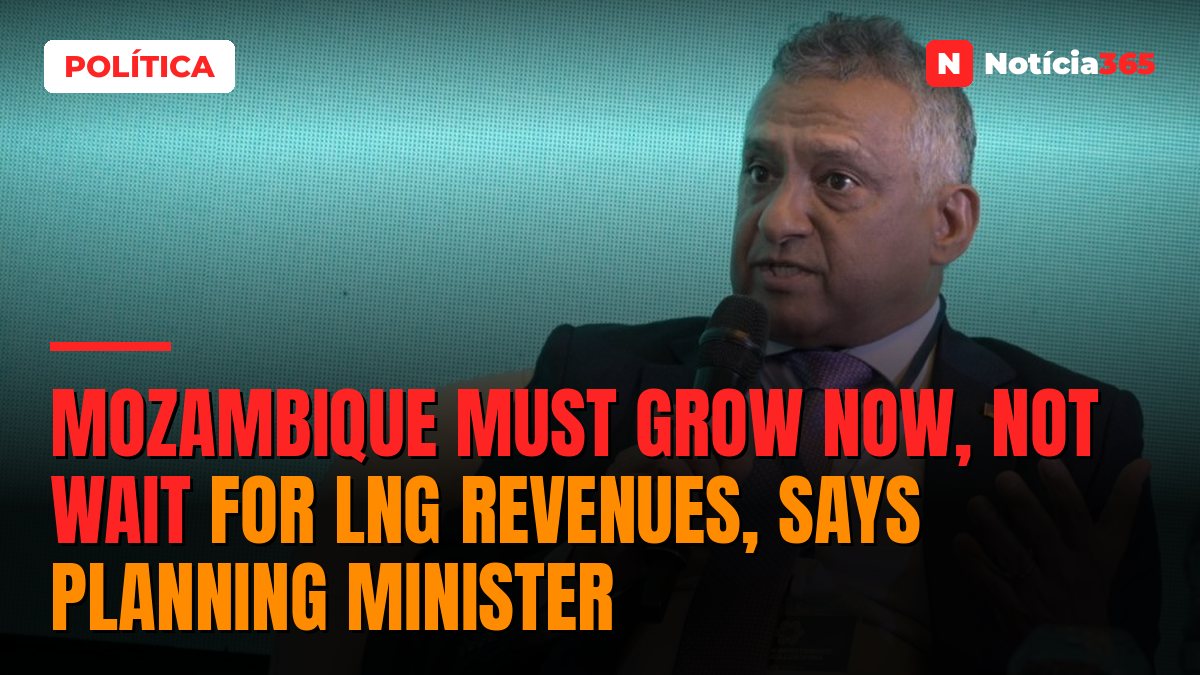

Mozambique’s Minister of Planning and Development argues that natural gas fiscal revenues will not become meaningful until 2029 or 2030, and that the country must in the meantime accelerate economic diversification through agriculture, tourism, logistics and small and medium-sized enterprises.
This is one of the central messages from Salim Cripton Valá, Minister of Planning and Development, in an interview script prepared for Forbes África Lusófona, conducted by Nilza Rodrigues on the sidelines of the II Lusophone Africa Investment Forum. The forum was held on 26 and 27 October on Sal Island, Cape Verde.
Organised by the International Finance Corporation (IFC), a member of the World Bank Group, the event brought together investors, government officials and financial institutions to examine investment opportunities in Portuguese-speaking African countries, with emphasis on development corridors, agribusiness and sustainable tourism.
“LNG fiscal revenues will only become significant from 2029 or 2030,” states the interview script, dated 27 October. Until then, the minister identifies agriculture, tourism, logistics and small and medium-sized enterprises as the key activities to sustain economic growth.

The proposal is to use gas revenues to finance a broader productive base, with domestic companies capable of generating employment, processing raw materials and increasing exports.
“Gas revenues will finance agriculture, industry, tourism and infrastructure — the sectors that create jobs for Mozambicans,” the minister states in the script. “Properly framed within the country’s Development Strategy, natural gas can be a powerful driver of economic diversification, not its competitor.”
Rovuma Basin Investments Approach US$50 Billion
According to data compiled for the interview, natural gas projects in the Rovuma Basin represent combined investments of approximately US$50 billion, spread across ventures at different stages of execution.
Coral Sul has been producing since 2022, and Coral Norte is expected to come on stream in 2028. The Mozambique LNG project, led by TotalEnergies, has resumed construction and stands at approximately 40% completion, according to the script. The Rovuma LNG project, led by ExxonMobil, is preparing to advance.
The document also notes that contracts awarded by Mozambique LNG to local companies are estimated at more than four billion dollars. For the government, Mozambican participation must translate into national suppliers, skilled workers and productive capacity that remains in the country.
The Local Content Law and the new Mining and Petroleum laws are presented as instruments to strengthen that participation. The guiding criterion for this approach is stated directly: “In every project, the question to ask is what remains in the country.”
Avoiding a Repeat of the Mozal Experience
The Mozal experience is one of the examples the minister uses to explain the limitations of large investments when they are not accompanied by the development of a national industrial supply chain.
According to the script, over 25 years of operation at the aluminium smelter, very few Mozambican companies managed to process the aluminium produced domestically. The government intends to prevent the same outcome with natural gas.
The concern is to ensure that energy investments create opportunities for other economic activities — from the supply of goods and services to industrial processing, technical training and the development of Mozambican enterprises.
“A resource has a price,” the minister summarises, “and the value it generates is what a country knows how to do with it.”
Agriculture, Tourism and SMEs at the Centre of Diversification
Agriculture occupies a central place in this strategy, given its capacity to generate income and reduce dependence on food imports. The script notes that three-quarters of the employed population works in agriculture, forestry and fishing.
The Government’s Five-Year Programme aims to increase the number of agro-processing infrastructure units from 18 to 101, and storage facilities from 316 to 1,257 by 2029. The objective is to create conditions for producing, preserving and processing a greater share of domestic output.
In tourism, the document highlights growth of 14.5% in the hospitality and restaurant sector in the second quarter of 2026, presenting it as one of the activities capable of delivering results in the short term.
Micro, small and medium-sized enterprises — which, according to the script’s data, account for approximately 95% of Mozambique’s business landscape — are another priority. Access to financing, however, continues to constrain their expansion: credit to the private sector fell from 19.3% to 16.5% of GDP between 2023 and 2025.
The government points to the Mutual Guarantee Fund, the Local Economic Development Fund and other financing instruments as means of supporting businesses. These are expected to be complemented by the Mozambique Development Bank, due to begin operations in 2027, with a mandate to finance medium- and long-term investments.
“The Development Bank will finance long-return projects in agriculture, industry, energy, tourism and infrastructure, among other strategic areas, that commercial banks do not finance today,” the script states.
This approach forms part of the National Development Strategy 2025–2044. For Salim Valá, the outcome of gas investment should be measured by its capacity to transform the economy and improve living conditions for the population.
“Twenty years from now, the result of the gas cycle should be measured in companies, in income, in good infrastructure, in skilled technicians and in the improvement of family welfare.”
Source: Diário Económico
Original article: https://www.diarioeconomico.co.mz/2026/10/28/oilgas/salim-vala-defende-que-mocambique-deve-crescer-sem-esperar-pelas-receitas-do-gas/