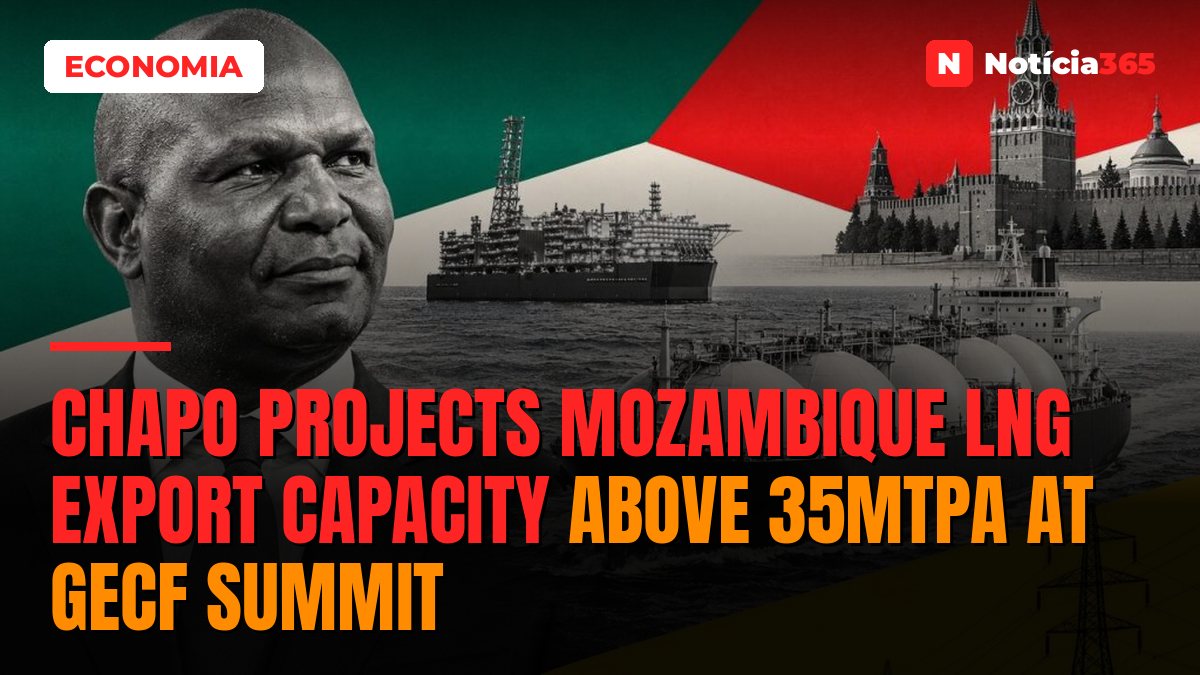

President Daniel Chapo has said Mozambique could reach an annual liquefied natural gas export capacity of more than 35 million tonnes once the large-scale energy projects under development in the Rovuma Basin become fully operational, positioning the country among the relevant producers in the international energy market, according to Lusa.
Chapo made the projection on Tuesday (27) during the 8th Summit of Heads of State and Government of the Gas Exporting Countries Forum (GECF), held in Moscow, Russia, where he highlighted the potential of Mozambique’s energy resources to strengthen the country’s role in the global gas market.
“When these ventures are fully operational in the coming years, Mozambique could reach an export capacity of more than 35 million tonnes of liquefied natural gas per year, establishing itself among the relevant producers in the international market,” Chapo declared.
The president recalled that when Mozambique joined the GECF as an observer in 2022, the country was preparing to begin LNG exports from the Rovuma Basin. He noted that Mozambican gas is now being traded on international markets. “Today, Mozambican gas is already reaching international markets, contributing to the diversification of supply sources and to global energy security,” he said.
Mozambique has three major approved projects for the exploitation of natural gas reserves in the Rovuma Basin, considered among the largest discoveries globally in recent decades. The commissioning of these ventures is expected to allow a gradual increase in the country’s production and export capacity.
As previously reported by Diário Económico, Daniel Chapo has projected between US$50 billion and US$60 billion in investment in the natural gas industry over the next five to ten years.
During his address, Chapo argued that the utilisation of natural resources must go beyond the export of raw materials, contributing directly to industrialisation, the expansion of energy access, and the creation of economic opportunities for Mozambicans. “We want the gas that comes from the depths of our land and our sea to be transformed into energy that lights up Mozambique, bringing light to our schools and health units, producing fertilisers that strengthen agriculture, and generating jobs for our youth and women,” he declared.
According to the head of state, Mozambique is pursuing a shift in economic paradigm, seeking to move from a model centred on natural resource extraction to one oriented towards value addition, industrialisation, and the strengthening of economic sovereignty. In this context, Chapo said it is essential that investments in the gas sector contribute to technology transfer, the training of national professionals, and the development of Mozambican companies.
Chapo also highlighted progress in electricity access, stating that national coverage has risen from 30% in 2018 to 70% currently, with the target of achieving universal access by 2030 remaining in place. At the summit, the Mozambican president called for a just, balanced, and inclusive energy transition, arguing that international financing mechanisms must take into account the differing economic and social realities of developing countries.
For Chapo, the responsible use of natural gas must continue to play an important role in energy security, in complementarity with investment in renewable sources. He also presented four priorities for the sector’s future: greater stability and predictability in the international gas market; technology transfer and the training of national professionals; promotion of investments that ensure the local transformation of resources; and an energy transition capable of reconciling environmental protection with economic development.
The prospect of surpassing 35 million tonnes annually represents a potential export capacity, contingent on the completion and commissioning of the megaprojects, and does not correspond to the volumes currently exported by Mozambique.
Source: Diário Económico
Original article: https://www.diarioeconomico.co.mz/2026/10/28/oilgas/visita-a-russia-pr-anuncia-potencial-de-exportacao-de-35-milhoes-de-toneladas-de-gas/