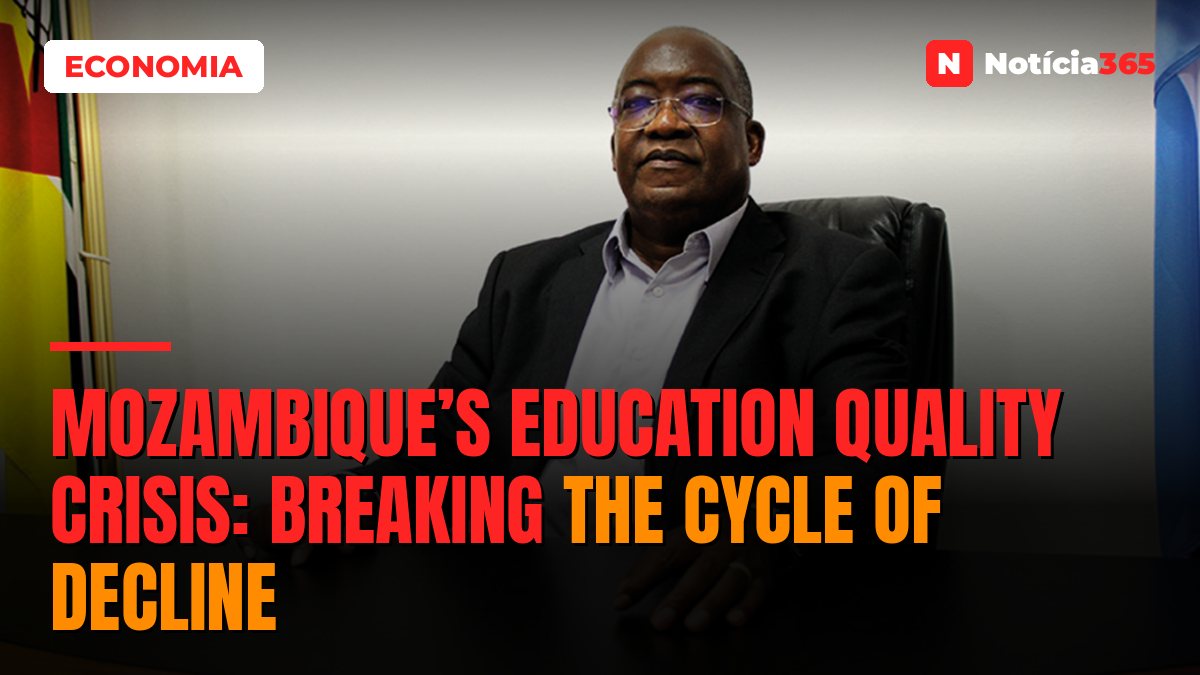

Many of the problems facing Mozambican education are well known. Jorge Ferrão, rector of the Universidade Pedagógica de Maputo and a former minister of education, is pointing to indicators of sharp learning deterioration — and laying out what he believes needs to change.
Ferrão anchors his analysis in two international learning quality indices: the Programme for International Student Assessment (PISA), promoted by the Organisation for Economic Co-operation and Development (OECD), which evaluates young people's ability to understand and apply knowledge in reading, mathematics and science in real-world situations; and the Southern and Eastern Africa Consortium for Monitoring Educational Quality (SACMEQ), which benchmarks countries across Southern and Eastern Africa on core competency attainment.
Declines recorded in SACMEQ reading and mathematics scores suggest that the expansion of school enrolment is not being matched by comparable learning outcomes. The share of pupils achieving an acceptable level in Portuguese fell from 62.7% in 2013 to just 16% in 2023.

In mathematics, the picture is even more alarming. According to data cited by the rector, only 8.4% of pupils reached minimum competency thresholds in 2023. Simply saying that 'education is failing' is not enough, Ferrão argues. What matters is understanding precisely what is failing, by how much, where it has worsened, and what factors explain the deterioration.
Investing Where It Matters Most
Ferrão contends that Mozambique is making a fundamental error by failing to apply an 'educational geography' capable of determining where each metical invested delivers the greatest impact. 'While the district of Namicopo in Nampula has classes of more than 100 pupils, in Matutuíne in Maputo province you cannot fill a class of 30. Yet building a school where demand is low can be easier than responding to the pressure that exists in large urban centres,' he said.
Jorge Ferrão believes the education sector carries an agenda 'far too large' to be managed by a single ministry.
He argues that population concentration must become a key variable in setting investment priorities. This approach would require reversing current logic — first identifying where needs are greatest, and only then directing resources to those areas.
Ferrão rejects the notion that continued growth in school-age population can go on justifying inadequate learning conditions. To accelerate construction, he advocates mobilising companies operating in the country to participate in funding and improving school infrastructure. Responsibility, in his view, should not rest exclusively with the state. Ferrão believes workable collaboration mechanisms with the private sector can be found to address a gap that directly affects the formation of the future workforce.
Creating a Dedicated Body for Basic Education
The former minister of education argues that the sector carries an agenda 'far too large' to be managed by a single ministry, and calls for the creation of a structure devoted exclusively to primary and secondary schooling. The idea is not without precedent — Ferrão cites experiences from South Africa, India, and Brazil.
Learning quality also depends on classroom conditions and the support available to pupils.
Mozambique has thousands of primary and secondary schools, tens of thousands of teachers, and millions of pupils. At the same time, the government structure responsible for education is also required to oversee higher education, culture, and other areas. For Ferrão, this dispersal of responsibility reduces the capacity to concentrate on the system's most fundamental problems.
Speaking to E&M, Ferrão compared the national education system to a sponge that absorbs a great deal but yields nothing when squeezed. Five million children enter the system, but by the third grade only 1.3 million remain. 'The gap is too large to be explained by grade repetition alone,' he said. The question of what happens to the remaining children — whether they are still counted within the system — remains unanswered.
A New Standard for Teaching Careers
Ferrão also argues that 'a national examination is needed for those who wish to become teachers'. His proposal extends beyond the entry point. He advocates a structured teaching career with progression by competency levels, periodic assessment, and continuous professional development, so that teachers maintain and update the skills required throughout their working lives. The question, in his view, should not merely be how many teachers exist, but what kind of teachers are entering classrooms and what mechanisms exist to guarantee their quality.
That accountability must also be reflected in how results are measured. For Ferrão, assessing teacher performance by the number of pupils who pass examinations is insufficient. It is necessary to verify whether pupils have actually acquired foundational competencies — specifically, the ability to read, write, and perform basic mathematical operations.
Source: Diário Económico
Original article: https://www.diarioeconomico.co.mz/?p=552576