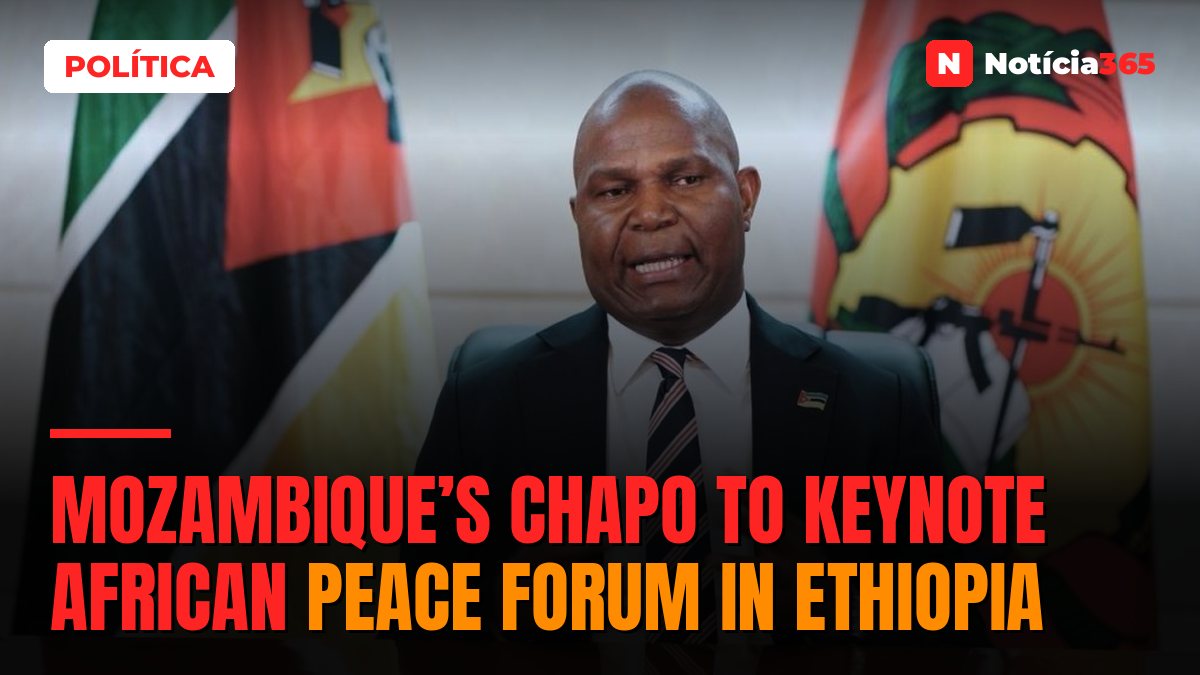

Mozambique’s President Daniel Chapo will attend the 12th Tana High-Level Forum on Security in Africa from 23 to 25 October in Bahir Dar, Ethiopia, where African leaders and experts will seek continent-led solutions to challenges of peace, security, and economic sovereignty.
According to a statement from the Presidency, Chapo will serve as the lead speaker on a panel themed: “From the Margins to the Centre: Building an African Model for Peace and Sovereignty in an Era of Geopolitical Rivalry.”
The forum is convened under the overarching theme “Pathways to Peace in Africa: Economic Sovereignty and Geopolitical Transformation” and brings together heads of state, policymakers, and specialists to discuss strategies for advancing peace, strengthening security, and promoting sustainable development across the continent.

Chapo will be accompanied by First Lady Gueta Selemane Chapo, Interior Minister Paulo Chachine, and Mozambique’s Ambassador to Ethiopia and Permanent Representative to the African Union, Nuno Tomás, along with other officials from the Presidency.
Since October 2017, Cabo Delgado, a natural-resource-rich province in northern Mozambique, has been the epicentre of an armed insurgency that has killed thousands and triggered a humanitarian crisis displacing more than one million people internally.
In April 2025, attacks spread to the neighbouring province of Niassa. Among the most serious episodes was an assault on the Niassa Reserve and the Mariri Environmental Centre in the Mecula district, where non-state armed groups attacked facilities, looted assets, destroyed camps, and burned a park aircraft. The incidents resulted in at least two deaths and the displacement of more than 2,000 people, of whom 55% were children.
The conflict, linked to Islamic State-affiliated extremist groups, has claimed more than 6,600 lives and displaced over 1.2 million people since 2017, according to international organisations. The violence has destroyed infrastructure, disrupted economic activity, and severely curtailed access to essential services.
A report released in September by the United Nations Office for the Coordination of Humanitarian Affairs (OCHA) estimated that approximately 1.38 million people were living with the consequences of displacement in Cabo Delgado, including around 662,000 internally displaced persons and 722,000 individuals who had returned to their areas of origin.
The report also recorded more than 400 conflict-related incidents in the first half of 2026, a 10% increase compared with the same period in 2025, and warned that the return of families to their communities does not necessarily indicate a recovery in security conditions or livelihoods.
Source: Diário Económico
Original article: https://www.diarioeconomico.co.mz/?p=554895