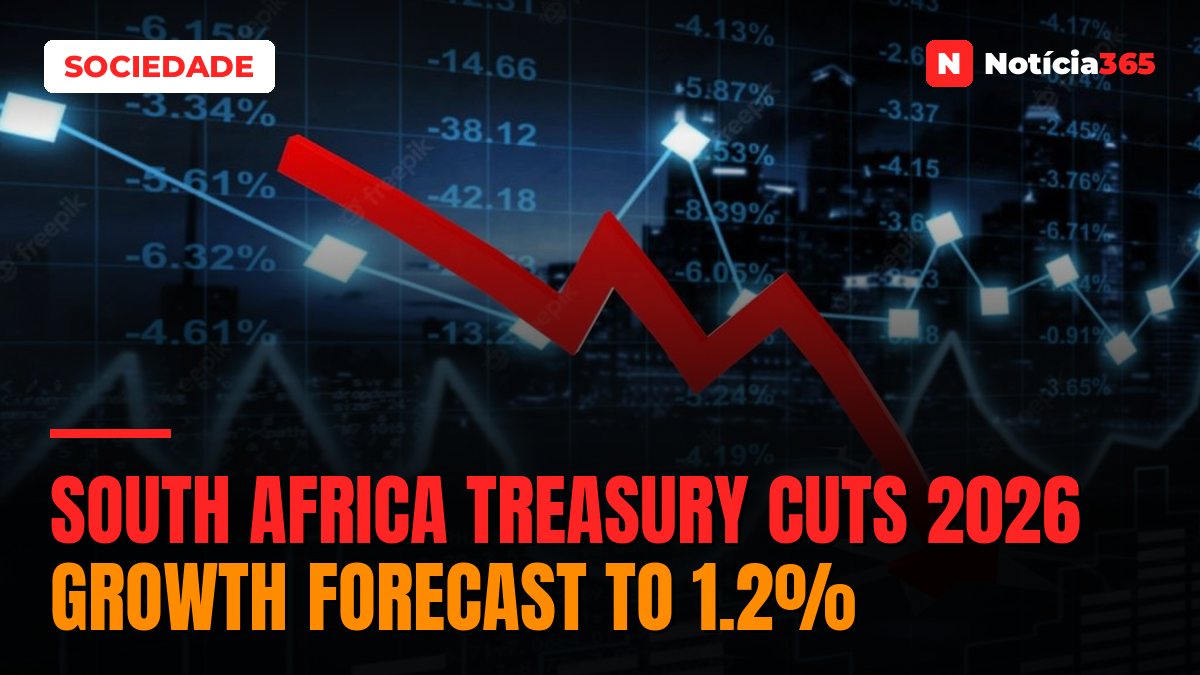

South Africa’s National Treasury has revised its 2026 economic growth forecast down from 1.6% to 1.2%, while maintaining that the economy continues to withstand the effects of the conflict in the Middle East. The revised estimate was announced on Wednesday, 21 October, during the presentation to Parliament of the Medium-Term Budget Policy Statement (MTBPS).
Despite the cut, the Treasury remains more optimistic than the International Monetary Fund (IMF), which reduced its own 2026 growth projection for South Africa from 1.4% to 1%. The Treasury also noted that the IMF has applied steeper cuts to the outlook for emerging markets and developing economies, with an average downward revision of 0.8 percentage points.
For subsequent years, the Treasury projects growth of 1.6% in 2027, below the 1.8% forecast in February, and 2% by 2029. Inflation is expected to average 4.4% in 2026, following the rise in oil prices triggered by the conflict between the United States and Iran, before returning to the South African Reserve Bank’s 3% target only in 2029.
In the document’s foreword, Finance Minister Enoch Godongwana states that the country has made progress in restoring public finances. “In my budget speech in February, I said we had reached an important turning point in public finances. I spoke about restored credibility, renewed resilience, and a nation getting back on track,” he writes.
The minister maintains that this assessment remains valid, despite a turbulent year for the global economy. He argues that the commitment to macroeconomic stability has strengthened the economy’s capacity to withstand external shocks, and that reforms in energy, rail, and tourism are removing obstacles to growth.
According to the Treasury, the economy’s performance reflects the greater stability achieved in recent years: a reduced inflation target, a narrowing fiscal deficit, stabilised debt, and a lower risk premium have left the country better positioned to absorb external shocks.
The MTBPS envisages the continued recovery of public finances and improvements in the quality of government expenditure. It also includes measures to strengthen service delivery by local governments, modernise public financial management, and extend structural reforms across sectors deemed essential.
In his address to Parliament, Godongwana said the strategy to accelerate growth and consolidate public finances rests on four pillars: macroeconomic stability, structural reforms, strengthening state capacity, and infrastructure investment. According to the minister, these measures are removing barriers to economic activity, attracting private investment, and improving the state’s capacity to meet its commitments, while also helping the country navigate a difficult international environment without neglecting domestic priorities.
The Treasury believes that continued reforms, combined with improved public administration, could create the conditions to accelerate growth and increase investment.
Source: Diário Económico
Original article: https://www.diarioeconomico.co.mz/2026/10/21/mundo/africa/africa-do-sul-tesouro-corta-previsao-de-crescimento-para-12-em-2026/